Phillies top prospect Andrew Painter stayed healthy, but ‘didn’t do everything I wanted to this year’ in triple A
The pitching prospect suffered a torn elbow ligament that required Tommy John surgery. Despite a rough year in the minors, the Phillies believe Painter will be a premier MLB starter.

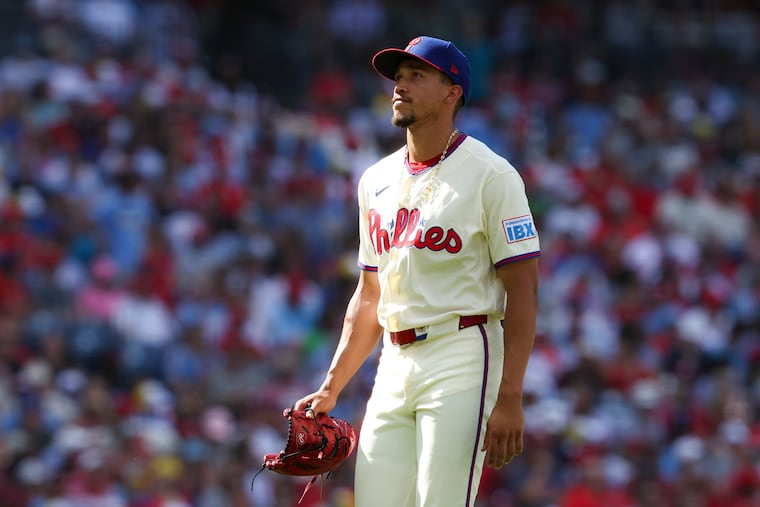
ALLENTOWN — Andrew Painter played catch and did agility drills in the outfield Tuesday, just like every other pitcher playing out the string in the last week of the minor league season.
That wasn’t the plan.
Never mind that Painter is 22 and didn’t get to triple A until May. Or that he didn’t pitch for two seasons after tearing a ligament in his right elbow and having surgery. The Phillies figured their top prospect would be in the majors by now, and we know this because, well, the president of baseball operations told us so.
» READ MORE: The Phillies are once again poised for a World Series run. The plan this time: Whatever it takes
But here was Painter, tossing around a football on the eve of dragging a 5.35 ERA into his final start for triple-A Lehigh Valley, then taking stock of a season that didn’t follow anyone’s timeline.
“I’ll set expectations for myself and critique the ways I’m pitching and everything,” said Painter, this week’s guest on Phillies Extra, The Inquirer’s baseball podcast. “So, from that aspect, no, I didn’t do everything I wanted to this year.”
OK, let’s pause here and note that Painter made 26 starts in all between low-A Clearwater and Lehigh Valley, missing none and finishing with 118 innings, 106⅔ of which came in triple A.
If someone told Painter in spring training that he would reach those thresholds, regardless of the level or the results, would he have been satisfied?
“That’s obviously a win, for sure,” he said before allowing three runs on seven hits and one walk in four innings Wednesday night to finish with a 5.40 ERA in triple A, 5.26 overall. “It’s probably priority No. 1. Being healthy and being able to make every start, and learning how to bounce back, and just kind of being able to have a feel for my body and what my body’s feeling, I think that was one of the biggest takeaways and something I’m grateful for.”
In hindsight, maybe it should’ve been the only thing that really mattered.
But in December, Dave Dombrowski outlined the plan for Painter’s return to competition by saying, “We’re going to save a lot of his innings until we get to July-ish for the big league level. Of course, if you’re going to pitch him in July — it might be June, might be August, somewhere around there — you can’t use too many [innings] at the minor league level at that point."
And with that, the Painter Countdown began, even though most pitchers who come back from Tommy John elbow surgery say that it takes a minute — sometimes even a full year — to find their pre-injury effectiveness.
» READ MORE: Kyle Schwarber’s bet on himself paid off. And how he did it boosts his value — even as a DH.
Painter claims that his mind didn’t wander much during the season about when he might graduate to the majors, not that anybody would have blamed him if it did. It’s human nature, after all.
“No, I mean, this year, this whole thing has been kind of just building off of each start and really just learning the game,” he said. “The big thing was just finding ways that I could be better and make myself better that next week.”
The Phillies remain bullish — for good reason. Painter is straight out of central casting for a top-of-the-rotation starter — 6-foot-7, with a smooth delivery and wipeout stuff. Dombrowski looks at Painter and sees Justin Verlander 2.0. It’s an easy comp. And when rival teams ask for Painter in trade talks, it’s a non-starter.
A rough season in triple A won’t change that.
“It happens. It’s just part of it,” Dombrowski said recently. “I think he’s still going to be a premium major league starting pitcher.”
Phillies minor league director Luke Murton added: “At the end of the day, Andrew Painter is going to be who he wants to be and who we’re all expecting him to be in the future.”
In a candid self-evaluation, Painter identified his fastball as the root of his struggles. Velocity wasn’t a problem. His four-seamer averaged 96.6 mph, grazing 100 in April and still clocking in at 98 in the first inning Wednesday night.
But fastball command proved to be a challenge. Painter’s walk rate in triple A rose to 9.7%, compared to 6.2% in A-ball and double A in 2022.
“My whole arsenal and kind of what defines me as a pitcher is the fastball, and something I’ve always prided myself on was just being able to use the fastball to both sides of the plate and just set up other pitches with that,” Painter said. “And this year I don’t think I was able to do that. Walks were up; just wasn’t commanding the baseball as good.
“You’ll feel great for three innings and then kind of forget how to throw a strike in the fourth.”
» READ MORE: The Phillies should get Trea Turner back this season. But which player will they have for the playoffs?
It’s a common post-Tommy John occurrence. Marlins ace Sandy Alcantara had surgery a few months after Painter in 2023, missed last season, and had an 8.4% walk rate through 21 starts this year, up from 6.0% from 2021-23. And he’s a former Cy Young Award winner.
One rival talent evaluator chalked up Painter’s inconsistent command to “just injury and rust” and said it’s appropriate to give him a mulligan, for at least this season.
The curveball was Painter’s most effective breaking pitch, with triple-A hitters batting only .196 against it entering Wednesday night. His changeup remained effective, too. But several scouts who saw Painter in May and June were perplexed that he didn’t use it more often — or almost at all — especially against left-handed hitters.
It turns out, Painter shelved the changeup for a reason.
“Early on I was getting blisters and wasn’t able to throw that pitch, which really hurt me a little bit,“ he said. ”Because that’s been a very good pitch for me, and when that’s on, everything else is working around that.”
Without the changeup, Painter fiddled with an ever-changing slider. Initially, he set out to throw a harder slider that acted more like a cutter.
“And it was getting barreled,” he said. “I was giving up a lot of damage on that. So, that was also another focus — how can I get that pitch to be a little more depthy, a little slower, to get more swing and miss?"
It’s all part of a learning curve that the Phillies probably should’ve anticipated from a young pitcher who had not yet reached triple A even before missing two years of development.
But the offseason figures to bring more questions about Painter’s major-league timeline.
“I’ve always been told, second year back from TJ is kind of the year you feel good,” Painter said. “Obviously I want go out there and compete and go six or seven [shutout] every single time. But this [season] was kind of just being where your feet are at and building on that process, just knowing that it’s just going to get better.”