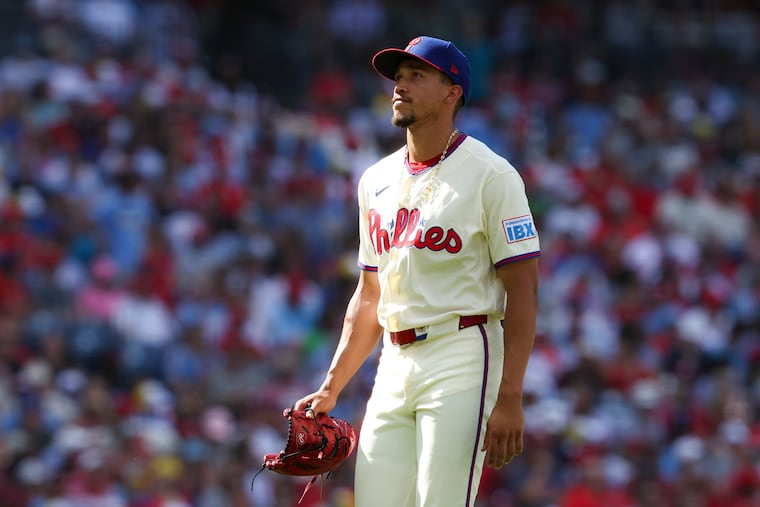
The Phillies should get Trea Turner back this season. But which player will they have for the playoffs?
Can a potentially compromised Turner still be a game-changer for a Phillies run to the World Series? “That’s where you trust the training staff and trust yourself,” he said.

As Trea Turner pulled on his jeans and laced up his Adidas, a visitor leaned against his locker.
Kevin Long, like Phillies fans everywhere, was anxious.
What did Turner do to his hamstring? ... Was it bad? ... What were the trainers saying? ... When might he play again?
Turner and Long talked quietly for a few minutes Sunday in Miami, the star shortstop managing a thin smile, his longtime hitting coach shaking his head as he walked away.
» READ MORE: Inside Trea Turner’s remarkable improvement at shortstop that has turned him into an MVP candidate
A day later, the Phillies got answers. An MRI confirmed that Turner did strain his right hamstring and would need time on the injured list. But it was a Grade 1 strain, the most mild variety. Typical recovery: three weeks, maybe less.
“The report I got today,” Turner told reporters Monday night, “was a little more positive than we kind of thought [initially].”
Indeed, if you’re going to strain a hamstring three weeks before the postseason begins, this probably was the best-case scenario. Turner’s season isn’t over; it’s merely on hold. And if he’s back in the leadoff spot for the Phillies’ playoff opener, everyone will pardon the interruption.
Now, though, comes another relevant question, because there’s only one thing that really matters for the 2025 Phillies: Will Turner return as the athletic force who can lead them to the World Series?
At his best, Turner is among the most dynamic players in the sport. And everything he does begins with his legs. Even now, at age 32, he leads the majors in sprint speed at 30.3 feet per second, remarkably the same time that he posted as a 24-year-old in 2017.
Turner is also in the midst of his best season since at least 2021. He leads the National League in hits (179) and wins above replacement, as calculated by FanGraphs (6.7). At .305, he’s positioned to win a batting title. If he doesn’t play again before the playoffs, he would be only the fourth Phillies player to finish a season with at least 90 runs, 175 hits, 15 homers, 30 steals, and a .300 average, joining Bobby Abreu (2002), Lenny Dykstra (1993), and Ed Delahanty (1893).
But if he isn’t at full speed, can a compromised Turner still be a game-changer?
» READ MORE: The Phillies set goals for Trea Turner in 2025, and he has bought in: ‘He’s doing everything we asked’
The thought crossed Turner’s mind even before the team plane took off from Miami on Sunday night.
“I feel like that’s where you trust the training staff and trust yourself,” he said. “You lean on those guys in there and try to figure it out.”
Turner has experience with this. In April 2017, he came out of a game after straining his right hamstring on the bases for the Nationals. Then, like Sunday, he wasn’t limping after the game. Then, like now, it was diagnosed as a Grade 1 strain. He missed 11 games and went 21-for-57 through 13 games upon returning.
More recently, in May of last season, Turner strained his left hamstring. It was a Grade 2 strain, more severe than this one. He missed 44 games and went 25-for-75 with five homers in his first 17 games back.
“Last year, I thought we did a pretty good job,” Turner said Sunday. “I might’ve come back a little early, but did a good job managing it and putting that behind me. And I was running good by the end of the season. We’ll kind of do that same thought process.”
But the timing of this injury won’t allow Turner to ease back into running the bases with his usual intensity or volume. In 2017, he didn’t attempt a stolen base until his ninth game back. Last year, he didn’t try to steal for 15 games.
It always was paramount for the Phillies to get a bye in the wild-card round by finishing with one of the two best records in the NL. The road to the World Series is easier if you have to win seven games rather than nine. And the Phillies won’t have their best pitcher, Zack Wheeler, who is awaiting surgery for thoracic outlet syndrome after having a blood clot removed from near his right shoulder.
» READ MORE: Phillies’ Nick Castellanos says he’s putting the ‘team goal’ ahead of personal success
But a bye also would push back the Phillies’ first playoff game from Sept. 30 to Oct. 4 and give Turner 26 days to recover after suffering the strain rather than only 22.
And make no mistake: While Turner would like to play again before the end of the regular season, everyone with the Phillies knows it’s more important for him to be ready for Game 1 of the playoffs, whenever that is.
“That’s all we really want,” Kyle Schwarber said Sunday, “making sure that he’s healthy enough to have him out there for the postseason.”
Said Turner: “The playoffs is obviously the most important. Trying to find that fine line of trying to get ready for that but also not rushing it back and coming back for no reason. Shooting for the playoffs. Hopefully a little bit earlier, but more toward playoffs.”
There isn’t a more significant series, then, than three games next week at Dodger Stadium. Entering play Tuesday night, the Phillies (84-60) were four games ahead of the Dodgers (80-64) for the second-best record in the NL behind Milwaukee. They took two of three games from Los Angeles from April 4-6 at Citizens Bank Park.
Turner won’t be in the lineup next week. But now that the Phillies know they eventually will get their star shortstop back, they must do whatever it takes to really get him back.
“That’s always the hardest part,” Turner said. “You’re never going to know if you’re 100% until you play in a real game. So you get as close to that as possible and then go from there.”

Matt Klentak's fingerprints are still on the Phillies' roster six years after he was the team's general manager. These days, Klentak is part of the front office for the Brewers, who recently clinched their fourth consecutive NL Central title. With the Brewers coming to town Tuesday, Klentak joined Phillies Extra to discuss his current and former teams. Watch here.
You can also subscribe to the podcast version of Phillies Extra on Spotify or Apple Podcasts.
Previous episodes: Jeff Francoeur | Luke Murton | Mike Hazen | Tony Gwynn Jr. | Kevin Stocker | Bobby Dickerson | Jim Bowden | John Middleton | Ryan Howard | Dan Baker