What Bryce Harper said, what he couldn’t say, and how it reflects on Dave Dombrowski
Look at last season’s Mount Rushmore of hitters and you’ll see the source of Harper’s frustration.
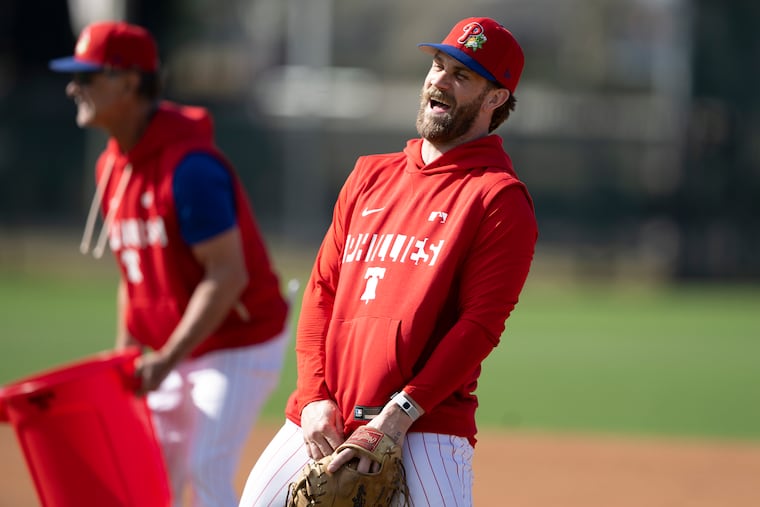
The best way to understand Bryce Harper is to think about all the things he can’t say.
He can’t say that Alec Bohm is a seven-hole hitter at best. He can’t say that Adolis García is much closer to Nick Castellanos than he is a legitimate four- or five-hole hitter. He can’t say that J.T. Realmuto isn’t the guy he was three years ago. He can’t say that he’d swing at fewer pitches out of the zone if he had more confidence that the guys behind him would get the job done.
Given all of those things, Harper also can’t say that Dave Dombrowski has not been an elite personnel boss for at least a couple of years. He can’t say that Dombrowski’s lack of eliteness is chiefly to blame for the Phillies’ run-scoring struggles. Harper can’t say that he was much closer to the hitter the Phillies needed in 2025 than Dombrowski was to being the roster-constructor they needed.
To throw shade at Dombrowski would be to implicitly throw shade at teammates whose “underperformance” is mostly a function of Dombrowski needing them to be something they aren’t.
» READ MORE: Bryce Harper says Dave Dombrowski’s ‘not elite’ comment is ‘kind of wild to me still’
Harper could have gone deeper. He could have said that the Phillies lost to the Dodgers last season because Dombrowski cobbled together a playoff roster that didn’t allow Rob Thomson to pinch-run for Castellanos. He could have said that the Phillies have finished the last three seasons one reliever short. That they lost to the Diamondbacks in 2023 because Gregory Soto, Craig Kimbrel, and Orion Kerkering were pitching in roles where the Phillies should have had a prime high-leverage arm.
Harper could have pointed to Austin Hays, to Whit Merrifield, to Max Kepler, to David Robertson. He could have asked why he, or we, should have any faith in the decisions to sign García or trade away Matt Strahm when those decisions were made by the same man who made all the previous ones.
But Harper didn’t say those things. He couldn’t say those things. Instead, he said things that could lead one to conclude that he is a little too sensitive, a little too close to the prima donna archetype, a man in possession of emotions triggered by even the faintest whiff of criticism.
When Dombrowski raised the question of whether Harper would ever be the elite player he’d once been, Harper could have raised a question of his own:
Who are you to talk, suit?
Instead, he said things like this:
“It was kind of wild, the whole situation,” Harper said Sunday when he arrived at spring training. “I think the big thing for me was, when we first met with this organization, it was, ‘Hey, we’re always going to keep things in-house, and we expect you to do the same thing.’ When that didn’t happen, it kind of took me for a run a little bit. I don’t know. It’s part of it, I guess. It’s kind of a wild situation, you know, that even happening.”

David Murphy alerts
It only makes sense in conjunction with the other things we heard from Harper and his camp. In October, in an interview with MLB.com, agent Scott Boras pointed to the number of pitches Harper saw in the zone (43%, fewest out of 532 qualifying players). On Sunday, Harper riffed on that theme, pointing out the paltry production the Phillies got out of the lineup spot directly behind his usual place in the three-hole.
Look at last season’s Mount Rushmore of hitters and you’ll see the source of Harper’s frustration.
One of the common bonds for Aaron Judge, Shohei Ohtani, and Cal Raleigh was the talent that followed them in the batting order.
Hitting behind Judge were Cody Bellinger, Ben Rice, Jazz Chisholm, and Giancarlo Stanton. Each of those players finished the season with at least 24 home runs and an .813 OPS.
» READ MORE: With free agency looming next year, Alec Bohm is prepared to bat cleanup (again) for Kyle Schwarber or Bryce Harper
Ohtani’s supporting cast needs no introduction. Mookie Betts and Freddie Freeman are both former MVPs. Will Smith has been an All-Star in three straight seasons.
Raleigh was most often followed directly by Julio Rodriguez, Josh Naylor, Eugenio Suárez, and Jorge Polanco. Three of those players finished 2025 with at least 26 home runs.
Each of those three superstars — the three leading vote-getters on AL and NL MVP ballots — were followed in the batting order by at least three players who finished the season with at least 20 home runs. Compare that to Harper, who usually had two players behind him with more than 12 home runs, neither of whom is on the roster this season (Kepler 18, Castellanos 17).
If anything, Harper was underselling the situation when he met with the media Sunday in Clearwater. The two-time MVP limited his focus to the Phillies’ struggles in the cleanup spot, where they ranked 20th in the majors in OPS last season.
“I think the four spot has a huge impact,” Harper said. “I think the numbers in the four spot weren’t very good last year for our whole team. I think whoever’s in that four spot is going to have a big job to do, depending on who’s hitting three or who’s hitting two.”
But the issues behind Harper — and/or Kyle Schwarber, depending on the configuration — are deeper than the next-man-up. As we saw last season, pitchers are more than willing to pitch around two hitters when those hitters are Harper and Schwarber, especially when the guys behind them allow for an extended period of exhalation. Lineup protection is a cumulative thing.
We saw that in 2022, didn’t we? A big reason the Phillies thrived with Schwarber leading off and Harper batting third was the presence of Rhys Hoskins (30 homers, .794 OPS) and Realmuto (22 homers, .820 OPS) behind them. Even in 2023, they had some combination of Castellanos (29 homers, .788 OPS), Realmuto (20 homers, .762 OPS), and Bohm (10 homers, .765 OPS).
Boras and Harper have zeroed in on the number of pitches he sees out of the zone. It’s part of the story, no doubt. Over the last three seasons, he has seen a lower percentage of pitches in the zone than any previous three-year stretch of his career. When he was NL MVP in 2021, he saw a career-high 46.7% of pitches in the zone.
At the same time, Harper was pretty darn good in 2023, when he saw 41.2% of pitches in the zone, the second-lowest of his career, according to FanGraphs. Just as important is what Harper chooses to do with the pitches he sees.
Last year, his chase rate was 36%. In 2021, it was 25.5%. But he wasn’t necessarily chasing more pitches. His swing percentage on pitches in the zone was 78.3%, up from 72.1% in 2021.
» READ MORE: Believe it or not, Aidan Miller and the Dodgers are more connected than one might think
Protection is a mindset as much as it is an externality. The more protected a hitter feels, the more comfortable he is waiting for his pitch rather than trying to do too much. Pitchers won’t necessarily approach Harper differently if they feel more danger from the hitters behind him. But Harper will absolutely feel more comfortable taking whatever pitchers give him.
The Phillies acknowledged as much with their openness about their failed pursuit of Bo Bichette. Dombrowski knows what the Phillies need. They need what they had in 2021 and 2022 in prime Hoskins and prime Realmuto (and company).
They will need to get lucky to have it this season. Their decision-making will need to be filtered through this context. Aidan Miller, Justin Crawford, the trade deadline. Bohm and García will get the first chances. Dombrowski’s future as the bossman will be determined by how they perform, and then by what happens if they don’t.

Tim Mayza was among the best, most under-the-radar Phillies stories this year. And he's coming back for more after signing a new contract last week. The Lancaster County native joined Phillies Extra, The Inquirer's baseball podcast, to discuss his solid season, building a culture in the bullpen, the origin of his "Sheriff" nickname, and more. Watch here.
You can also subscribe to the podcast version of Phillies Extra on Spotify or Apple Podcasts.
Previous episodes: Aidan Miller | Scott Franzke | Larry Andersen | Matt Klentak | Jeff Francoeur | Luke Murton | Mike Hazen | Tony Gwynn Jr. | Kevin Stocker | Bobby Dickerson