Bryce Harper and Scott Boras are right. Here’s a wild stat that makes their point.
Only one player in the majors last year failed to score more than 72 runs while posting an OPS of at least .800 in 580-plus plate appearances. It was Harper.
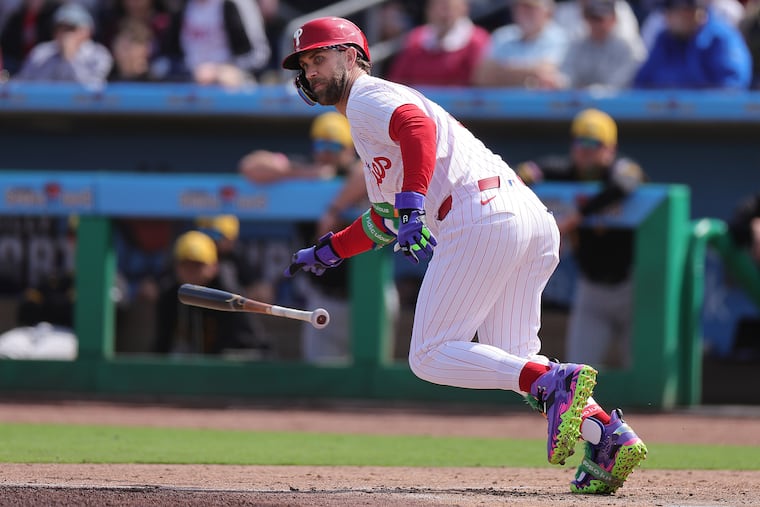
No man is an island. Unless that man is Bryce Harper and he has just reached base.
Last season, there wasn’t a lonelier lot in life than to be a Phillies superstar standing on first, second, or third. Only four players in the majors reached base as many times as Harper did and scored fewer runs. The 72 runs he did score were the fewest of his career in a season with at least 500 plate appearances. Only one player in the majors last year failed to score more than 72 runs while posting an OPS of at least .800 in 580-plus plate appearances. It was Harper. In fact, he was the only player to do it since 2023. That’s not some hocus-pocus bit of cherry-picked math. Fifty-nine players meet our criteria (.800 OPS, 580 PAs). Harper’s 2025 campaign ranked dead last in runs scored.
Not since E.T. have we seen someone with such otherworldly attributes struggle this hard to get home.
We’ve heard a lot of chatter about lineup protection this offseason. Scott Boras broached the topic back in October. Harper himself weighed in last week. Their focus was on pitchers pitching around Harper in order without the threat of reprisal from those due up next.
» READ MORE: The 2026 breakouts the Phillies need, starting with Aidan Miller
“I think the four spot has a huge impact,” Harper said when he arrived in Clearwater, Fla., for spring training. “I think the numbers in the four spot weren’t very good last year for our whole team. I think whoever’s in that four spot is going have a big job to do, depending on who’s hitting three or who’s hitting two.”
Neither Harper nor his agent spoke much about the issue of him rotting on base like an unsold ham on Easter Monday. But it’s just as important, if not more so.
Last season, Phillies hitters had 366 plate appearances when Harper was on base. That’s not including his home runs. We’re limiting ourselves to the plate appearances when Harper was physically standing on base, hoping for a teammate to drive him home. In those 366 plate appearances, the hitters behind Harper combined for a whopping .227 batting average, .290 on base percentage, and .342 slugging percentage. Of the 180 times he reached base without driving himself in (i.e., without hitting a home run), he ended up crossing home just 45 times.
That’s a remarkably low percentage. Three out of four times that Harper reached base, the inning ended with him jogging back to the dugout. That’s a remarkably low percentage compared to most other hitters of his ilk. Even more troublesome is the fact that Kyle Schwarber’s percentage wasn’t much better. But we’ll get to that in a second.
First, let’s remind ourselves of the real-world situations that these numbers tabulate. Harper didn’t have a great NLDS against the Dodgers. But he did reach base six times. That was tied for second on the team behind Alec Bohm. Bohm reached base 10 times and scored three runs. J.T. Realmuto reached base six times and scored three runs. Harper reached base six times and scored one run.
» READ MORE: The Phillies finally have a ‘true closer’ in Jhoan Duran, and that solidifies the rest of the bullpen
It’s an imperfect example. In the NLDS, Harper mostly expired on first base after arriving there with two outs. You could write it off to circumstance if not for the body of evidence. In the 2025 regular season, no player in the majors was stranded as often as Harper, once you account for where he hits in the order. His driven-in percentage (25%) ranked dead last among players who regularly hit in the top-third of the order (minimum 500 plate appearances).
The table below shows the 34 players who had at least 500 plate appearances in an average batting order position between the two-hole (2.0) and three-hole (3.0). Their run percentage is the number of times they reached base and later scored.
Chourio
Rodríguez
Springer
Butler
Witt Jr.
Lowe
Ramírez
Smith
Judge
Henderson
Machado
Donovan
Grisham
Nootbaar
India
Guerrero
Jr.
Ramos
Rooker
Langford
Devers
Reynolds
Schwarber
Harper
Just as concerning as Harper in dead last is Schwarber a mere two spots ahead of him. Of the 34 qualified hitters, Schwarber and Harper ranked 32nd and 34th in scoring percentage. Put another way, Schwarber and Harper’s teammates ranked dead last in their ability to drive them in.
Between Schwarber and Harper is Cal Raleigh, whose Mariners advanced to last year’s ALCS and put up a sporting effort. Meanwhile, Toronto’s Bo Bichette scored at a below-average rate. The Blue Jays made the World Series. It isn’t completely unheard of for upper-middle-of-the-order hitters to drive in more runs than they score, given the drop-off in quality behind them. But the Phillies have two players at the bottom of the list. We’re talking about the upper two-thirds of their order. And they aren’t just below-average. They are virtual outliers. The only other team that has two players in the bottom half of this list is the Angels. Nobody wants to be mentioned in the same breath as the Angels. If you are comparable to the Angels in a certain regard, it’s a sure sign the regard needs fixing.
If Harper sounds a little cranky this spring, think about how it feels to reach base and not score. And then think about the fact that the Phillies still don’t have a viable solution. Is it any wonder that Harper is acting like he woke up on the wrong side of the red-light therapy sleeping bag?

Tim Mayza was among the best, most under-the-radar Phillies stories this year. And he's coming back for more after signing a new contract last week. The Lancaster County native joined Phillies Extra, The Inquirer's baseball podcast, to discuss his solid season, building a culture in the bullpen, the origin of his "Sheriff" nickname, and more. Watch here.
You can also subscribe to the podcast version of Phillies Extra on Spotify or Apple Podcasts.
Previous episodes: Aidan Miller | Scott Franzke | Larry Andersen | Matt Klentak | Jeff Francoeur | Luke Murton | Mike Hazen | Tony Gwynn Jr. | Kevin Stocker | Bobby Dickerson