‘Phillies Extra’ Q&A: Dusty Wathan on J.T. Realmuto’s future, preparing for robot umpires, and more
As Realmuto became a free agent this week, Wathan sat down with The Inquirer’s baseball podcast to share the secrets of the 34-year-old catcher’s durability.
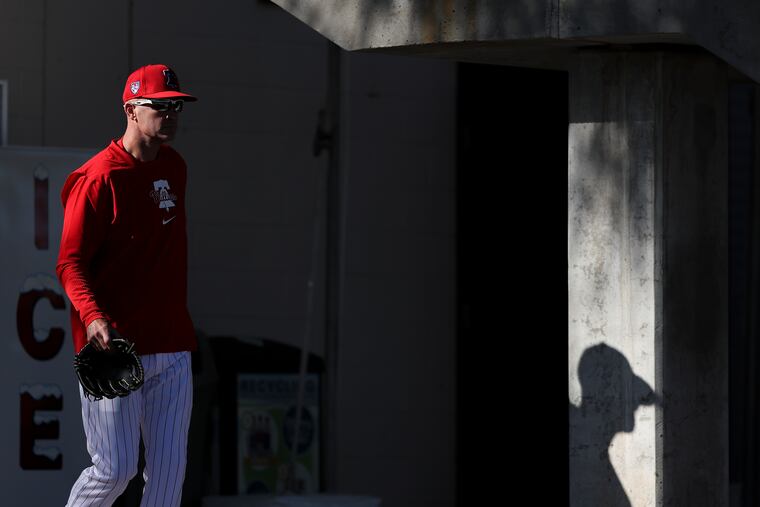
In eight seasons on the Phillies’ major league staff, Dusty Wathan has worked for two front-office regimes and three managers and coached countless players.
One constant: J.T. Realmuto.
Realmuto has been behind the plate for 833 of the Phillies’ 1,032 regular-season games — and all 38 playoff games — since his arrival in 2019. And as the team’s catching coach, Wathan has worked more closely with him than anyone.
So, as Realmuto became a free agent this week, Wathan sat down with Phillies Extra, The Inquirer’s baseball podcast, to share the secrets of the 34-year-old catcher’s durability. He also discussed his view of the controversial decision to bunt in Game 2 of the division series against the Dodgers, his ambition to manage someday, and more.
Here’s an excerpt from our conversation, edited for brevity and clarity. Watch the full interview below and subscribe to the Phillies Extra podcast on Spotify or Apple Podcasts.
Q: As the coach who has worked more closely with J.T. than anyone over the last seven years, how is he able to maintain this workload at his age when almost no catchers are able to do it? And why is he worth betting on to be able to do this for another two, maybe three years, or more?
A: Well, first of all, God gifted him with a great body and great work ethic and being able to take care of it. He takes care of his body as good as anybody I’ve ever been around. At the end of the season, we were talking when we were all packing up a couple days later, and I really didn’t know how old he was. We were talking about it. I said, ‘How old are you going to be next year?’ He said, ‘Well, I’m going to be 35.’ You would never know looking at him, talking to him, the way he acts, the way he runs, the way he takes care of himself, that he’s that age.
» READ MORE: Free-agent outlook: J.T. Realmuto will be 35, but he remains as valuable as ever to the Phillies
It’s a crazy thing that he can start that many games [132 this season] and be so fresh. And, honestly, this year, second half of the season was pretty darn good, really, [the] offensive side of it. So I think he just takes care of himself. He wants it so bad. He loves the game of baseball. He loves catching.
I think maybe the one-knee stance has helped a little bit. I know he’s talked about it. When he first came over here, we switched over to one knee. That was kind of when it was becoming in vogue to go to one knee more, and he said that it’s taken a lot of wear and tear off of his knees and back. But athletically, he’s so good at hopping into stances and things like that, that I don’t think that’s affected him much.
But he’s had a couple little nagging things here and there, but nothing major. I think he’s just gifted and works hard at keeping his body in shape. The guy works out every single day after the game. It’s impressive. Whether we’re leaving to fly across the country, whether we have a day off the next day, he’s in that weight room doing something every day to get himself ready for the next day.
Q: I’d argue that there’s more on a catcher’s plate in 2025 than there’s ever been before, and there’s going to be something new next year with the automated ball-strike system, which is coming to the big leagues. How much are you preparing for that already?
A: It started a couple years ago, really, when they really started putting ABS in triple A. Talked to a lot of the triple-A staff the last couple spring trainings. Talked to catchers that have been down there — [Rafael] Marchán, [Garrett] Stubbs — what do they think about it? Ideas? How do they do it? I think for the most part you won’t see the pitcher challenge much because it’s just a hard perspective from a pitcher to see exactly where the ball crossed the plate. I think you’re going to see a lot from the catchers and hitters.
» READ MORE: The Phillies watched an epic World Series and saw a reminder of what they need to do
And I think one thing we talked about midway through this year, when it looked like it was kind of a foreseeable thing that this was going to happen next year, was that we want to try to catch as many bullpens next year with the ABS system on and challenge our guys to let us know, was that a ball or was it a strike, so that they can learn the system as fast as possible and as well as possible. And I think we did that in spring training with the games. The guys would come back in between innings, not challenge one or challenge one. They learned a little bit. And I would say, ‘Hey, should you have challenged that one?’ And they were like, ‘Yeah.’ And I was like, ‘No, it was just a little bit off.’ So, we started doing it last year in spring training.
Because you know how it is. When [a rule change] gets that close, it’s going to happen. Whether it was ’26, ’27, ’28, it was right there. It was going to happen. So we kind of already started preparing for this a couple years ago, and then really took advantage of it in spring training. I think next spring training, we’re still going to practice our receiving and things like that, but I think the guys that are going to be really elite at knowing the strike zone, as far as catchers, are going to have an advantage.
Q: Your dad, John, managed the Kansas City Royals for several seasons in the late ’80s and early ’90s. You were in high school back then, and I know you were a bat boy during some of that time. You must have a go-to Bo Jackson story from being around him back then.
A:
… Bo was a great guy. Loved his family. Great family man. But I guess the one story that people laugh at all the time, and the relationship that he and I had was, I used to bat-boy and ball-boy down [the] left-field line, play catch with him, all that stuff, so we had a lot of interactions.
Well, I’m in junior college in California a couple years later, and I’m coming up to John Wayne Airport to pick up my mom. And she’s already standing there. No cell phones back then. The plane came in early. I pull up, and Bo’s standing there, and my mom’s standing there, and I’m thinking to myself, ‘Oh, this is not going to be good. He’s going to give me some grief for this.’ He goes, ‘Listen here, you never be late for your mama. She’s done so much for you. You make sure you’re here to pick her up on time.’ I said, ‘All right, Bo. Thanks, buddy.’ But that’s the kind of guy he was.

The Inquirer's Lochlahn March takes a look at each of the Phillies' position groups -- who will be back, free-agent questions, prospects who could be in the mix and more.
Infield | Starting pitchers | Bullpen | Catchers | Outfield
But the special things on the field were the throw from left field at the Kingdome [in Seattle]. He could do things that no one else could do. I’ve seen him grab a bow in a clubhouse and [shoot] dead-middle of [the] target from 30 yards without even knowing whose bow it was. Just the special things that he could do as an athlete were crazy. But a great human being as well as an athlete. So, very special time in my life to be able to hang around him and kind of have a lot of good interactions through my high school years with him.
Phillies Extra is your deep dive into all things Phillies on Gameday Central! Hosted by Scott Lauber, each episode brings you insider analysis, exclusive interviews with players and experts, reader emails, and more to cover the hottest topics with the Phillies and across Major League Baseball. Don’t miss it — the conversation starts here!
You can also subscribe to the podcast version of Phillies Extra on Spotify or Apple Podcasts.