Q&A: John Middleton on Phillies’ high payroll amid looming labor war, Dave Dombrowski-Bryce Harper saga, and more
In a wide-ranging interview with The Inquirer, the Phillies owner described going "to bed at 11 o’clock thinking we had a deal" with Bo Bichette and why he doesn't believe in blowing up his team.
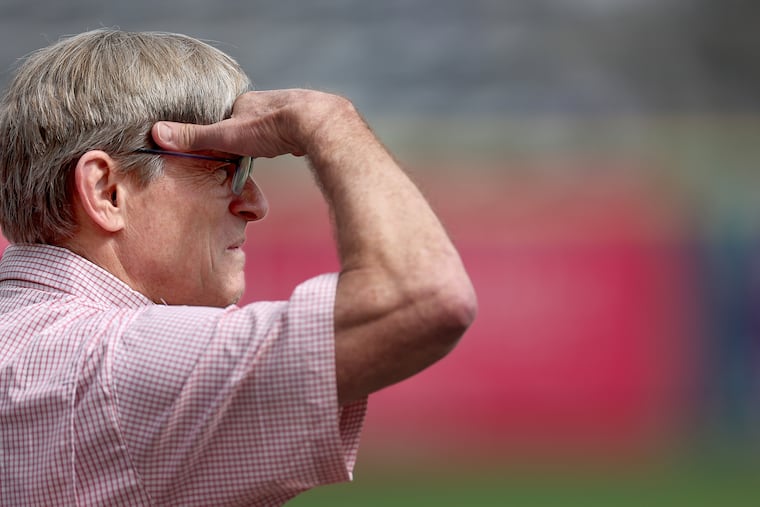
CLEARWATER, Fla. — From his third-floor office overlooking the Phillies’ spring-training ballpark, John Middleton can see clear sky for miles.
Never mind the creeping storm clouds.
“We’re way too far away from it,” Middleton said Friday. “I don’t know when in the next nine months, or whenever the heck it is, we’ll have a clearer sense of the landscape. But we sure as heck don’t have it now.”
So, why worry? Yes, baseball is barreling toward a labor battle that is expected to get nasty. The particulars: Many owners want a salary cap, similar to what the NFL, NBA, and NHL have; players have historically opposed all limits on wages. The collective bargaining agreement will expire Dec. 1, and a lockout seems inevitable, with the possibility that it could eat into next season.
» READ MORE: Phillies roster questions going into the first spring game: Fifth starter, bullpen picture, and more
But that’s 283 days away. There are 162 regular-season games from here to there, with an All-Star Game to host in July. And it will be another expensive season for Middleton and his ownership partners.
Last year, the Phillies’ luxury-tax payroll totaled $314.3 million, fourth-highest in the sport after the Dodgers, Mets, and Yankees. The Phillies paid a club-record $56.1 million in taxes and are bracing for a similar bill at the end of this year.
“Higher,” Middleton said.
Indeed, the projected payroll is $317 million. It will be the fifth consecutive season that the Phillies have gone into luxury-tax territory and the second year in a row they cleared the highest threshold ($304 million for 2026), which carries a 110% tax rate. Middleton said they’ve also budgeted $80 million in local revenue (tickets, concessions, media deals, etc.) for revenue sharing.
“Do the math,” he said. “You’re pushing $140 million in spending essentially [for] being taxed. If I had $140 million back, could I have a higher payroll? Yes. But that’s not happening, so I don’t think about that fantasy. But it’s a lot of money. It really is.”
It’s also life among the big spenders in baseball’s current economic system. Middleton doesn’t sit on the owners’ labor policy committee, which is headed by the Rockies’ Dick Monfort and includes the Yankees’ Hal Steinbrenner, and said he’s restricted by the National Labor Relations Act from speaking publicly about negotiations with the players’ union that are set to begin in late March.
But in a wide-ranging conversation with The Inquirer, Middleton said the Phillies’ offseason spending wasn’t impacted by the looming labor uncertainty. If anything, it was business as usual.
They re-signed Kyle Schwarber and J.T. Realmuto and added reliever Brad Keller and right fielder Adolis García. They were ready to make a seven-year, $200 million offer to free-agent infielder Bo Bichette, who signed a short-term (three years), higher-annual-salary ($42 million per year) deal with the Mets.
» READ MORE: J.T. Realmuto ‘never felt like a Plan B’ for Phillies while continuing fight to boost pay scale for catchers
In all, the Phillies spent $227 million on free agents, then paid $19.2 million for Nick Castellanos to play elsewhere.
“Any time you get to the end of a collective bargaining agreement, you just never know what the next one’s going to look like,” Middleton said. “And the rules have changed [over the years]. So, you could make decisions in the year or two preceding a new CBA that you look back and you say, ‘Hmm, had I known this was going to be the new CBA with this new rule, I maybe would’ve done something different.’
“I just think the problem, if you give that too much weight, you don’t do things that you should be doing in today’s world with today’s sets of rules to win today. So, I would say we were aware of it, we talked about it, but it didn’t change any of the decisions that we made.”
Because Middleton is chasing that (dang) World Series trophy. It’s been 18 years since the Phillies won it. They went on an unexpected ride to Game 6 of the World Series in 2022 but haven’t won a postseason series since ‘23. They’re 2-8 in their last 10 postseason games.
Middleton, 70, has the sensibilities of a lifelong fan who grew up watching Dick Allen in the 1960s and the competitiveness of a former collegiate wrestler. He was disappointed after last year’s exit in the divisional round. But unlike the previous October, he wasn’t angry.
The Phillies went toe-to-toe with the vaunted Dodgers, holding them to 13 runs and a .199 batting average in four games. Their three losses came by a total of four runs. And don’t even get Middleton started on umpire Mark Wegner’s missed strike call on a 2-2 pitch to the Dodgers’ Alex Call with one out in the seventh inning of Game 4. Call walked on the next pitch and scored the tying run. Cristopher Sánchez said Wegner later admitted to him that he got it wrong.
“Assuming he made the correct call, all of a sudden that’s a strike, [Call is] out, [the run] never scores, we win the game, we go to Game 5 two days later in Philadelphia,” Middleton said. “I’m not telling you we would have beaten the Dodgers because they beat us twice at home. But the Dodgers didn’t want to play us in Game 5 in Philadelphia. There’s not a chance in the world that they were looking forward to that prospect.”
Middleton acknowledges that the Dodgers, owned by Guggenheim Partners, have inherent financial advantages that only Steve Cohen, the billionaire hedge-fund manager who owns the Mets, can match.
The Phillies have won more regular-season games in each of the last four seasons. Attendance to Citizens Bank Park has risen from 2.23 million fans in 2022 to 3 million in 2023, 3.36 million in ‘24, and 3.37 million last season.
» READ MORE: The Phillies’ Trea Turner was still the fastest man in the league at 32. And it’s not due just to ‘genetics.’
But in 2024, Middleton also added three new investors to the Phillies’ ownership group. At the time, he said it would “allow us to pursue our strategic growth opportunities and long-term goals.”
“Look, when Hal Steinbrenner publicly says the Yankees can’t do what the Dodgers are doing — and the Yankees for decades have been the team that can do pretty much whatever it wants — that’s telling,“ Middleton said. ”[The Dodgers] are smart, competent people, which makes them fierce competitors. And the fact that they’ve got some financial clout, particularly clout that other teams can’t match, it makes them even tougher competitors.
“But the division series that we lost was the first time in three years, I think, that we lost a series to them. We were 5-1 against the Dodgers in series prior to that. So, it’s not like we haven’t beaten the Dodgers consistently.”
Middleton touched on other subjects, with answers lightly edited for brevity and clarity:
Q: What was your perspective on Dave Dombrowski’s comments about whether Bryce Harper is still elite and the baseless rumors that followed about possibly trading him?
A: I just kind of chuckled to myself like, ‘Well, I guess they know something that I don’t know.’ The good news is Dave and Rob [Thomson] and Bryce talked it through after the last set of comments that Bryce made down here, and they’ve agreed that everything’s fine. I’m happy that they’ve reached that point, and I’m comfortable, confident that everything’s behind us now.
Q: You have a close relationship with Bryce. Did you personally call him to make sure everything was OK?
A: Nah. I’ve talked to Bryce over the years about other issues. But in Dave, you’re talking about one of the truly historically great GMs in the history of baseball. People in my position should not undermine their GMs and their head coaches, their managers. And when you have the background and the track record that Dave does, it’s particularly important that you understand your limitations [as an owner].
There have been times when Dave and I are talking about something, and he’ll look at me and say, ‘I’d like you to talk to the player.’ If he thought I needed to talk to Bryce, he would have been the first person to raise his hand and say, ‘John, it would be helpful if you talked to Bryce.’ He didn’t do it. Because Dave asked me to do it, I spent most of a day in Kyle Schwarber’s living room, at his kitchen table, because Dave said it would be helpful. And I talked to J.T. I’ll do whatever I need to do to be helpful, but I’m not going to force myself into a situation where I’m not needed.
» READ MORE: Bryce Harper says Dave Dombrowski’s ‘not elite’ comment is ‘kind of wild to me still’
Q: What’s your reaction to the narrative that the Phillies are “running it back” again with the same core that keeps falling short in October?
A: I understand the frustration. I will also tell you I do talk to a lot of fans, and there are clearly fans who voice the issue that you did. But I would tell you most of the fans understand. They look at it and they say, ‘OK, I get it. You were a missed call away from probably winning Game 4 and going on to Game 5.’ Not everybody’s going to acknowledge that. But it’s also not like we didn’t try. First of all, we re-signed Kyle. We could have let him go like the Mets, let [Edwin] Díaz go or [Pete] Alonso go. We re-signed J.T. We tried to sign Bichette. We actually thought we had a deal. At 11 o’clock that night, we had a deal, in our opinion. Not finalized. And the Mets did nothing that we wouldn’t have done and haven’t done, so I don’t blame the Mets. But you went to bed at 11 o’clock thinking we had a deal, and I woke up at 8 o’clock worried we didn’t have a deal, and two hours later, I knew we didn’t have a deal. So, it’s not like we didn’t try. We did try to tweak the team.
But go back to that [Phillies] team in ’76, ’77, ’78, they missed the World Series three years running. They go out and sign Pete Rose after the ’78 season. They promptly finish fourth in ’79 with theoretically a better team, and they ran it back in ’80. Now, that doesn’t mean we’re going to win the World Series in ’26 because the ’80 Phillies won the World Series after four tries. But you certainly don’t blow up teams. And it’s hard with a team that was good as that team was and our job is to improve it. You can look at certain places and say, ‘Well, you can improve it here or you can improve it there,’ but that means you have to go out and find the better player and bring that player in. Look, we tried to do that with Bichette. So, I get the frustration. I’m frustrated. I mean, Dave’s frustrated. Rob’s frustrated. A lot of the players are frustrated.
Going back to the Dodgers series, our players executed. You look at ’23 and ’24, even ’22 frankly a little bit, I think there were execution problems in those three years. I don’t feel that way about ’25.
Q: The Phillies have had a top-five payroll now for five years. Could you have ever envisioned a $317 million payroll?
A: So, the answer is yes. And I’d say yes because I think we have such a spectacular fan base. I trust the fan base. I have confidence in the fan base that, if we put the right team on the field, they’ll respond. And that doesn’t always happen. There’s plenty of examples in not just baseball, but other professional sports where there’s a team that’s really, really good and the fans yawn. And I knew that was never going to happen in Philadelphia. New York’s clearly a bigger market than Philadelphia, and they have higher prices than Philadelphia, so their seats sell for more, their hot dogs sell for more, their suites sell for more. But I always thought we could get reasonably close to them from a revenue standpoint, and then hopefully outcompete them. And look, I still feel that way.
Q: What has the ramp-up for the All-Star Game been like? How hectic are the next few months going to be?
A: I think we and MLB are better organized that I wouldn’t say it’s hectic. But there are a lot of details you have to get from the planning stage and the early conversation stage to a final decision and getting that decision implemented. And we’re kind of down that path so that we’ve kind of made final decisions on most everything. But now we’ve got to implement them, and that’s a whole other set of challenges. So, yeah, it’s nerve-wracking. I’m excited. I’m looking forward to it. I think of it like my daughter’s wedding. I’m excited, I’m looking forward to it, and I know I’ll be really happy the day after when I wake up and it’s done.

Tim Mayza was among the best, most under-the-radar Phillies stories this year. And he's coming back for more after signing a new contract last week. The Lancaster County native joined Phillies Extra, The Inquirer's baseball podcast, to discuss his solid season, building a culture in the bullpen, the origin of his "Sheriff" nickname, and more. Watch here.
You can also subscribe to the podcast version of Phillies Extra on Spotify or Apple Podcasts.
Previous episodes: Aidan Miller | Scott Franzke | Larry Andersen | Matt Klentak | Jeff Francoeur | Luke Murton | Mike Hazen | Tony Gwynn Jr. | Kevin Stocker | Bobby Dickerson