How far will the Phillies go in the playoffs? Outs 13-21 will likely determine their fate.
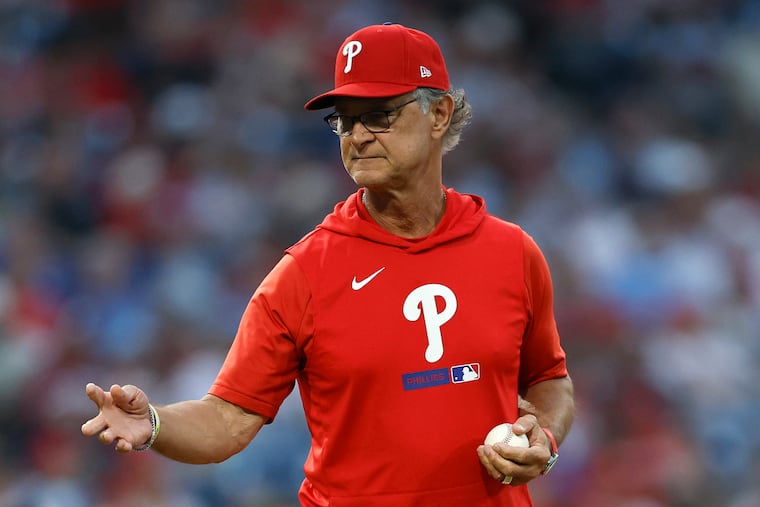
Rob Thomson has leaned on his bullpen during the playoffs over the last three years. Sometimes it has worked, other times not. But there is one clear difference this postseason.
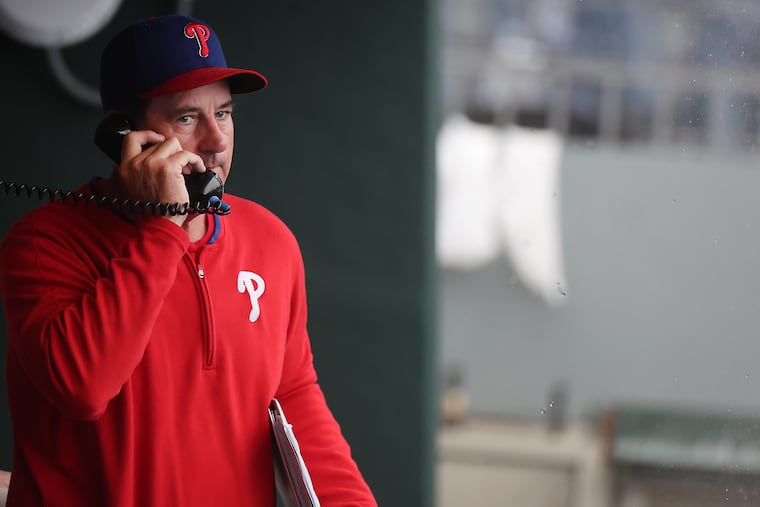
Since 2022, the Phillies have played 34 postseason games, more than any team in baseball and an adequate sample to draw a conclusion about Rob Thomson’s managerial game theory in the playoffs.
He leans on the bullpen.
Thomson isn’t alone. Because every out feels more precious in October compared with the regular season, managers across the sport are programmed to remove starters earlier in games and call on their best relievers.
» READ MORE: Bryce Harper is ready to become Mr. Red October again for the Phillies. There’s only one thing missing ...
Over the last three years, Phillies starters threw 77.6 pitches and got 15.3 outs per game in the playoffs (72.7 pitches and 13.7 outs in non-Zack Wheeler starts). Consequently, more responsibility fell to the bullpen.
Sometimes it worked. When it didn’t, it was difficult to live down. To wit: Thomson pulled Ranger Suárez after 69 pitches in 5⅓ scoreless innings of a tide-changing eventual 2-1 loss in Game 3 of the 2023 National League Championship Series. In Game 6 of the 2022 World Series, he infamously lifted Wheeler after 70 pitches in the sixth inning.
Everyone remembers what happened next.
“I think in the postseason, at its core, you’re reading the game a little more,” pitching coach Caleb Cotham said earlier this season. “You’re a little quicker on the trigger [with a starter]. You don’t want to be too late. There’s times where we’ve been a little late; we’ve maybe been a little too early. You’re just trying to make the best decisions.”
Maybe Thomson will rethink his philosophy. Jesús Luzardo will likely start Game 2 or 3 of the divisional round. If he gets into a groove, there’s a case to ride with him. In 32 regular-season starts, he held hitters to a .189 average and .556 OPS the third time through the order, including .182 and .521 on pitches 75 to 100.
But with Wheeler recovering from thoracic outlet decompression surgery and out for the playoffs, it’s tough to imagine Thomson going long with any starter other than Cristopher Sánchez. And even the big lefty hasn’t seen the sixth inning in a postseason game.
» READ MORE: The postseason is a ‘wild animal,’ but the Phillies will play the Dodgers in the NLDS … right?
It’s likely, then, that the Phillies’ choices in the fifth, sixth, and seventh innings — outs 13 to 21 — will determine how far they advance.
One difference in this postseason: The Phillies have a lockdown closer. The last three outs, and sometimes more, will belong to Jhoan Duran, enabling Thomson, Cotham, and even the relievers sitting in the bullpen to count backward from 27 as they construct the bridge from the starter to the ninth inning.
“Just knowing who’s getting the ball in the ninth, it takes a little off the other seven of us down there not wondering when [the phone will ring],” lefty Matt Strahm said. “I get the analytic side of baseball and all that, but I’ve always thought roles have a huge impact on a team. It’s different, those last three outs. I don’t think you can find on a computer how difficult they are. And a closer is just a different breed. They know how to get out of that corner when they get backed into it.”
The Phillies didn’t ask Duran to get more than three outs — or throw more than 24 pitches — in a game after acquiring him at the trade deadline. But he has done it — 28 times, to be exact, including two scoreless innings for the Twins in Game 4 of the 2023 divisional round.
“Any time you have somebody who’s a dominant ninth-inning guy, it’s helpful,” president of baseball operations Dave Dombrowski said. “Because then you can script around that.”
Having Duran pushes Strahm and righty David Robertson into more traditional seventh- and eighth-inning setup roles, perfect for when the Phillies can get 18 outs from their starters. But the starters completed the sixth inning in only 13 of those 34 postseason games since 2022, including nine times by Wheeler.
In that case, lefty Tanner Banks and righty Orion Kerkering will loom large in the middle innings.
Banks entered Thomson’s circle of trust by lowering his walk rate to 4.5% (his career mark was 7.5% entering the season) and posting a 3.07 ERA in 67⅓ innings. But teams covet swings and misses from their relievers, especially in the playoffs, and Banks’ strikeout rate (22.8%) was about league average.
» READ MORE: The Jhoan Duran Effect is real so far, and there’s precedent for what the Phillies hope he delivers
At his best, Kerkering has big-time swing-and-miss ability. He had a two-month stretch in May and June when he allowed two earned runs in 21⅓ innings and picked up his first two major league saves. But the 24-year-old righty stumbled badly in the second half, with a 6.57 ERA in his last 16 appearances.
To Thomson, then, there wasn’t a better sight in the regular-season finale than Kerkering striking out the side on 16 pitches to strand the automatic runner on second base in the 10th inning. One night earlier, he struck out the Twins’ Royce Lewis to strand an inherited runner on second.
“He was really good the last couple games,” Thomson said. “Just execution, pounding the zone, attacking with confidence. It’s encouraging going into the playoffs.”
The Phillies rushed Kerkering to the majors two Septembers ago. He dominated at times in the 2023 postseason while also playing a role in two bullpen meltdowns in Arizona. Last year, he appeared in all four games against the Mets and gave up one run on four hits, two walks, and five strikeouts.
Ready or not, Kerkering will surely be back in the mix again — and probably in the middle innings, when so many postseason games are decided.

Matt Klentak's fingerprints are still on the Phillies' roster six years after he was the team's general manager. These days, Klentak is part of the front office for the Brewers, who recently clinched their fourth consecutive NL Central title. With the Brewers coming to town Tuesday, Klentak joined Phillies Extra to discuss his current and former teams. Watch here.
You can also subscribe to the podcast version of Phillies Extra on Spotify or Apple Podcasts.
Previous episodes: Jeff Francoeur | Luke Murton | Mike Hazen | Tony Gwynn Jr. | Kevin Stocker | Bobby Dickerson | Jim Bowden | John Middleton | Ryan Howard | Dan Baker