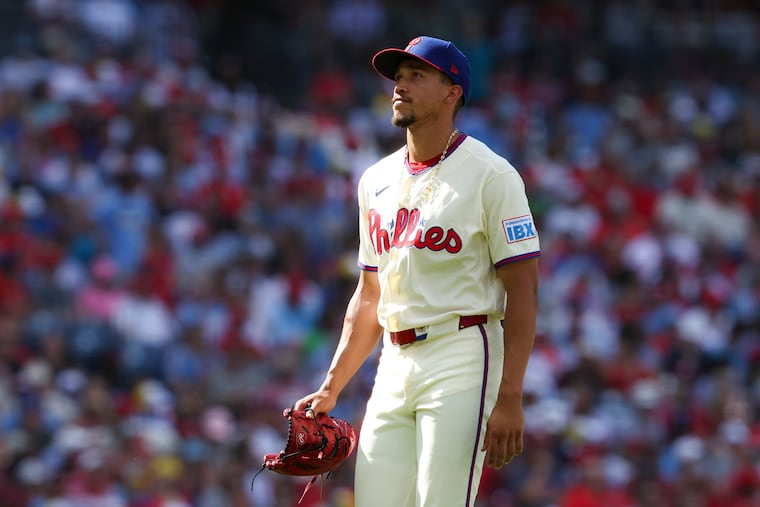
Zack Wheeler’s surgery and long absence resets the Phillies’ immediate and long-term future
Now that the club knows its ace will be sidelined perhaps well into next season, it can adjust for now and plan accordingly for later.

It’s not closure, and it’s not certainty, but it’s something close to both.
The Phillies and their fans now know why Zack Wheeler won’t pitch for them again this year. Last week he was found to have a blood clot on the right side of his upper body. Later in the week he was diagnosed with venous thoracic outlet syndrome.
It is a blessing that the problem was found, and its root, and that Wheeler likely not only will survive this issue, but he will return to pitch the final two years of his contract.
It is a curse that the problem exists at all, but then, throwers are at a greater risk for this ailment, according to the Cleveland Clinic website. Wheeler is a magnificent and well-worn thrower. Including the postseason, he’s thrown 28,957 pitches in the majors alone — full-effort, big-stage pitches, with millions of people watching, with wins and losses and personal awards and team championships at stake.
It’s a lot.
» READ MORE: Zack Wheeler will undergo season-ending surgery: ‘You’re never going to replace an individual like that’
The procedure to address his issue is called thoracic outlet decompression surgery, and it’s as scary and as invasive as it sounds. There are several varieties of procedure, but most involve the removal of at least a piece of a rib. The futures of athletes after they undergo this procedure vary.
Best case, Wheeler starts throwing in two months and returns in six months in the same form that made him a Cy Young Award candidate five of the past six seasons, all spent as the Phillies’ ace. Worse case, his rehab and return is delayed. Worse case, he might never be dominant again. Worst case, at the age of 35, he’s done.
No one will know which case is Wheeler’s case until next season — maybe not until midseason next season. There’s a very real chance that we don’t see vintage Zack Wheeler again until after Philadelphia hosts the 2026 All-Star Game.
But everybody at least now knows it is a very serious thing. It might not have been, but it is.
Teammates and administrators and fans knew news like this was coming, and this news, and the detection, and the dispatch of the treatment means Wheeler will be able to see his four young children grow up and he will be able to spend the time with them that he plans to spend when his career is over.
That’s what is important.
But he also is, arguably, the most important part of a $241 million payroll for the 2025 Phillies, the biggest single-season expenditure in team history, at $42 million, and a big chunk of the $1.3 billion that Phillies owner John Middleton, in the past few years, has committed to winning the franchise’s first World Series since 2008.
Like Bryce Harper, the other cornerstone, from professionalism to leadership to performance, Wheeler has been worth every penny, both in the six months leading into October, and even more so when the playoffs roll around.
» READ MORE: Marcus Hayes: Trea Turner and Bryce Harper say Zack Wheeler’s blood-clot scare helped inspire the Phillies
But one of the reasons Middleton spends so lavishly is that if Harper or Wheeler or Kyle Schwarber are absent, the remaining stable can compensate for their absence.
That, now, is their task. The news, now, delivers a measure of certainty.
It delivers certainty to Taijuan Walker, who lost his spot in the rotation and has been a spot starter for much of this season with the absences of Ranger Suárez and Aaron Nola. Walker now he knows he’ll be pitching every fifth day.
It delivers certainty to the future of Andrew Painter, the Phillies’ top prospect, who has endured an inconsistent triple-A season after missing 2024 recovering from elbow surgery. Including Walker and Wheeler, the Phillies would have had five starters returning under contract next season. Painter now knows without question that, come April, he will need to be a part of next season’s rotation.
It delivers certainty to the lineup, which, spurred by Wheeler’s troubles, has averaged 8.3 runs in their last six games. The well-paid hitters know they need to produce every time out; that they no longer can count on their ace giving up two earned runs or fewer, as Wheeler has done 42 in of his last 53 regular-season starts and in nine of his 11 postseason starts.
It’s uncertain if Wheeler will ever be that good again, but it’s not impossible.
The most relevant comparison to Wheeler’s situation is Merrill Kelly, who, at the age of 31, underwent this surgery in September of 2020, returned to competition in April of 2021, and continues to pitch for the Texas Rangers. Notably, in 2021, pitching for the Arizona Diamondbacks, Kelly carried a 2-7 record and a 5.40 ERA through his first 14 starts.
There is no rush.
Not now that we know.