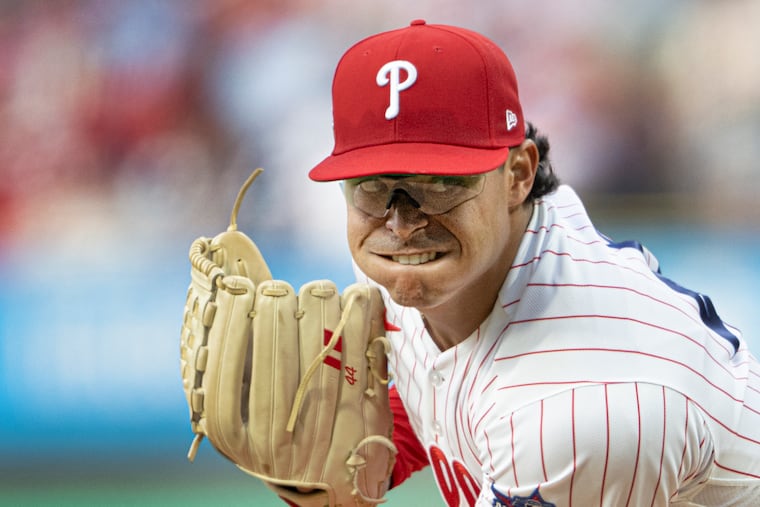
Rhys Hoskins’ injury was a sliding door moment in Phillies history. And it still ‘kind of eats at’ Bryce Harper.
If Hoskins doesn’t get injured, perhaps he's still a Phillie and the ongoing need for a righty power bat in the cleanup spot never arises. Hoskins, in town with the Guardians, has wondered himself.
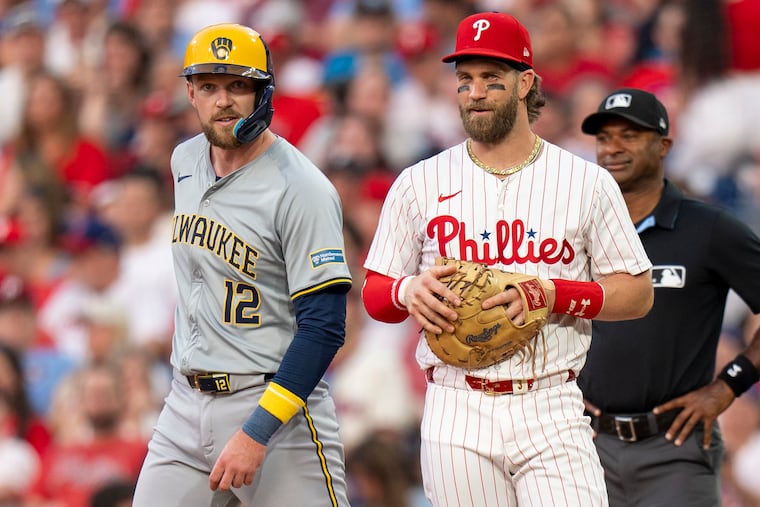
Imagine if Rhys Hoskins backpedaled for that chopper on the grass behind first base in that spring training game in 2023 and didn’t shred a ligament in his left knee.
Hoskins surely has.
“Oh, of course I have,” he said. “I’m only human.”
Bryce Harper thinks about it, too, because it’s among the more fascinating sliding doors in recent Phillies history. If Hoskins doesn’t blow out his knee and have season-ending surgery, Harper doesn’t move to first base — at least not in 2023, maybe not ever.
And maybe the Phillies’ best right-handed power hitter of the last 15 seasons is batting behind Trea Turner, Kyle Schwarber and Harper, tidying a cleanup spot that has been a mess for two years running.
Let that alternate history wash over you this weekend, with Hoskins back in town with another new team (the Guardians) and in an unfamiliar part-time role.
“I think about Rhyser all the time,” Harper said this week. “He’s one of my favorites I’ve ever played with. You kind of feel bad in a certain way, I guess. Right? Because you think to yourself, if I wouldn’t have done this [learned to play first base], then maybe he’d still be here.
“But I love Rhyser, man. When I see him in another uniform, it’s a little rough for me. I love seeing him. I loved playing with him. Great clubhouse guy. That’s one of the ones that kind of eats at me a little bit.”
Hoskins was healthy and ready to play by the 2023-24 offseason. By then, though, Harper was a full-fledged first baseman. He said the Phillies weren’t interested in putting him back in the outfield.
In hindsight, maybe they should have.
Hoskins’ production dipped since the knee surgery, with a .732 OPS and 103 OPS-plus since 2024. After two years with the Brewers, he signed a minor-league deal with the Guardians in spring training and plays mostly against left-handed pitching.
Entering the weekend, Hoskins, now in his ninth season, is batting .185 with four homers and a .704 OPS.
» READ MORE: The Phillies have an Alec Bohm problem. What are their options? And how long can they wait?
But the leaguewide trend since 2024 is more offense from first base (.749 OPS, according to Statcast) than right field (.737). In keeping Harper at first, the Phillies churned through righty-hitting outfielders/utility types: Cristian Pache, Whit Merrifield, Johan Rojas, Weston Wilson, Austin Hays, Otto Kemp, Harrison Bader, Adolis García, and Felix Reyes.
Not coincidentally, there’s a void in the cleanup spot. Since the beginning of last season, the Phillies’ No. 4 hitters are slugging .387 with 28 homers and a .691 OPS. Relative to the rest of the majors, they rank 23rd in OPS and 24th in homers.
It’s a long time ago now, but in 239 games as the Phillies’ cleanup hitter from 2017 to 2022, Hoskins slugged .528 with 57 homers and a .913 OPS.
The Phillies also entered the weekend batting .193 (59-for-306) and slugging .327 against non-opener lefty starters. Despite struggling against lefties so far this season, Hoskins has hit them throughout his career (.492 slugging, .869 OPS).
By now, the ship has almost certainly sailed on a Phillies-Hoskins reunion. Positionally, he doesn’t fit, even though Harper reiterated that he would go back to right field for a few months if the Phillies are able to trade for a first baseman before the Aug. 3 deadline.
“I have no desire [to do it] long-term, but if the right player comes along and that’s what we need, I’d be open to it,” he said. “That’s as real as it gets. I still feel like I can throw a baseball from right field, and I can catch a fly ball. It’s been a long time, but I would do it in a heartbeat for us to win a World Series.”
» READ MORE: Dave Dombrowski is ‘responsible’ for this reeling Phillies roster. And these decisions helped get them here.
Hoskins, a guest on The Inquirer’s Phillies Extra podcast this week, said he wished that the Phillies would have asked Harper to do it after the 2023 season, though he’s also “a firm believer that everything in life happens for some sort of reason, whether you like it or not.”
“I don’t think there was any opportunity to talk my way into right field at all,” Harper said. “I was going to do whatever they wanted me to do. If, after ‘23, they wanted me to move back out, I would’ve went back out there. I’m comfortable out there. I like playing out there.
“But I’ve gotten very comfortable at first base. I feel like I’m pretty good over there as well.”
Shielding Nola from decline
Let’s play a game of Guess That Pitcher.
Pitcher A: From 2007 to 2015 (ages 25-33), he led the majors in starts (297) and innings pitched (1,988), with a 3.67 ERA, and was 11% better than league average by ERA-plus. He also pitched 59⅓ innings in the postseason.
Pitcher B: From 2017 through 2024 (ages 24-31), he led the majors in starts (235) and innings pitched (1,432⅔), with a 3.62 ERA, and was 17% better than league average. He also pitched 53⅔ innings in the postseason.
Aaron Nola is Pitcher B, as you may have guessed. Pitcher A is James Shields, a workhorse for the Rays and later the Royals, Padres, and White Sox. And their extreme durability and reliability over an eight- or nine-year stretch has made them pitching doppelgangers.
» READ MORE: Over? History shows it’s not over for the Phillies’ season. Here’s what it took for others to turn it around.
The Phillies are hoping the similarities will stop there.
With all that mileage on his arm, Shields stumbled to a 5.85 ERA in 2016. The Padres traded him to the White Sox (for a prospect named Fernando Tatis Jr.), and after injury issues and a 5.23 ERA in 2017, Shields pitched one more season and retired at age 37.
Nola, who turns 33 in two weeks, is second in Phillies history in strikeouts (1,927), fourth in starts (295), and seventh in innings (1,766⅓). That, plus the four years and $98 million left on his contract, makes this difficult to reconcile: Among 164 pitchers who have worked at least 100 innings since the beginning of last season, Nola ranks 161st with a 6.02 ERA.
“He’s gotten a lot of big outs for this team,” catcher J.T. Realmuto said. “We wouldn’t be where we are without him. So, we’re all pulling for him to get through it, and we have confidence that he will.”
The answers aren’t clear. Maybe Nola needs to use his changeup more, especially against lefties. Or maybe he needs to leverage his curveball, historically his best pitch, and throw it earlier in the count for strikes to set up his fastball.
In any case, the Phillies continue to search for answers to help Nola regain some of what made him so effective — and to avoid falling off the cliff, like Shields did.
The Mattingly effect
In winning 16 of their first 20 games under interim manager Don Mattingly, the Phillies benefited from a Charmin-soft schedule and dominant starting pitching.
But Mattingly’s fresh perspective helped, too.
For four years, president of baseball operations Dave Dombrowski maintained an unusual degree of continuity in every area of the organization, from the front office and the coaching staff down through the roster, which Harper said caused players to feel even more unsettled by speculation about Rob Thomson‘s job security.
“Everybody was talking about it since the Dodgers series last year, right?” Harper said. “Like, that’s no secret. So, I think it was just a dark cloud over everybody, including Thomper. Did Thomper deserve that? I don’t think so. But then we go 9-19 and there’s a fall guy, and Thomper was the fall guy and it happened and the dark cloud was gone.”
» READ MORE: ‘Somebody’s got to do it.’ And as usual, Don Mattingly is happy to be the one, this time for the Phillies
Before letting Thomson go on April 28, Dombrowski offered the job to an outsider: Alex Cora, who had been fired by the Red Sox three days earlier. Once Cora chose to stay home with his family over managing again this season, Dombrowski elevated Mattingly.
Mattingly was essentially an outsider, too, after being hired in January as bench coach. If he had preconceived ideas about players or personnel, they formed during spring training and the season’s first three weeks.
“He has a fresh take because also he was in a different dugout and watched us play, right?” Harper said. “As a [opposing] manager, as a bench coach, he did all the homework, like he knew exactly who we were but from the other side. That’s a different perspective.”
Until the end, Thomson maintained that his message to players or to the collective team hadn’t gone stale after 625 regular-season games and four playoff runs with largely the same group.
“I don’t sense that,” he said after his dismissal. “I don’t sense a staleness to the players. I see frustration with the players, but I think that’s natural when you have the record that we do.”
Harper noted that Mattingly likely brought some insider knowledge when he became bench coach. His son Preston is the general manager under Dombrowski. And although they didn’t work together until this year, “they probably talked about our team,” Harper said, with a shrug and a chuckle.
» READ MORE: Andrew Painter is learning through experience and working to sharpen his fastball command
But even as bench coach, Mattingly came into staff meetings with a vantage point different from Thomson or his coaches.
Maybe it gave him an advantage when he took over as manager.
“I think so,” he said. “You kind of feel like you do from the other side. Because I studied the Phillies before, like trying to get them out and trying to maximize our the lineups against them. So, you have an idea of who they are kind of on paper.
“You just don’t know how they are in the locker room, day to day, how the flow of things work.”
Dombrowski said what executives in all sports say after firing a manager or coach, notably that his struggling team needed a “new voice.” Sometimes that’s true. Usually it isn’t.
But for an organization that has kept so much the same, any change, especially in the manager’s office, likely had a greater impact.
“He’s one of the better baseball guys in the game today, just because he played for so long, had success, so he knows talent,” Harper said. “I think he’s done a good job of building confidence in a lot of guys in here, too, like saying, ‘Hey, you’re really good. You’re going to play better.’”

Let's talk about the Phillies' bullpen. Larry Andersen happens to be an expert on the subject. The popular Phillies radio analyst had a 17-year major-league career in which he appeared in 699 games – all but one in relief. He joins Phillies Extra to break down the biggest question standing between the Phillies and a long run through October: How will they bridge the gap to closer Jhoan Duran? Watch here.
You can also subscribe to the podcast version of Phillies Extra on Spotify or Apple Podcasts.
Previous episodes: Matt Klentak | Jeff Francoeur | Luke Murton | Mike Hazen | Tony Gwynn Jr. | Kevin Stocker | Bobby Dickerson | Jim Bowden | John Middleton | Ryan Howard