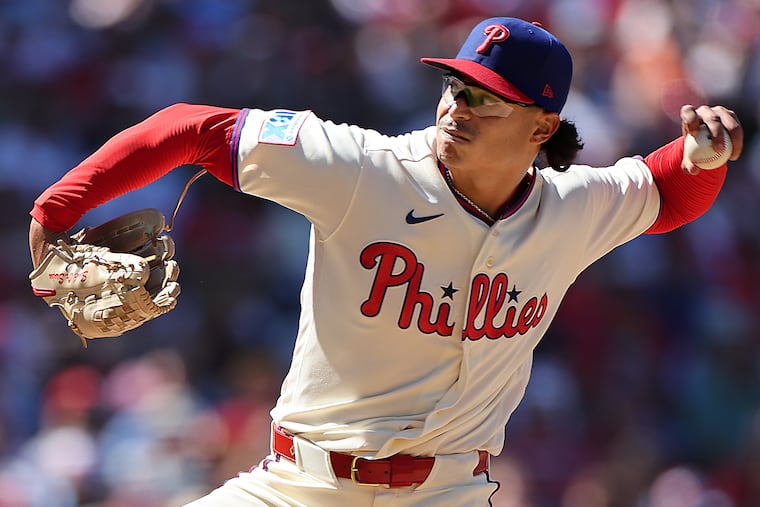
Starting pitchers say the Phillies ‘just make us better.’ And it starts with ‘next generation’ coach Caleb Cotham.
Expectations are high for a deep starting staff, and much of that has to do with the coaching, led by a guy who balances new- and old-school approaches.
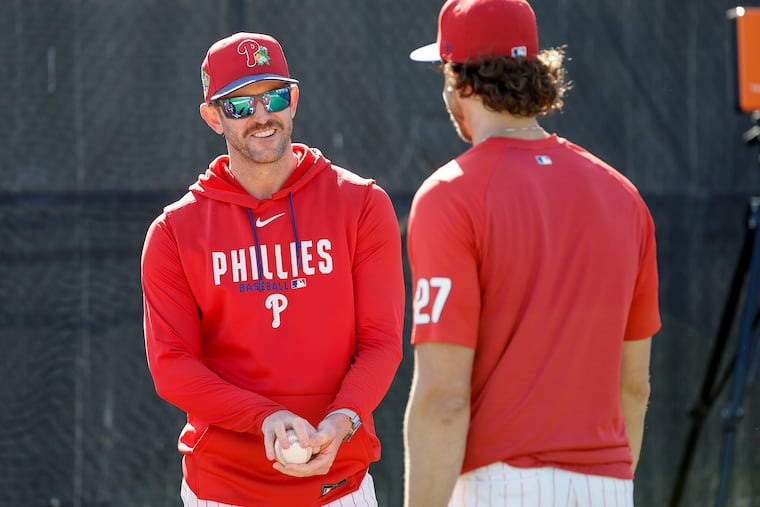
On two occasions this spring, the Phillies gathered in the BayCare Ballpark lunchroom to celebrate one of their starting pitchers.
First, when Jesús Luzardo signed a five-year extension with the club on March 10, the team held a news conference at its spring training complex that was attended by family, friends, teammates, and coaching staff alike. The same thing happened two weeks later, when Cristopher Sánchez agreed to a new six-year, $107 million contract in an unprecedented move by the Phillies to give their ace a raise.
The gatherings and the moves they represented reflect how the organization has doubled down on its investment in the team’s biggest strength. The Phillies, this year and every year, will go as far as their rotation will take them.
“I think there’s nothing more important than starting pitching in this game,” catcher J.T. Realmuto said. “I think the dollars kind of show that.”
» READ MORE: 20 things to know about the Phillies for the 2026 season
Results have gone hand-in-hand with the commitment. The Phillies’ starting rotation has ranked in the top 10 in ERA in the National League in each of Caleb Cotham’s five seasons as pitching coach.
Even with Zack Wheeler’s season cut short and Aaron Nola hampered by injuries for most of the year, Phillies starting pitching put up a 3.53 ERA in 2025. That marker was second-best in all of baseball after the Texas Rangers (3.41).
The Phillies also led MLB in quality starts with 84, and three members of the rotation received Cy Young votes. Sánchez finished as runner-up to Pittsburgh’s Paul Skenes, Luzardo finished seventh, and Wheeler finished ninth.
This year, the group will look a little different. Ranger Suárez departed for the American League after earning a five-year deal from the Boston Red Sox in free agency. Wheeler is progressing well in his rehab from thoracic outlet decompression surgery, but he will open the season on the injured list.
Prized prospect Andrew Painter will make his long-awaited major league debut on Tuesday, slotting in fifth in the rotation to open the season behind Sánchez, Nola, Luzardo, and Taijuan Walker.
The expectations are just as high with this staff, and a lot of it has to do with the coaching behind it.
“You can just tell, not only with me, but with all the guys that they get their hands on,” Luzardo said, “they just make us better overall.”
But how?
Pitch design
After Luzardo was traded to Philadelphia from Miami last winter, one of the first things he did was get on the phone with Cotham for an hour. And one of the first things they talked about was whether Luzardo had ever thrown a sweeper.
“I felt like I got along with him very well,” Luzardo said. “I started to see a lot of the way he is and the way he thinks about pitching is very similar to me. We like to tinker with things, and we like to see how we can get better.”
Luzardo also already knew assistant pitching coach Mark Lowy well from working together in the past at Cressey Sports Performance, Luzardo’s offseason training facility in Florida.
» READ MORE: Hope for a new Phillies offense lies with Aidan Miller, Otto Kemp, Justin Crawford
At first, as they started developing the sweeper over the offseason and in spring training, Luzardo was reluctant to call it a confirmed part of his arsenal. But by the regular season, it not only was one of the best pitches in his repertoire, but it was among the best in baseball.
Luzardo’s sweeper, which he threw 31% of the time, had a plus-15 run value, according to Statcast metrics. Among all sweepers thrown in the majors last season, Luzardo’s was tied with Garrett Crochet’s for highest run value.
He hopes to see similar results out of his changeup, which was the lefty’s focus this spring as he searched for the next way to improve. After throwing the same circle changeup for his entire career, he worked with Cotham and other coaches this winter to alter its grip. Now, he throws a split-change with the idea of having more movement and depth — and hopefully more swing-and-miss as a result.
“You have to evolve,” Cotham said. “You have to keep seeing what you’re capable of. That’s the coolest part of being part of his journey, and being his coach, being part of that collaborative process. … You never want to take away from who they are by suggesting things at the wrong time. But he drives a lot of that because he really cares about being really, really good.”
Wheeler has a similar approach to his repertoire. While at his core, he is a power pitcher, he introduced the sweeper to his arsenal in 2023 and then the splitter in 2024 in an effort to continually bring something new to the table. Cotham’s help has turned both pitches into effective secondaries.
“He’s helped me definitely get to where I’m at, that next level,” Wheeler said. “He’s sharpened my tools, so to speak, especially with off-speed stuff.”
» READ MORE: Phillies’ Zack Wheeler will make a rehab start Saturday, takes a huge step in return from surgery
Wheeler considers himself a visual person, and said Cotham taps into that. He will grab a baseball himself and show Wheeler exactly how to hold it and how the ball should spin out of his hand to help him grasp the concepts more easily.
“He’s come to me before with my splitter, ‘Hey, the numbers show that if you hold it this way, it’s going to have five more inches of drop,’ or whatever it may be,” Wheeler said. “And he saw that by looking around the league. There’s just so much info out there.”
According to FanGraphs, the Phillies pitching staff had the best collective Stuff+ (105) in baseball last season. Stuff+ is a pitching model that evaluates the physical characteristics of a pitch, such as its velocity and movement, to determine its effectiveness.
Simply put: As a group, Phillies pitchers had the nastiest pitches in baseball.
Luzardo isn’t the only one with a new pitch this year, as Walker also has introduced a different slider. In the past, he has relied primarily on his splitter and cutter against right-handers, but he wants his slider to develop into another swing-and-miss option. Now when he throws his slider, Walker has a flatter wrist and a “curveball” mindset. The pitch has dropped in velocity from last year but has added two inches of horizontal break.
“For our team, it feels like guys are doing that every year,” Realmuto said. “Caleb works so hard with our guys in the offseason, trying to tweak something here and there, trying to learn a new pitch, and constantly working and trying to improve.
“Especially our starters, I feel like every year they come in working on something new and some new way to improve. So I feel like that’s just a testament to the pitching staff.”
Elite to even more elite
Not every starting pitcher necessarily needs or wants to continually add to his arsenal as a way to improve, though. Sánchez has toyed with a cutter in the past, but really only has used three pitches on his path to become one of baseball’s top lefties.
It helps when one of those pitches is as elite as Sánchez’s changeup, which he pairs with a sinker and slider. Sánchez already had a decent changeup when he started working with the Phillies coaches, but the key to turning it into a pitch with a 45.1% whiff rate last season was more consistency.
Cotham said the Phillies worked with Sánchez on making his delivery tighter and more repeatable, as well as finding the optimal grip.
» READ MORE: Why has Dave Dombrowski invested even more in the Phillies’ starting pitching? Check his record: ‘It’s worked’
“He’s a story of the sum of a lot of little things, not necessarily one big thing,” Cotham said.
Sánchez’s changeup is now infamous leaguewide, but it still manages to mystify hitters.
As manager Rob Thomson put it: “I don’t know where his ceiling is. From where he’s come from, it could be anywhere.”
Sánchez and the Phillies will keep pushing higher. Right now, that involves throwing his slider more often to give hitters one more thing to worry about. But as long as Sánchez has his best weapon and it continues to work for him, he doesn’t necessarily need a fourth, fifth, or sixth pitch.
“Could he throw a sweeper? Sure. Could he throw a curveball? Sure. Could he throw a four-seam? Sure,” Cotham said. “But there’s a beauty in having three pitches that you can throw at any point. … The benefit of having a simple plan is your hitters actually might become more obvious on what they’re trying to do. They’re trying to not swing at changeups? Then there’s a counterpunch that Sánchy has.”
At this point in his career, Nola’s arsenal isn’t changing a whole lot, either. He has used the same five pitches — four-seam, sinker, changeup, cutter, and his signature curve — for years. He entered this spring focused on crisping up the pitches he already has, rather than toying with a new one.
“I’m never looking at pitchers relative to other guys,” Cotham said. “I’m looking at each individual we are, relative to what the hitters are saying. The core fundamentals, you have to have options in the strike zone, and depending on what pitches you have, what solutions do hitters have for that?”
Old school, new school
In the analytics age of baseball, there is an immeasurable amount of information available at everyone’s fingertips. But every pitcher is different in how he wants to consume that information.
“Caleb’s different from guy to guy. For me, I need to dumb it down a lot of times,” Nola said.
According to Wheeler, that’s one of Cotham’s biggest strengths: finding what works for the individual.
“He’s got a lot of different personalities to deal with,” Wheeler said. “And he knows each of his guys.”
» READ MORE: Phillies prospect Gage Wood may have to take a longer road to the majors — and he’s OK with that
The fact that his playing career wasn’t too long ago helps. Cotham, 38, retired from baseball in 2017 after pitching for the Yankees and Reds. Before the Phillies hired him in 2020 to replace the retired Bryan Price, he was an assistant pitching coach and director of pitching for Cincinnati.
There’s a sense among the Phillies rotation that Cotham is able to blend an old-school baseball approach with a new-school mindset.
“Old school like, ‘Hey, don’t over-rotate, or lift,’ and then you can put analytic side to it,” Wheeler said. “And you can kind of mesh those and help you become the pitcher that you want to be or the pitcher that you need to be. And so the analytic side and the pitching coach mechanical side, he puts both of those to good use. And kind of meshes it together. Old-school guys that I’ve had in the past were just like, ‘Hey, don’t over-rotate,’ or this simple stuff that you’ve heard a lot.
“He’s that next generation-type pitching coach. We’re all lucky to have him.”
He’s a good bridge for a player like 22-year-old Painter, who only really started to dig into analytics last season. Before, he would just get out on the mound and throw, never thinking about things like spin rates or induced vertical break.
But in his first season back from Tommy John surgery, Painter dealt with inconsistent fastball command at triple-A Lehigh Valley. And he started to learn more about what some of the numbers meant.
“It’s great to have a little balance there,” Painter said, “because you can get really caught up with all the technology, all the analytics, and kind of get away from the important things. You still have to be able to command the ball, still being in the zone and work counts. And that’s the most important part. Being able to dive in the analytics and data, while also prioritizing commanding the ball and getting in the zone, getting ahead in counts.”
» READ MORE: Winning a World Series ‘changes everything.’ And the Phillies legacies for this veteran core are riding on it.
Since they’ve started working together, Cotham has helped Painter gain consistency with his fastball grip and ensure he has the same feeling in his hand each time he releases the pitch.
Cotham describes his approach as using technology as a tool to accelerate toward the fundamental goal of a pitcher, which has always been the same.
“It’s the art and science,” Cotham said. “You’re just trying to leverage all these things that you possibly can — the experience of guys that came before us and the technology we have available now — to make better pitches more consistently and get guys out.”

Let's talk about the Phillies' bullpen. Larry Andersen happens to be an expert on the subject. The popular Phillies radio analyst had a 17-year major-league career in which he appeared in 699 games – all but one in relief. He joins Phillies Extra to break down the biggest question standing between the Phillies and a long run through October: How will they bridge the gap to closer Jhoan Duran? Watch here.
You can also subscribe to the podcast version of Phillies Extra on Spotify or Apple Podcasts.
Previous episodes: Matt Klentak | Jeff Francoeur | Luke Murton | Mike Hazen | Tony Gwynn Jr. | Kevin Stocker | Bobby Dickerson | Jim Bowden | John Middleton | Ryan Howard