‘Phillies Extra’ Q&A: Terry Francona on manager firings, why Philly and Boston are different, and more
The former Phillies and Red Sox manager discussed the unique challenges of managing in the two sports-crazed Northeast markets after each fired their managers.
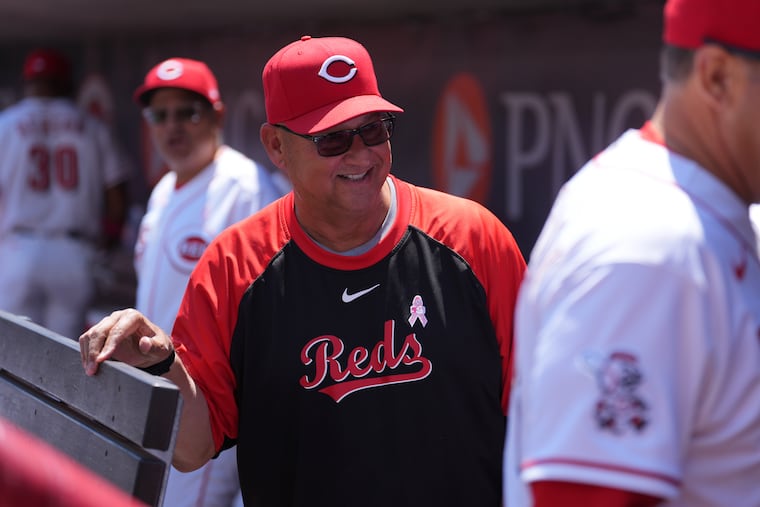
Terry Francona will lead the Cincinnati Reds into town this week, which is reason enough to catch up with a manager who will wind up in the Hall of Fame someday.
But the Red Sox and Phillies fired their managers in a four-day span last month.
Surely, Francona can relate.
Francona lived through the managerial land mines in Philadelphia and Boston. He managed the Phillies for four seasons (1997-2000) before famously steering the Red Sox to World Series championships in 2004 and 2007. And he was also let go by both teams.
» READ MORE: ‘Phillies Extra’ Q&A: Aaron Rowand reflects on his iconic (and painful) catch on its 20th anniversary
Last week, Francona sat down with Phillies Extra, The Inquirer’s baseball podcast, to discuss the unique challenges of managing in the two sports-crazed Northeast markets. He also talked about his young Reds roster, including 24-year-old star shortstop Elly De La Cruz.
Here are a few excerpts from the conversation. Watch the full interview below and subscribe to the Phillies Extra podcast on Spotify or Apple Podcasts.
Q: What was your reaction to seeing Alex Cora and Rob Thomson get let go even before the end of April?
A: We get sort of tunnel vision with what we’re doing, and you kind of pay attention maybe to the team you’re playing and then the next team. So when Alex got let go, I was stunned. And again, I’m not privy to everything that’s going on. We opened the season with them, and I certainly paid attention. And then you kind of start worrying about your own self and your team and everything like that. But it really did surprise me.
But like I said, I’m not privy to the inside things that are going on anywhere. And it always seems like, in baseball, once the dam breaks, it’s like it opens it up, and other teams probably start thinking, ‘Well, if they did it, should we?’ And again, it’s never a fun thing, because a lot of them are friends of mine. It kind of comes with the territory, but it’s not the funnest part of the territory.
Q: We always hear Philly and Boston, and New York gets lumped into that too, that it’s different there. Is that really the case?
A: Yeah, it really is. And you need to recognize that, or I think you’re messing up. Like in Boston, I laugh and ... people ask me all the time, and I’m like, there was a fire to put out every day. And if there wasn’t, somebody would make one up, and you have to put it out. There’s just so much fan interest, media interest, and with all that passion and interest, the manager is going to go home with a headache some nights. That’s just the way it is.
It’s a great place to be a part of baseball, but there are some things that come along with it. That’s why I used to marvel at Joe Torre, what he did in New York, because he made it so easy for those guys just to play baseball. And I don’t think it’s quite as easy as he made it look.
» READ MORE: Bryce Harper is off to a strong start. And ‘protecting himself’ has played a key role.
Q: This fall, it’ll be 30 years since the Phillies hired you. What’s the biggest difference in managing a team now than it was in 1996 or even in 2004 when you got to Boston with the Red Sox?
A: When I came in the winter of ’96, Lee Thomas was a general manager. Ed Wade was the assistant general manager, and I think Nancy Nesnidal [executive assistant] was in the [front] office. Now the baseball ops departments are so big, and it’s not a bad thing. There’s some really good, interesting stuff. But what happens is ... everybody comes to the manager, from this way, from this way, this way, and if you’re getting 50 different opinions, it can kind of overwhelm you.
I think we have a good setup here [in Cincinnati], where we try to answer questions, and there’s a lot of ways to do that, and I think that’s always the best way to do it is take everything and try to meet in the middle. And when you do that, when you have respect for everybody else’s area, I think it works the best.
Q: A lot of people wanted to connect dots between Kyle Schwarber and Cincinnati in free agency during the offseason, because he’s from there, and he was a Reds fan growing up. Was there ever a point when you thought you might actually be able to write this guy’s name on a lineup card?
A: I don’t ever want to speak for him, but we definitely talked to him, and there was a lot of interest, and after visiting with him, my opinion of him has only grown. And I know his reputation in the game is spotless, and he’s one of the best, and I can see why. That’s probably my best answer I can give you.

Phillies Extra is your deep dive into all things Phillies on Gameday Central! Hosted by Scott Lauber, each episode brings you insider analysis, exclusive interviews with players and experts, reader emails, and more to cover the hottest topics with the Phillies and across Major League Baseball. Don’t miss it — the conversation starts here!
You can also subscribe to the podcast version of Phillies Extra on Spotify or Apple Podcasts.