
Partner Content
Effecting Radical Change One Life at a Time
Southeast Asian Mutual Assistance Association Coalition CEO Thoai Nguyen on how lifting people up can build a movement.
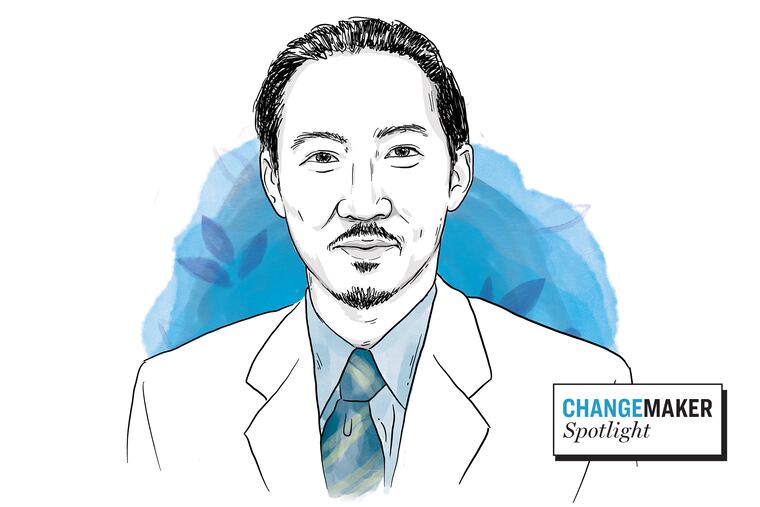
“My path from being a 9-year-old boy, a refugee from Vietnam in a family resettled in South Philadelphia, to becoming CEO of SEAMAAC [Southeast Asian Mutual Assistance Association Coalition], just seems perfectly fitting for a story of America,” Thoai Nguyen said. “But when I think more deeply upon my life and other people who faced very similar challenges, it could have gone in many different ways.” Nguyen’s sensitivity to the potential outcomes of immigrants is informed both by his personal experiences as well as his leadership of SEAMAAC. The organization’s services, which include education, health care, and community development, are crucial in this moment: In 2023, immigrants comprised 14.3% of U.S. residents, up from 11.19% in 2000. In 2024, Philadelphia’s immigrant population reached an 80-year high. And while poverty in the city is at a 25-year low, housing remains unaffordable and more people are experiencing homelessness than ever before.
The nonprofit is also invested in changing the cultural discourse around immigration. On Jan. 22, 2026, the organization will launch “Indivisible,” a video storytelling project in collaboration with the American Swedish Historical Museum and funded by the William Penn Foundation. “Indivisible” invites Philadelphians to share their family’s immigration experience, connecting their roots to today’s political discourse. “I want people to discover themselves as they’re telling their story,” Nguyen said. “And then in doing so, inspire others to look at their own roots.”
Here, Nguyen shares his roots as a Vietnamese refugee in Philadelphia in the 1970s, and his unique perspective on community outreach, organizing, and where SEAMAAC is headed.
Tell me about your family’s experience coming to the United States. How does that shape the work you do now?
My family was resettled to South Philadelphia in 1975 after uprooting everything we’d known for generations. It really shaped my very early understanding of the world around me.
Because my father worked for the U.S. government for many years while he was in Vietnam, we were prioritized to be airlifted out. We were the first family to land in South Philly in the Seventh Street business corridor, which, at that time, was still a thriving, vibrant business district, primarily for Jewish businesses owned by Jewish families who had survived the Holocaust and I believe that experience made them more compassionate to my family’s plight. At first we were the only Asian family in the midst of working-class Irish, Polish, and Italian immigrants. So for the first four to five years, that was what I knew.
From the late ’70s up until 1985, more Vietnamese refugees began to be resettled there, and then Cambodian, Laotian, ethnic Hmong, ethnic Chinese followed. That caused a lot of racial tension. Being one family, we may not have been a threat, but when you have hundreds of different families speaking six or seven different languages, wearing different clothing, eating different food, practicing different customs, you’re going to push up against the nativist sense of entitlement and turf.
It impacted my understanding of who I am in the context of everything. For the first five years as a refugee, I had a very diverse friend group. I remember playing hockey, soccer, and American football, and our team was really representative of the neighborhood. My older brother and I were the only Asian guys on the team, but we were kind of embraced by the neighborhood. I should say that (and this is not a pat on the back or anything) my dad’s family was fairly wealthy and he was very well-educated and very sophisticated. He spoke four languages — Vietnamese, English, Japanese, and French — fluently. As a result, our upbringing in Vietnam was very urbane.
But the new refugees coming in were not coming from that same sort of social environment. A lot of them came from more agrarian areas, and they had a more difficult time adjusting to the urban neighborhood in South Philly. And while I was accepted into a group of Italian- and Irish-American kids, the reality of identity really hit me. They may not have seen me as different, but I was very much an immigrant. I felt this deep sense of connection with the new refugees, and about the same time, my dad started working for one of the refugee resettlement agencies to help the new refugees entering the neighborhood. When I was 15 or 16 years old, I would start advocating for some of the new refugees when my father was busy at work. They would knock on the door, and I would go out and help them facilitate a discussion with the landlord or the neighbor to get around some sort of cultural misunderstanding.
“If you boil down problems faced by the family or community today, the cause of the problems is usually poverty.”
How would you describe what SEAMAAC does and why it matters?
We describe the people that we serve as economically, socially, and politically vulnerable communities. The name singles out the Southeast Asian immigrants and refugees because they were part of our original mission. And while we still serve Asian communities, today, our mission statement is really an economic, social, and political-class statement. Depending on the year, 50% of the communities we serve are Black families or families with African ancestry. There have also been a lot of Ukrainians entering Philadelphia in the past five years. So we serve economically- and historically-disenfranchised or vulnerable families of all races and ethnicities. It doesn’t matter who they are, if we have programs or services they need, then they are welcomed.
We also do advocacy, education and organizing work, which is something that was not there before I came to SEAMAAC. I would argue that the quality of our services today is a hundred times better than 20 years ago because our work today is deeply informed by a radical analysis of poverty.
Can you tell me more about that? How do you define radical?
When we say “radical,” we don’t mean people running around arguing to defund the police. We mean “radical” in the sense of its Latin origin, which means “root.” To me, if you boil down the problems faced by the family or community today, the cause of the problems is usually poverty. Debilitating generational poverty. Some of our services are just a band-aid on certain issues. We’re plugging leaks here and there. But to get to the root cause of these issues, we need to get people to think and act strategically, to really think more about who they’re voting for.
How does SEAMAAC engage in community empowerment?
I would say that we don’t do any “empowerment” work because that creates a presumption that we have power to give to people. We really try, instead, to build an environment in which people can find their own voice and agency, then have self-determination in their future. To me that is less about traditional social services than it is about movement building and community organizing. And we’re trying to build really slowly, but steadily.
I’ll give you an example: I sometimes guest lecture at Penn, Jefferson, or Temple. And students are generally really interested in my organizing background and what I did prior to SEAMAAC. And on the surface, that’s the sexy stuff. I was organizing against the police brutality, getting arrested for civil disobedience, and taking over buildings, taking over bridges and tunnels in New York City. But a lot of students will say, “Oh, Mr. Thoai, tell us the most radical thing that you’ve ever done.” And they think that I’m going to talk about the time that I scaled this building to drop a protest banner.
But in reality, the most radical thing that I’ve ever done is finding livable wage jobs for 20 families at one time, where mom and dad got jobs at a hospital system in Philadelphia. And they are now getting paid better than minimum wage and receiving health care coverage for their family from a 40-hour work week. What more radical way can you change a person’s life than doing that? Mom and dad now don’t have to work two jobs, 12 hours a day. They have Saturdays and Sundays free to spend with their family. What is fundamentally better than that?
What gives you hope about the work? What keeps you up at night?
What keeps me up at night is the crisis that’s been building in our democracy over the last 10 months and the fact that working-class Americans are being disenfranchised through the defunding of our public benefits. I’m concerned specifically with how defunding impacts the families SEAMAAC serves. We’ve already taken an $800,000 loss over the previous nine to 12 months. And that affects the lives of the people whom we serve but also the livelihood of our team. In that period, we also lost 15 staff members. So we went from a team of 50 to now 35. Clearly we need more people because requests for service have increased, not decreased.
Our ability to meet the demand is stable for now, but that requires the remaining 35 staffers to work extra hard. And as the CEO, I have to be really careful about them burning out, or worse, for them to say, “I’m done. I can’t do this anymore.” So it’s a real fine line for the nonprofit sector. That’s what keeps me up at night, thinking about the 12 people that I had to lay off over the last six months, I feel terrible. But you can’t sustain this work without hope. I’m sure you’re familiar with Mariame Kaba’s concept that hope is a discipline?
Actually, I’m not.
Her concept is that hope has to be an active verb. When you only hope for something, it does not mean that it will automatically happen, you have to take action day by day to make that hope into a reality.
After more than 20 years leading this organization, what are you most proud of?
I’ve been here long enough, 21 years now, that people are asking me about my legacy. Is my legacy going to be the Wyss Wellness Center that we opened up in collaboration with Jefferson Health? Or is it going to be the South Philly East Community Center that’s scheduled to open in December of 2026? I would say that it’s nothing structural like that, even though I love talking about tangibility.
I think the legacy that I leave for SEAMAAC is the dozens of young activists and organizers that I have the honor of mentoring right now and the dozens that I’ve mentored in the past. If I can instill a sense of compassion and integrity in a quarter of the people who we’ve developed at SEAMAAC, the things that I’ve done in life will have been worth it. Over the past 40 years, I’ve mentored a lot of great people and some have started their own organizations. Some are still doing anti-prison work, anti-death penalty work. I was mentored by some great community organizers, so I am just passing on their knowledge to the next generation of organizers.
PHILLY QUICK ROUND
What’s your favorite Philly food splurge? The pizza steak at Lazaro’s Pizza.
Favorite Philly small business? I always have to say Stina Pizzeria. It is not just the pizza — it’s the owner and their mission. And he named the restaurant after his wife, Christina. I mean, that’s just lovely.
What do you wish people knew about the people who call Philly home? We are rough around the edges, but we’re for real.
Who’s the greatest Philadelphian of all time? John Coltrane, a genius musician, an amazing civil rights leader. A jazz icon.