Jenice Armstrong: Haitian toddler here for serious surgery
SETH NEWMAN, a general surgeon at Abington Memorial Hospital, was a volunteer in Haiti this spring, when he came across a case that stopped him cold.
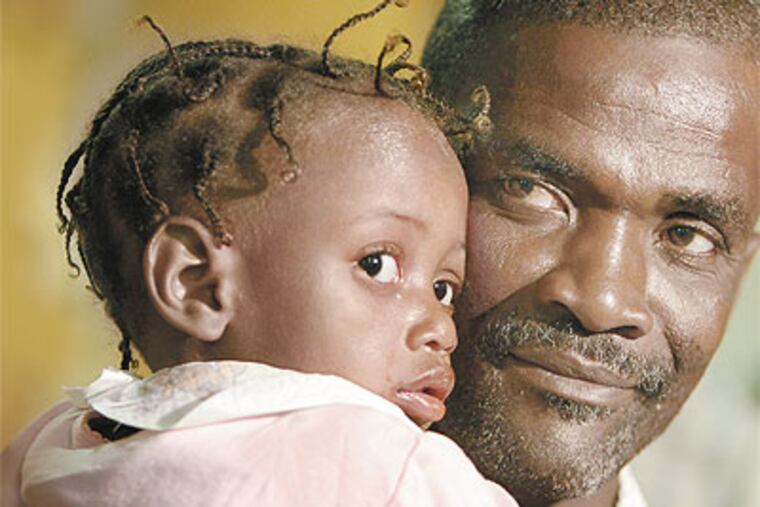
SETH NEWMAN, a general surgeon at Abington Memorial Hospital, was a volunteer in Haiti this spring, when he came across a case that stopped him cold.
It was a toddler with a rare birth defect, an anorectal malformation that left her without an anus. As a result, instead of passing stools the normal way, they were coming out of her vagina. In addition, she had a mass the size of a small orange on her perineum. These kind of tumors grow and, because of its location between her legs, if left untreated, it would complicate her ability to sit or even wear pants. In the United States, these kinds of deformities are treated at birth.
This patient was nearly 2 years old.
Newman took a picture on his BlackBerry and e-mailed it to a colleague, Ala Stanford Frey, a pediatric surgeon. Her immediate reply: "Don't touch it. She needs to be here because it's very complex."
Little Mirlande Felime needed surgery and she would have to travel to the United States for it. Her parents weren't surprised. When she was born 23 months ago, they were told that she would need such an operation, but no one in the impoverished island nation was equipped to perform it.
In a lucky twist of fate, it just so happens that Frey specializes in the exact kind of surgical procedures that Mirlande so desperately needs. Without it, she probably would have contracted sepsis and would not have made it to adulthood, possibly not even her 5th birthday.
The challenge, of course, was how they would get Mirlande to the United States and who would pay for it. She would need at least three, possibly four surgeries.
Her parents, who are no longer together, were of modest means even before the earthquake six months ago decimated their country.
The only reason Mirlande was lucky enough to even be considered for treatment was that her father, Josue Felime, 46, had carried her in his arms to a makeshift hospital set up inside a relief tent outside an airport near Port-au-Prince.
Six months after the earthquake that killed an estimated 300,000 Haitians, the situation in Haiti remains dire. Haitians are still awaiting millions in pledged donations to arrive, and frequently the supplies that do get there are poorly distributed.
Newman recalled his time there. The heat "was intolerable. The temperature in the operating room the first day I was there was well over 100 degrees," Newman said. "There is nowhere to escape and say, 'I'm going to step inside and cool off there. . . . It's hard to describe what it's like living like this.
"The need is just massive in terms of medical care, in terms of housing," he added. "The amount of human misery and suffering there is unbelievable. . . . There are still people living in tents in the middle of a median strip."
His initial e-mail to Frey was followed by a flurry of others among doctors and administrators at Abington and at St. Christopher's Hospital for Children, where Frey also operates. By the time the messages slowed down, it was decided that Abington would cover the cost of the little girl's care, as well as house father and daughter for the six months or so that Mirlande would need to recuperate.
She and her father arrived in Philadelphia Saturday evening. A Temple University medical student whose family is from Haiti was among those who met them at the airport to serve as an interpreter.
Watching the father and daughter walk through the hospital cafeteria yesterday, I tried to imagine what they must have felt to have left Haiti and landed in the antiseptic world of Abington, and later, when they were treated like celebrities as cameras flashed and TV cameras followed their every move.
After a bit of fitful crying, Mirlande settled in the arms of a volunteer from the Christian Fellowship Center of Philadelphia, in the Northeast, which has a large Haitian membership.
Her first surgery is scheduled for Thursday, when Frey will do a more thorough examination while the child is under anesthesia. On July 29, Frey will operate a second time, this time removing the tumor and performing a colostomy. "I have to remove the mass and also create an anus . . . and divert the fecal stream from that area," she explained. "She's been stooling through this small area for her entire life."
The second operation is expected to last six to eight hours.
"If all goes well, the last procedure will be to close the colostomy," Frey explained.
Speaking through an interpreter, Felime said: "The one thing that I want is for this operation to go well. I would like God to walk along with Dr. Frey . . . I thank the entire hospital staff for taking this on."
Mirlande is in good hands.
It looks as if her luck has finally turned. She'll get the care she needs, as well as airfare back home. When they brought her in yesterday, she had a "Dora the Explorer" backpack and a red lollipop that held her attention for a bit.
But what about all the others back in Port-au-Prince?
"This brings the issue of what's still going on back to the forefront of the media," Newman said.
Send e-mail to heyjen@phillynews.com. My blog: