Buried treasure right near Tut's
The arrival of the Egyptian trove at the Franklin Institute brought out the best in Aya's Cafe.
History warns us to enter dining rooms offering special-event menus with caution. So it was with modest expectations that I stuck my head in at Aya's Cafe, not far from Logan Square, where a sign taped to the front door recently bid "Welcome, Cousin Tut."
In its first two years, the cafe billed itself generically "Mediterranean," heavy on the Italian. But the advent of the Tut exhibition at the Franklin Institute, just 700 steps away, has unearthed its inner Egyptian: Aya's is at heart, and certainly in its Arabic-scented kitchen, far more resonant of Cairo than of Athens or, say, Naples.
Now its four-course Pharaonic menu is bursting with national pride: The menu's Greek-style moussaka has become stewy musakaa, seasoned with aromatic Arabic spices and nutmeg, and presented in a clay casserole. The lovely, tender cilantro lamb stew with chickpeas in tomato-lemon sauce has become Lamb stew, Tut-style. A shepherd's salad of tomato, cucumber and feta is now, well, Egyptian salad.
All about town, places have Tutted up menus: London Grill fields lemon chicken, braised lentils and eggplant salad. The Four Seasons has a pyramid-shaped dessert. McGillin's Olde Ale House has its gold-rimmed Tut-tini (though I'd be loath to order one in that temple of Bud Light). Even the Franklin Institute has its Tut's Oasis, an evening boîte featuring braised chicken with pistachios and apricots.
But for genuine Egyptian soul food, I'll take the real deal, overseen by chef-owner Tarek AlBasti, a former Egyptian national team rower who actually rowed the Schuylkill in competition before moving here with Carolyn Baugh, an Indiana girl he met on her year abroad in Cairo, and later married. They chose Philadelphia so she could finish graduate work at Penn: Aya is their daughter, now in second grade.
The cafe is a thoroughly family affair - various aunts and uncles and in-laws serving and managing and cooking. Aunt Mona, however, her head covered and her hands busy, appears to be the kitchen's constant and mainstay.
There's a practiced, sure-footed touch in the seasonings - in the custardy, vanilla rice pudding; the fresh, warm stuffed grape leaves; the play of cumin, nutmeg, allspice and cinnamon in the tomato-based, Moroccan-style soup and against the sweet pepper in the ground lamb-and-tender eggplant musakaa.
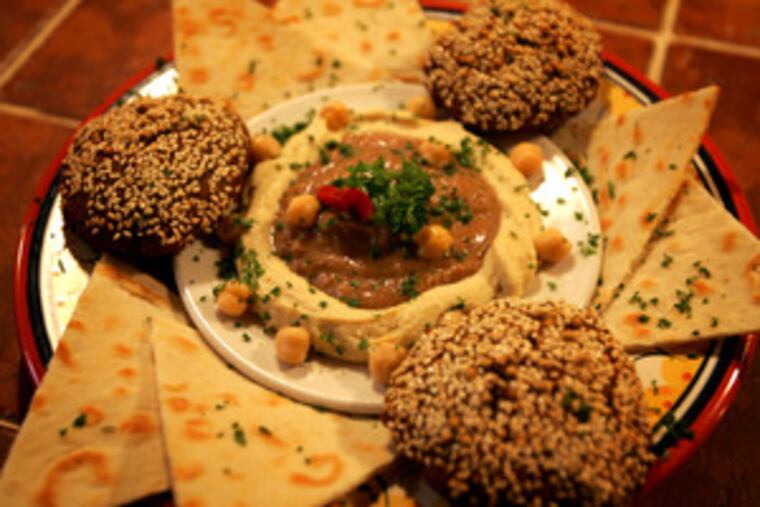
But a word here about Egypt's national dish, a fava bean dip called foule that years later brings a smile of recognition and sudden craving among immigrants who in their youth strolled past street vendors hawking fresh-made batches of the soupy stuff. Think of it as a black bean dip that went to finishing school; it is subtly seasoned with garlic and olive oil, loose in consistency and redolent of dried favas that have been rehydrated and then finely mashed. It makes hummus seem uncouth.
At Aya's, it is served with a fine-textured, almost airy Egyptian style of falafel, also made from fava meal (not chickpea flour) that is celery-green inside from fresh cilantro, green onion and basil. It is flatter than usual and oval, not a ball, its dark shell fried to a satisfying crispness and rolled in crunchy white sesame and coriander seeds.
Have Aya and her family been to the Tut exhibit? Not yet, says AlBasti. But in August they visited the antiquities museum in Cairo, and Aya loved the mummies, and riding horses in the desert to see the pyramids: "She's a natural," he says, a worthy cousin of Tut.