The most wonderful ham of the year
The Easter meat is a succulent treat, and must be worthy of the anticipation. So, do your hamwork.
For all of my childhood, the ritual Easter ham came bedded in gelatin in an aluminum can that had a key stuck to the bottom. There was a knack to threading the end of a strip of the can through the key's slot to wind it off and detach the top without slicing a finger.
Now I have a family member - my brother, Steven - who owns a smokehouse restaurant where he hickory-smokes more than 200 shank hams at Easter and 800-plus at Christmastime. He has caused the evolution of my clan's taste buds; we now think of canned ham as mere lunch meat.
On the rare Easter or Christmas that I neglected to mail-order a ham from Steve (or, shhhh, some other discriminating purveyor), I, like so many people, would stand bewildered in front of supermarket ham displays.
Ham isn't a meat most of us purchase by rote or with a confidence born of success. It's a treat, and we invest a lot of hope in its choice and preparation. People think about ham the way the overburdened parents of toddlers think of the rare movie in a theater that they've managed to sneak out to see: It better not be a clunker.
The first piece of advice usually given about finding a great cured back leg of a pig - this is what ham is, a salted, dry-rubbed or brined piece of pork - brings to mind the search for a good contractor or plumber: Get good references.
"We always get our hams from reliable butchers," says Ellen Yin, co-owner of the restaurant Fork and its gourmet market Fork: etc. on Market Street. The market's year-round best seller is hickory-smoked country ham from Lancaster County that's studded with cloves and draped in clover honey.
The ham has gained a stellar reputation among people who would rather trust Yin than themselves in picking a ham - and the many whose ovens cannot accommodate a whole ham's 10-to-20-pound size.
A second piece of advice is to eschew convenience and buy a ham with a bone in it. Yin does because she knows that meat, poultry and fish taste better when they are cooked on the bone. Yin said the marrow in the bone provides more flavor.
In her cookbook Bones (Morrow, 2005), Jennifer McLagan writes that "Meat cured on the bone has much more flavor. The finest hams always still have their bones. . . . [which] keep the ham moist and flavorful as it ages. So always choose a bone-in ham."
Cooks with limited carving expertise should opt for a shank-end ham. Easier to carve because it contains one bone, it's the part of the leg closest to the foot. The meat tends to have a sweeter flavor than the other part of the leg, the butt end.
A butt-end ham has a higher ratio of meat to bone, is fattier, and is harder to carve because it contains the hip and pelvic bones.
Of course, there is always spiral-cut ham, the bagged lettuce of the protein world. Carving being a bit of a lost art in America, spiral-cut ham is hugely popular. It is produced on an expensive machine on which a ham rotates around a blade to turn bone-in or boneless ham into a huge Slinky. These hams are then commonly coated with very sweet glaze and vacuum-packed for longevity.
One Easter I served a spiral-cut ham. Never again. I felt like a cheater. In addition, I come from a sugar-schizophrenic family that, although it cottons wholeheartedly to ketchup, doesn't like sweet glaze on meat products.
We prefer unglazed hams whose fatty surface caramelizes and engenders competition for pieces of the crisp outer coating.
But I've learned to temper my desire for such a crackly surface. Perhaps the biggest mistake people make is overcooking ham that is already fully cooked. Most ham cooks fail to understand that when it comes to the so-called city hams (see sidebar for definition of terms), and end up with a dried-out ham.
And, since ham tastes best at room temperature, the real purpose of putting most types in the oven is to set a glaze or coax the surface fat into that coveted salty crispness.
I've always thought that the low saltiness of my brother's country-style hams (again, see sidebar) relative to others had something to do with what happens at his shop. He explains that when a ham is overcooked, not only does the meat dry out, but the water content drops and the salt becomes more concentrated, resulting in a saltier taste. The more it is reheated or cooked, the saltier it will become. This is especially true for country-style hams, which contain very little added water.
A few final words:
For tips on the artistry of decorating ham with fruit such as pineapple rings and maraschino cherries as though it were an Easter hat, look elsewhere. Not to sound snooty, but that's a canned-ham thing.
Also, I have witnessed several ham and turkey carvings that could more properly be called massacres. One hacksaw job in particular caused a friend to turn away, muttering, "I just can't watch," as irregular shards of ham flew willy-nilly.
Consider buying an electric knife. You will think you have turned into your father, but a kitchen buzz saw helps eliminate the horror of it all.
BBQ mama chooses to pick ham
If you've ever dreamed of doing a job that is unusual, intensive, tasty, aromatic and, OK, hellish - pick a ham. I should know. Some weeks, I pick at least 30 pounds of ham.
By "pick" I don't mean "select." That's easy compared to what I do.
My youngest son, Steven Gemperlein, owns Porky's Smokehouse, a deli/restaurant north of Pittsburgh where he smokes hams, turkeys and cheese. Patrons adore his hams and sandwiches with picked ham doused in pungent barbecue sauce.
Ham barbecue sandwiches have a bit of history in my family. When my children were young, their father would travel to the now-defunct Isaly's in Kittanning every Sunday after Mass to buy piles of what is known in the Pittsburgh area as "chip-chopped ham." Essentially, this was ham shaved so thin you could almost see through it. Lots of people in western Pennsylvania, including my family, used tangles of chip-chopped for sandwiches. They also often doused it in barbecue sauce and served it on rolls.
Steven's sandwiches are related to this childhood favorite, but they definitely are its difficult kin.
This is because smoked ham does not miraculously appear shredded, and no machine can do the job. And, unlike fresh pork, a smoked ham does not fall apart after long cooking. This is where pickers come in.
Steven has had other pickers. One elderly lady consented and picked many hams, but she died a while ago. (No connection to the ham.) To be honest, nobody really likes the job.
Let me tell you why this is.
"Picked" ham should not be confused with chopped or minced ham. Picked ham gives an entirely different texture to a sandwich. Unfortunately, it is much harder to achieve.
The process begins after the ham is well-smoked and cool enough to handle. To pick a ham properly, it must first be cut in half and the fat removed. I carefully cut off the rind to get a better look at the grain of the ham because, unlike other methods of cutting meat in which the cutting goes against the grain, picked ham must be in strings.
Pulling the ham apart with the grain is essential to the success of barbecued ham sandwiches. Using paring knives and/or forks, I pull, or "pick," with the grain to achieve those threadlike pieces.
It can take hours to pick a whole ham. Many hams are nasty, with spots that refuse to be picked apart. I rage at them.
So why, at age 77, do I pick ham? He is my son.
What's a mother to do?
Glazed Country Ham
Makes 18 to 22 servings
EndTextStartText
1 hickory-smoked country ham shank bone-in, fully cooked, 16 to 18 pounds (preferably from Lancaster County)
1 cup clover honey
20 to 50 whole cloves
EndTextStartText
1. Heat the oven to 375 degrees. Using a pastry brush, brush honey onto the ham. Insert cloves in the outside of the skin.
2. Bake the ham until glazed golden-brown, 20 to 30 minutes.
Editor's note: The directions above are for glazing a fully cooked ham that will be served warm, but basically at room temperature. To heat the ham through, wrap it in foil (to retain moisture) and bake it at 325 degrees for 12 minutes per pound (3 to 31/2 hours) or until a meat thermometer registers 130 degrees. Then set the oven to 375 degrees, baste the ham with honey, and roast until glazed, about 20 minutes more. Let the ham stand 10 minutes before slicing. This allows the meat juices to settle and the internal temperature to rise on residual heat to 140 degrees, as recommended by the USDA.
Per serving: 363 calories, 47 grams protein, 16 grams carbohydrates, 13 grams sugar, 12 grams fat, 172 milligrams cholesterol, 3,652 milligrams sodium, trace dietary fiber.
EndText
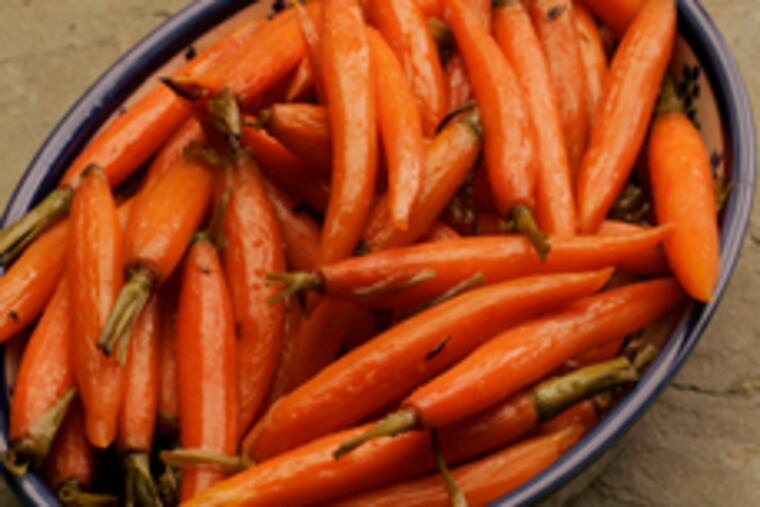
Honey Glazed Carrots
Makes 10 to 12 side-dish servings
EndTextStartText
3 to 4 pounds baby carrots
Salt and freshly ground black pepper, to taste
½ to 1 cup clover honey
EndTextStartText
1. Heat the oven to 375 degrees. Bring a pot of salted water to a rolling boil and blanch the carrots for 4 to 5 minutes.
2. Drain carrots in a colander and place in a single layer in a baking pan. Season with salt and pepper, to taste.
3. Brush the carrots liberally with honey and bake until the honey has caramelized, 7 to 8 minutes.
Per serving: 53 calories, 1 gram protein, 12 grams carbohydrates, 7 grams sugar, 0.2 gram fat, no cholesterol, 60 milligrams sodium, 4 grams dietary fiber.
EndText
Hot Cross Buns
Makes about 12 buns
EndTextStartText
For the Buns:
2/3 cup whole milk
1/2 ounce active dry yeast
1/4 cup granulated sugar
2½ cups all-purpose flour
½ teaspoon ground cinnamon
¼ teaspoon grated nutmeg
1 large egg, beaten
1 cup golden raisins
Grated zest of 2 oranges
1 teaspoon salt
3 tablespoons butter, cut up
For the Glaze:
1 cup confectioners' sugar
2 tablespoons lemon juice
EndTextStartText
1. Butter a round 8- or 9-inch baking pan and line with parchment. Wipe a nonmetal bowl with oil.
2. For the buns, in a mixer bowl, using the dough hook at low speed, combine the milk, yeast, sugar, flour, cinnamon, nutmeg, egg, raisins and orange zest. Let the dough rest for 2 minutes. Add the salt and butter. Knead at medium speed until the dough is well mixed and smooth, about 5 minutes.
3. Put the dough in the oiled bowl. Cover with plastic wrap or a towel and let stand until doubled in size, about 1 hour.
4. Heat the oven to 350 degrees. Divide dough into 12 equal pieces, forming small balls. Place the balls in the buttered pan. (It's OK if they touch.) With a sharp or serrated knife, carefully slash a cross on the top of each bun.
5. Bake at 350 until buns are golden brown and begin to pull from the side of the pan, about 20 minutes.
6. For the glaze, mix the confectioners' sugar and lemon juice to make a thick, syrupy frosting.
7. Move the pan to a rack to cool before removing the buns. Drizzle the glaze onto each bun along the lines of the cross.
Per bun: 231 calories, 5 grams protein, 45 grams carbohydrates, 13 grams sugar, 4 grams fat, 27 milligrams cholesterol, 228 milligrams sodium, 2 grams dietary fiber.
EndText
.