Clambake, hold the sea
A cozy home party with a salty air of fun awaits when you grill up the clambake goodies in your own backyard.
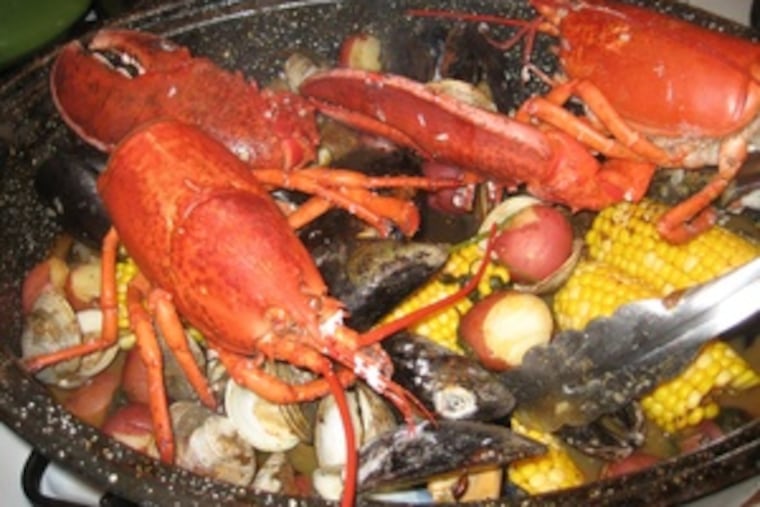
A true clambake on the beach is one of the most glorious food memories ever: the salty sea air rich with the smell of clams and corn and lobster steaming over hot rocks and seaweed in a pit dug in the sand.
"It is the great American cookout," says Jasper White, a clambake connoisseur, who grew up on the Jersey Shore and now runs restaurants in New England that specialize in that ancient tradition.
But the clambake's allure holds up even without the romance of the sun setting on the beach: "You've got the lobster, the corn, the potatoes - those ingredients are all so beautiful, and when all of those flavors mingle together, that is what summer cooking is all about," says White.
If you've ever partaken of or simply yearned for the clambake experience but thought there was no way you could pull it off, keep reading.
You need not travel to the beach, or dig a sandpit in your yard. A realistic clambake, salty sea smell included, is possible - with all the ingredients steamed in a roasting pan - right on your backyard grill or even on your kitchen stove. A clambake is, after all, just a huge one-pot meal, one that cooks happily and heartily on its own.
And what better way to celebrate Father's Day than to host a clambake in Dad's honor?
In Mastering the Grill: The Owner's Manual for Outdoor Cooking (Chronicle, $24.95), authors Andrew Schloss and David Joachim adapt the classic clambake for a backyard cookout, using a grill and rehydrated seaweed.
And Jasper White shares his "indoor clambake" technique in The Summer Shack Cookbook: The Complete Guide to Shore Food (W.W. Norton, $35). Based on the system used to produce up to 100 portions at a time at his restaurants, White's method does clambake in large pots on the stove-top.
We opted for the backyard grill to try our own clambake, because, all due respect to Mr. White, I really didn't want to do my first clambake on the kitchen stove. I adapted the Mastering the Grill recipe for a gas grill and it was a total hit.
On a lovely summer evening, it is a perfect outdoor supper to share with friends, as you can do most of the prep work in advance and then relax and visit as dinner simmers on the grill.
And not much else is needed to round out the meal, although one friend did bring homemade coleslaw, which was just the right complement.
The key to success is to prepare all the ingredients early: Peel and chop the onions, slice the chorizo sausage, husk and halve the corn, parboil the new red potatoes, and soak and rinse the shellfish. (And, yes, I admit, I was a wimp and had my seafood purveyor kill and clean the lobsters just hours before we ate.) All the ingredients should be ready to go before you light the grill.
After the grill is good and hot, put a few inches of water into the roasting pan and add the dried seaweed. Once the water boils, layer in the corn, onions and chorizo, and give it all a generous sprinkling of Old Bay seasoning. After about five minutes, add the potatoes, and then the clams and mussels.
In the meantime, bring pots of water to boil in the kitchen for the lobster. (I would have steamed the lobster on the grill as well, but there just was not enough room in the pan for six 11/2-pound lobsters, so they had to be cooked separately.)
Schloss and Joachim's recipe calls for 1 to 11/2 hours on the grill, but since I parboiled the potatoes, and cooked over a hot grill, I was able to reduce the time to about 15 minutes, just enough to cook the corn. The clams and mussels steamed open in less than 10.
The resulting feast was a brilliant treat for all the senses, the bright-red lobster shells glowing against the yellow corn and black mussels. The melange of flavors was absorbed in all the ingredients, each resonating with a taste of the sea, the peppery chorizo, and the zing of the Old Bay.
One guest who grew up in Maine, and even served a clambake at his wedding on the beach, applauded the kick from the chorizo and Old Bay: "The only spice we used in New England was butter," he said. "That is a nice addition."
The clambake has been around for 10,000 years, originating with American Indians cooking lobster and corn in seaweed in a pit on the beach, said Jasper White.
"It is a really special dinner," says White, whose popular catering company and Summer Shack restaurants serve thousands of clambakes each month. "It's festive, but it is not at all fancy."
And there is no reason not to carry on this most American of traditions just because you're not near a beach. Re-create it in your own backyard, and as you savor that buttery lobster and the corn dusted with Old Bay, you may just be able to imagine the salty sea breeze and the waves lapping on the shore.
Clambake on the Grill
Makes 10 to 12 servings
EndTextStartText
3 ounces dried kombu (kelp) seaweed (see Note)
8 ears fresh corn, shucked, halved crosswise
12 ounces cured Portuguese linguica or Spanish chorizo, sliced 1/2-inch thick
2 onions, peeled, cut into
8 vertical sections leaving root end intact
1 tablespoon or more to taste crab-boil spices (Old Bay) or sea salt
6 live lobsters, 1 to 11/2 pounds each
3 pounds small red-skinned
or new potatoes, scrubbed and parboiled 10 minutes
3 dozen littleneck or small cherrystone clams
3 dozen mussels, scrubbed and debearded (see Note)
1 bunch flat-leaf parsley
1/2 pound (2 sticks) butter, melted
2 lemons, cut into wedges
EndTextStartText
1. Heat the grill until hot. Pour 2 inches of water into a roasting pan, add half of the dried seaweed, cover with a lid or aluminum foil, and bring to a boil on the grill.
2. Meanwhile, on the kitchen stove, divide the remaining seaweed in 2 large pots with a few inches of water. Bring to a boil in preparation for steaming the lobsters.
3. To the boiling water on the grill, add the corn, chorizo, onions and spices. Cover and cook 5 minutes.
4. When water for the lobsters boils, add the lobsters and cook until the shells are bright red, 8 to 12 minutes.
5. Back on the grill, add the potatoes, clams, mussels and parsley to the pan. Cook until the potatoes are tender and the clams and mussels open, about 10 minutes.
6. Remove the roasting pan from the grill. Transfer the contents to a large serving platter.
7. Take the lobsters from the pot and cut them (in the shell) in half or in serving pieces: claws, tail and body.
8. Add the lobsters to the serving platter.
9. Serve with ramekins of melted butter and bowls of lemon wedges for dipping and squeezing.
Note: Dried seaweed can be found at Asian markets and some large supermarkets. (I found it at Wegmans.)
Per serving (based on 12): 727 calories, 79 grams protein, 39 grams carbohydrates, 5 grams sugar, 28 grams fat, 363 milligrams cholesterol, 1,464 milligrams sodium, 4 grams dietary fiber.EndText