Film food: No faking it
For "No Reservations" and even the animated "Ratatouille," filmmakers go to great gourmet lengths to make it all look and taste just right.
The first time director Scott Hicks walked into the busy kitchen of Fiamma Osteria in New York to research No Reservations, he was in shock.
"There were huge boiling pots; there were fires; there was heat. And the noise level . . . I thought . . . this is total chaos!"
But eventually he learned that what looked chaotic was really a structured, albeit frenetic, system, all orchestrated by the executive chef.
"I wanted to learn every nuance of a restaurant kitchen because I would be re-creating a world," Hicks says.
It also helped him understand that pressure and perfectionism were part of the job of his executive chef, Kate, played by Catherine Zeta-Jones.
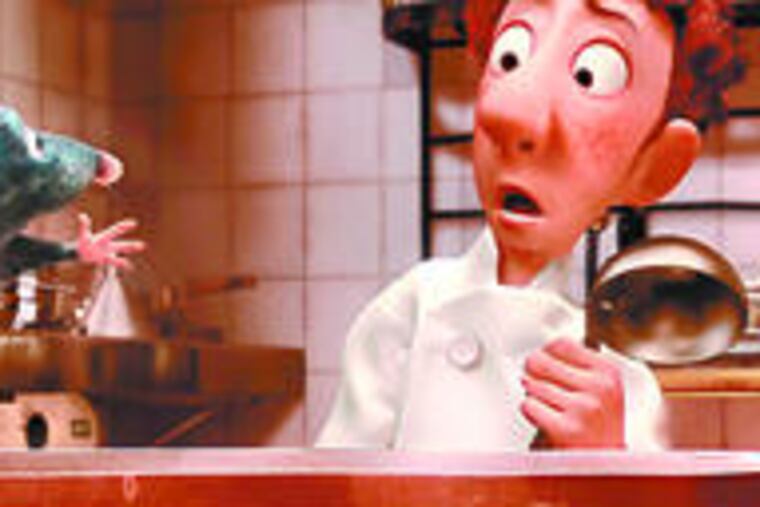
Likewise, even though Ratatouille is an animated children's movie, the filmmakers wanted to accurately portray the kitchen and formal dining room of one of the finest restaurants in Paris - because today, even some 10-year-olds and many parents do know the difference.
Pixar sent the film's executives to the French capital for a taste of venerable establishments such as Guy Savoy and Taillevent, where they studied up close how these classic kitchens work. But it didn't stop there.
Thomas Keller, perhaps America's most esteemed chef, was brought on as "production executive chef," tutoring the executives at his restaurant, the French Laundry in Yountville, Calif. And the entire animation department, 50 strong, was sent to an intensive set of cooking classes.
Indeed, producers and directors are working much harder these days to create authentic restaurant food and kitchens, as more and more moviegoers have become savvy and even passionate about food.
"In the early films, food was used primarily as props," says Steve Zimmerman, author of Food in Movies. "Lighting was poor, they didn't know how to make food look glamorous. . . . There wasn't an audience for food in film."
Along with the popularity of food magazines, celebrity chefs and, of course, the Food Network, he says: "Directors and producers take much more pride in authenticity today."
So when Reservations director Hicks wanted a five-star French restaurant menu, he called upon Lee Anne Wong, executive chef at the French Culinary Institute in Manhattan, to audition her signature dishes: entrees like seared diver scallops with saffron emulsion and black truffle jus, butter-poached lobster with creamy lobster nage.
When the film went into production, prop master Diana Burton's job was to reproduce each dish at least 15 times, using all the tricks of her trade. Even though she gathered quail, sea bass and truffles from the finest purveyors in New York, it didn't matter what it tasted like. It just had to look beautiful for a matter of minutes under the bright lights.
Hicks also wanted the actors to taste the fine French creations, so they could play their roles with authenticity. So Burton, fresh off a season serving manicotti and cannoli to Tony Soprano, re-created Wong's haute cuisine and served it to the stars, so the essence of saffron and kaffir lime and quail and black truffles would be embedded in their memory.
"In the film when I was begging Kate to tell me the secret of her saffron sauce, I felt a sense of urgency because I had just tasted this unbelievable flavor," says Aaron Eckhart, who plays her sous-chef, Nick. And the look of pure ecstasy on Kate's face after Nick served her a plate of real tiramisu defied even the best method acting.
In order to play an executive chef and a sous, the actors spent months in the kitchens of Josiah Citrin, chef/owner of Melisse French restaurant in Santa Monica, and Michael White at Fiamma.
They showed Eckhart how to keep his knuckles back when using a knife so he wouldn't cut his fingers, and how to bend his knees so his back wouldn't give out after long hours on the unyielding concrete floor of the professional kitchen.
"I practiced at home," Eckhart said. "It seems like the hardest job in the world because you have to be so precise. Catherine is definitely the better cook; she loved buzzing around the kitchen. Of course, she's the executive chef."
Zeta-Jones, who barely knew where the kitchen was before making the film, spent long days with White in his kitchen. She also waited tables at Fiamma on a busy Saturday.
"Sometimes she'd be annoyed. 'Some people are so rude,' she'd tell me."
But not everybody. After she presented one customer with his order of lamb, he looked up at her intently: "You know, you look a lot like Catherine Zeta-Jones."
Cool as a cucumber, she replied, "You know, I get that all the time."
But even though they strove for authenticity, looking good still won out at times: A plump squab was substituted for a puny quail in the signature dish, and Zeta-Jones handled pans without unsightly towels.
Of course, there weren't actors to train to cook in the animated Ratatouille, but there was a huge upscale restaurant kitchen with everything mise en place and the beautiful French food to re-create.
As Keller prepared each dish in his kitchen, the artists would animate the process for their celluloid chefs, Colette and Linguini. The digitized version of the real thing was shown to Michael Warch, manager of the sets and layout department and a professional chef in his own right. He would give notes on culinary accuracy and then the animators would go back to the drawing board. No fuss. No muss. No more cooking.
Until it came to animating the film's signature dish - ratatouille.
Because the writer had given the simple peasant dish a very special place in the plot, this was the recipe they had to get just right. And if anyone was a ratatouille expert, with zucchini, tomatoes and eggplant growing in his own garden, it was Keller. He had cooked this dish for his family and his restaurant hundreds of times.
But no matter how artistically he arranged the vegetables and how delicious it actually tasted, this vegetable stew - which can feed six people for under $5 - looked like a drab, boring moosh on film. Even Warch, who had earned the credit production sous-chef, couldn't find a solution.
And then it happened. Without the magic of the movies, just the ingenuity of the cook, Keller began creating a summer vegetable sculpture.
In the film, it was responsible for turning around a fading restaurant. On screen, its veggie beauty made a whole nation of moviegoers dizzy with desire and ravenous to taste it themselves.
Remy's Ratatouille (Confit Byaldi)
Makes 4 servings
EndTextStartText
1 layer prepared Piperade (see recipe)
1 medium zucchini (4 to 5 ounces) sliced into 1/16-inch-thick rounds
1 Japanese eggplant (4 to 5 ounces) sliced into 1/16-inch-thick rounds
1 yellow (summer) squash (4 to 5 ounces), sliced into 1/16-inch-thick rounds
4 Roma (plum) tomatoes, cut into 1/16-inch-thick rounds
1/2 teaspoon minced garlic
2 teaspoons extra-virgin olive oil
1/2 teaspoon fresh thyme
Kosher or coarse sea salt Freshly ground black pepper
For the Vinaigrette:
1 tablespoon extra-virgin olive oil
1 teaspoon balsamic vinegar
Fresh herbs (thyme flowers, chervil, thyme)
EndTextStartText
1. Have the piperade layer ready.
2. Arrange the zucchini, eggplant, squash and tomato slices over the piperade: Begin by alternating 8 slices of the 4 vegetables down the center (in the skillet). Overlap slices so that 1/4-inch of each is exposed. This will be the center of the spiral. Around the center strip, overlap more slices in a close (tight) spiral that lets them mound slightly toward the center (all may not be needed). Set aside.
3. In a small bowl, mix the garlic, oil and thyme; season with salt and pepper to taste and sprinkle over vegetables.
4. Cover skillet with aluminum foil; crimp the edges to seal. Bake in 275-degree oven until the vegetables are tender when tested with a paring knife, about 2 hours. Uncover; bake 30 minutes more. Cover loosely with foil if vegetables start to brown.
5. If there is excess liquid in pan, place it over medium heat on stove to reduce. (At this point it may be cooled, covered and refrigerated for up to 2 days. Serve cold or reheat in 350-degree oven until warm.)
6. For the Vinaigrette, in a small bowl whisk together the reserved tablespoon of Piperade, 1 tablespoon olive oil, the vinegar, herbs, and salt and pepper to taste.
7. To serve, heat the broiler and put skillet under it to lightly brown the vegetables. Cut into quarters and lift very gently onto plates using an offset spatula. Turn spatula 90 degrees as you set the food down, gently opening the spiral in a fan shape. Drizzle Vinaigrette around each plate.
Yountville, Calif.
Note:
If desired, layer the vegetables in easier stripes.
Per serving: 184 calories, 4 grams protein, 16 grams carbohydrates, 9 grams sugar, 13 grams fat, no cholesterol, 15 milligrams sodium, 5 grams dietary fiber.
EndText
Piperade for Remy's Ratatouille
Makes the bottom layer of recipe for 4 servings
EndTextStartText
1/2 red bell pepper, seeds and ribs removed
1/2 yellow bell pepper, seeds and ribs removed
1/2 orange bell pepper, seeds and ribs removed
2 tablespoons extra-virgin olive oil
1 teaspoon minced garlic
1/2 cup finely diced yellow onion
3 tomatoes (about 12 ounces total), peeled, seeded and finely diced (reserve juices) 1 sprig fresh thyme
1 sprig flat-leaf parsley
1/2 bay leaf
Kosher or coarse sea salt
EndTextStartText
1. Heat oven to 450 degrees. Line baking sheet with foil.
2. Put peppers on lined sheet, cut side down. Roast until skins loosen, about 15 minutes. Remove peppers from oven. Reduce oven temperature to 275 degrees.
3. When peppers are cool enough to handle, peel and discard the skins. Chop the peppers fine and set aside.
4. In medium skillet, heat the oil. Saute the garlic and onion on low heat until very soft but not browned, about 8 minutes. Add the tomatoes and juices, thyme, parsley and bay leaf. Simmer gently over low heat until very soft with little liquid remaining, about 10 minutes. Do not brown.
5. Add the reserved chopped peppers and let simmer to soften them. Remove and discard the herbs. Season with salt, to taste. Reserve a tablespoon of the mixture. Spread the remainder in the bottom of an 8-inch ovenproof skillet.
6. Proceed with recipe for Remy's Ratatouille.
Yountville, Calif.
Per serving:
101 calories, 2 grams protein, 9 grams carbohydrates, 5 grams sugar, 7 grams fat, no cholesterol, 7 milligrams sodium, 2 grams dietary fiber.
EndText
Quick Linguini Sauce a la Nick
Makes 6 servings
EndTextStartText
11/2 pounds linguini
1/4 cup extra virgin olive oil
2 cups coarsely chopped yellow onions
6 cloves garlic, minced
2 bay leaves
1 teaspoon dried oregano
4 cups ripe, fleshy tomatoes, peeled, coarsely chopped
2 tablespoons dry red wine or to taste
1/2 to 1 teaspoon crushed red pepper, to taste
2 teaspoons sugar
Salt and pepper to taste
1/4 cup julienned basil leaves
1 cup grated Locatelli or Parmesan cheese (about 4 ounces)
EndTextStartText
1. Bring a large pot of salted water to a boil, add the pasta, and cook until tender but firm (al dente).
2. Meanwhile, in a stainless or enamel-coated frying pan, heat the oil hot. Reduce heat to medium and saute onions until translucent, about 1 minute. Add garlic, bay leaves, oregano and tomatoes. Saute until soft, about 20 minutes.
3. Add the wine, red pepper, sugar, salt and pepper to taste. Cook over medium heat for about 10 minutes more.
4. When done, drain the pasta. Put it in a ceramic bowl, add the sauce, and toss to coat pasta.
5. Just before serving, sprinkle basil over top. Pass with the grated cheese for sprinkling.
from her grandmother's recipe in Naples, Italy
Per serving:
620 calories, 22 grams protein, 99 grams carbohydrates, 7 grams sugar, 16 grams fat, 12 milligrams cholesterol, 253 milligrams sodium, 7 grams dietary fiber.
EndText
Scallops With Saffron Sauce
Makes 4 servings
EndTextStartText
For the Scallops:
1 cup all-purpose flour
2 teaspoons seasoning salt
1/2 teaspoon dried oregano
1 teaspoon dried thyme
2 tablespoons lemon pepper
16 sea (or 1 pound bay) scallops, rinsed, drained
2 tablespoons olive oil
1/3 cup fresh parsley, minced
1 tablespoon fresh lemon juice, plus 1 teaspoon
For the Saffron Sauce:
1/2 cup finely minced shallots
4 Kaffir lime leaves, finely chopped (see Note)
1/2 cup dry white wine
A pinch of saffron threads
1 tablespoon heavy cream
1 stick cold butter, in pats
2 teaspoons fresh lemon juice
Salt and white pepperEndTextStartText
1. For the Scallops, in a bowl, mix flour, salt, oregano, thyme and pepper; roll the scallops in it to coat all lightly.
2. In a large skillet, heat the oil on high. Sear 4 scallops at a time (about 2 minutes on each side). Remove scallops to a plate; keep warm until served. Repeat 3 times to cook remaining scallops. Toss with parsley and lemon juice.
3. For Saffron Sauce, in a heavy pan on medium heat, reduce shallots, lime leaves and wine to 2 tablespoons.
4. Add saffron and cream. On medium-high heat, whisk in the butter, a pat at a time, adding the next before the last has completely melted. Stir constantly. Do not boil.
5. Add the lemon juice, salt and pepper, to taste. Serve the scallops with sauce poured over top.
Note: Asian and high-end markets stock Kaffir lime leaves.
Per serving: 450 calories, 21 grams protein, 17 grams carbohydrates, 1 gram sugar, 31 grams fat, 104 milligrams cholesterol, 586 milligrams sodium, 1 gram dietary fiber.
EndText
Traditional Ratatouille
Makes 8 servings
EndTextStartText
1 large eggplant (or 2 smaller ones), peeled
2 medium zucchini
1 or 2 green bell peppers
1/4 cup olive oil or as needed
1 yellow onion, sliced thin
2 cloves garlic, minced
2 firm ripe tomatoes, chopped (reserve seeds and juice)
2 tablespoons minced basil, oregano, marjoram or a mix
2 tablespoons chopped
parsley (optional)
Salt and pepper, to taste
EndTextStartText
1. Cut the eggplant, zucchini and pepper in cubes or strips (1/2-inch dice or 3-by-1/2-inch julienne); set aside.
2. Heat 2 tablespoons of the oil in a large skillet over medium heat. Saute the eggplant until it begins to brown. Remove from pan and reserve.
3. In the pan, heat remaining oil. Add the onion, zucchini and peppers. Cover, reduce heat, and cook 10 minutes.
4. Add the garlic and tomatoes; cook 5 minutes. Add the reserved eggplant and the herbs. Cook until all vegetables are tender, about 10 minutes. Season with salt and pepper.
5. Serve hot or at room temperature.
Per serving: 218 calories, 96 grams protein, 12 grams carbohydrates, 5 grams sugar, 6 grams fat, no cholesterol, 10 milligrams sodium, 5 grams dietary fiber.
EndText