AFTER JUST 10 minutes with Hardy von Auenmueller, acting president of the German-American Society of Pennsylvania, you wonder why Philadelphia doesn't taste a little bit more, well, German.
After all, it wasn't just the English and Swedes who settled here in the 17th century.
"Two hundred and fifty years ago, when Philadelphia's population was 20,000, at least 9,000 of the people were from Germany," von Auenmueller said. Today, more than a third of the city's population has German roots.
"Even the mayor has said he has German ancestors," he said.
German contributions to the city are plentiful, von Auenmueller noted, in the arts (the Wanamaker eagle was sculpted by a German); music (the last two conductors of the Philadelphia Orchestra); business (Rohm & Haas Co., Merck & Co. Inc.) and medicine (Hahnemann University Hospital, Lankenau Hospital). But take a look at the local restaurant scene, and what kind of international cuisine do you find? French, Asian, Mexican, Mediterranean, even Belgian. The city has exactly one German restaurant, Ludwig's Garten on Sansom Street, and it's known more for its beer than its spaetzle.
This in a town where Franklin once remarked, "America cultivates best what Germany brought forth."
This weekend, von Auenmueller and others who proudly call themselves German-Americans are hoping to make Philadelphia a German town once again. They've scheduled a weekend of festivities throughout the region in preparation for next year's 325th anniversary of the arrival of Germans in Philadelphia. In 1683, German lawyer Daniel Pastorius purchased 15,000 acres from William Penn and laid out the settlement of what would become known as Germantown.
Naturally, the classics - wursts and sauerkraut and big, meaty hunks of pork - will be part of the festivities. If you're going to do it yourself, that means you've got to head up to Fox Chase for the region's best German-foods market, Rieker's Prime Meats.
The 35-year-old business is one of the city's culinary wonders. Step inside the door off Oxford Avenue and your senses are assaulted with a waft of aroma and flavor on a par with South Philly's DiBruno's cheese shop.
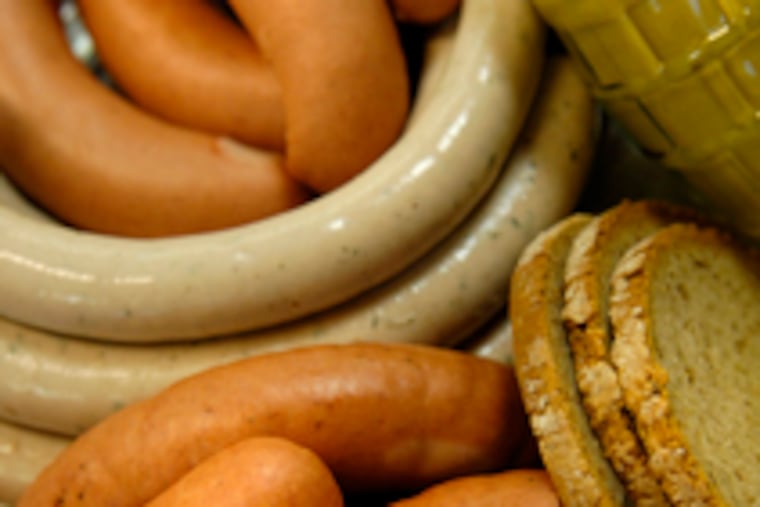
This is more than a deli - it's a kitchen. Specialty ready-cooked dishes, including sauerbraten, maultaschen and spaetzle, are prepared daily. Classic sausages are stuffed in natural casings and smoked in a back room. The bologna is honest beef, pork and veal with no filler or added salt to retain water.
The rouladen is the way they make it back in Germany: sliced beef coated with mustard, then rolled with diced pickles and onions and cooked in a dark, brown gravy. You can pick up ready-made sauerkraut, or Rieker will tell you the secret to perfecting your own: Add a shredded raw potato to soak up the liquid and produce a creamy texture.
"You ask for veal sausage, I ask you what kind," said Marcus Rieker, the owner's son. "We do four different kinds, depending on the season." Bratwurst, knackwurst, bockwurst . . . pile on the sauerkraut and get me a beer!
The wurst image
Maybe that's part of the reason for the dearth of local German eateries: The cuisine has an image problem. It's country fare - hulking, high-fat, diet-be-damned dishes of meat and cabbage.
But as Walter Staib, the chef at City Tavern, points out, there's much more to German food than pork knuckles. Staib, who was raised in Germany and received his early culinary training in his family's gasthaus, is the author of the author of the eye-opening "Black Forest Cuisine: The Classic Blending of European Flavors" (Running Press).
The book, published last year, offers a surprisingly diverse variety of foods you'd never associate with Germany.
Steak tartare, lentil salad, poached salmon - they're dishes that you'd expect to find in a trendy Walnut Street restaurant. His paupiette is lighter than the classic French version; instead of beef wrapped in bacon, it's thinly sliced brook trout tied with a strip of green leek. A delicate dish of sweetbreads in saffron-cream sauce would not look out of place at Le Bec-Fin.
"Most people," said Staib, "think German food is exclusively what you get for Oktoberfest." Indeed, the party atmosphere of beer halls is one where bellies are held by suspenders, and countless liters of lager are soaked up by cabbage, dumplings and sausage.
"That's Bavaria," said Staib. "The cuisine in the Black Forest differs the same way the food differs between Rome and Tuscany in Italy."
Bordering Switzerland and France, the Black Forest region in Germany's southwest is influenced by cuisines that are decidedly lighter. A green bean salad might use haricots verts instead of string beans. Venison is treated to a splash of cognac.
But what about the sausage and cabbage?
Staib doesn't shy away from it. In fact, he does his shopping up at Rieker's.
But when those traditional German meats make their way into his recipes, they don't seem to overwhelm the palate. Even bologna and cheese - the kind of plate you'd expect to find at an Eagles tailgater - is light enough for a café lunch when it's diced into a mustard vinaigrette and served on a bed of lettuce.
Can Philadelphia be a German town again? Maybe not, but I'd settle for the Black Forest.
Rieker's Prime Meats, 7979 Oxford Ave., Philadelphia, 215-745-3114. If you're not confident enough to tackle Staib's Black Forest recipes, a complete, ready-to-eat Oktoberfest special, including sausages, meats, spaetzle, sauerkraut and bread, is available at Rieker's for takeout, just $5.95 a person, with a minimum order of 10 people.