Spicing it up: Pickled ginger adds a light, bright snap
I've discovered that pickled ginger has a life beyond sushi (where it is properly called gari): It is an excellent ingredient, even when a recipe has no Japanese bent.
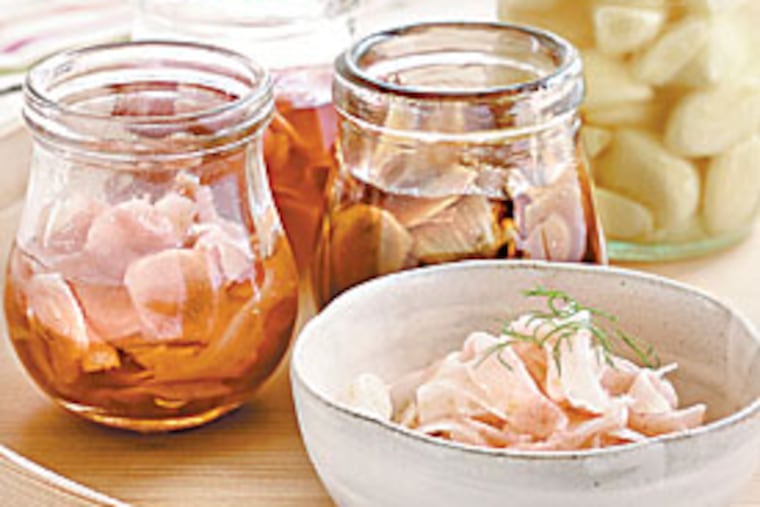
I've discovered that pickled ginger has a life beyond sushi (where it is properly called
gari
): It is an excellent ingredient, even when a recipe has no Japanese bent.
Since it doesn't show up often as a component in dishes - even in Japan - it can be mysterious, too. Many people are unable to figure out what their taste buds are reading as sweet, pungent and salty all at the same time. They are delighted when told that what they taste is something they have previously only seen as a pretty-in-pink tangle on their sushi plates.
Pickled ginger becomes especially useful as fall's produce creeps into markets, because it brings light, bright notes to squash, rice, pasta, leafy greens and other food associated with throwing a log on the fire.
Gari is a type of tsukemono, which are Japanese pickled vegetables that originated perhaps 1,500 years ago in snowy mountain villages where denizens needed to preserve their summer and fall harvests over the long winters.
Of tsukemono, Donald Richie, an author who focuses on Japanese culture, has written: "Even in the dead of winter, one bite and you are in full summer again."
Not all sushi eaters realize that gari is meant to be enjoyed on its own, between bites of sushi and sashimi to cleanse the palate so that a diner is more able to appreciate the subtle flavor differences of fresh, raw fish.
I used to find bargain bags of pickled ginger at my local Asian market, but they have disappeared of late, so I am back to buying multiple 12-ounce jars - or making it myself on the increasingly rare occasions when I've thought ahead and am feeling domestic to the nth degree.
Surprisingly, pickled ginger is really quite simple to make, and requires only five ingredients: fresh young ginger root, salt, rice vinegar, water and sugar.
The first step is to clean a large piece of ginger with a damp cloth and sprinkle it with salt. After sitting overnight, the knob is sunk, uncut, into a solution made with the other ingredients and left to bathe in it for at least a week. It should be shaved across the grain into its characteristic paper-thin slices only when it is needed.
Although some commercial pickled ginger does contain food coloring, its pink color is the result of a chemical reaction between the ginger and brine.
Regarding the brine: Never, never let it go down the drain. It's loaded with flavor and works wonders on rice, pasta, salad dressings and cooked vegetables such as spinach. In fact, I often emulsify an entire jar of pickled ginger in a blender or food processor and use the resulting slurry to flavor vinaigrettes, dips for dumplings or vegetables and sauces. The puree or the juice blends effortlessly with pan drippings from roast duck, chicken, pork or ham.
Look for gari in the refrigerated section of Asian markets or unrefrigerated in the international food aisles of grocery stores. (But don't confuse it with ben, or beni shoga, which is sold in similar glass jars. Beni shoga generally comes in small sticklike pieces and is deep pink to red. It is ginger pickled in plum vinegar and red shiso leaves. A garnish, it is sweeter than gari. It also leaches its color, creating, for example, a red rice salad.)
Eric Gower, author of The Breakaway Cook and The Breakaway Japanese Kitchen, also considers pickled ginger an essential pantry item. He serves it with grilled fish, julienned and sprinkled on salads, and in recipes.
He also pickles ginger in fruit-based vinegars such as cherry, fig, balsamic and persimmon using this recipe (in which no salt is involved):
Bring two cups of water to a boil in a small saucepan; add one cup of very thinly sliced ginger and blanch it for a minute. Drain the ginger and put it into a container with a tight-fitting lid. In the saucepan, heat a cup of flavored vinegar with two tablespoons of honey until it barely simmers. Stir, and then pour it over the ginger in the jar. It can be refrigerated for up to six months.
The recipes show how pickled ginger performs in a variety of ways - as a rice dish that is clamored for at our swim-team concession stand; as a unique, delicious edamame dish created by Gower; as something to enliven cooked green beans; and as a vinaigrette. The pink stuff has become so integral to my repertoire that I'm never without a jar in my refrigerator.
Pickled Ginger
Makes 1 pound
EndTextStartText
1 pound fresh young ginger
1 tablespoon salt
2 cups rice vinegar (unseasoned)
1 cup water
6 tablespoons sugar
EndTextStartText
1. Wipe the ginger with a damp towel. Sprinkle it with the salt, place it in a dish and let it sit overnight.
2. Mix the vinegar, water and sugar in a deep jar. Place the salted ginger in the mixture for at least a week, refrigerated. It will keep for months.
3. To serve, slice it across the grain with a very sharp knife.EndText
Gingered Green Beans
Makes 4 servings
EndTextStartText
1 tablespoon unsalted butter
1 tablespoon extra virgin olive oil
1 pound green beans, trimmed
Generous pinch of freshly ground black pepper
½ cup julienned pickled ginger
1 tablespoon soy sauce
2 tablespoons fresh orange juice
EndTextStartText
1. Melt the butter with the olive oil in a chef's pan or wok over maximum heat.
2. Add the beans and pepper, and cook, shaking the pan or stirring often, until they start to brown, about 5 minutes.
3. Stir in the ginger, soy sauce and orange juice. Reduce heat to medium-low. Cover and cook until beans are tender, about 7 minutes. Uncover and cook until liquid disappears.
4. Transfer to a warm serving bowl and serve.
Per serving:
102 calories, 2 grams protein, 9 grams carbohydrates, 2 grams sugar, 7 grams fat, 8 milligrams cholesterol, 265 milligrams sodium, 4 grams dietary fiber
Pickled Ginger Vinaigrette
Makes about ½ cup
EndTextStartText
¼ cup juice of pickled ginger
2 tablespoons lime juice
3 teaspoons minced pickled ginger
2 tablespoons sesame oil
4 tablespoons vegetable oil
EndTextStartText
1. Whisk the pickled ginger juice, lime juice, ginger, sesame and vegetable oils until thoroughly combined.
2. Serve over fresh fruit or lettuce salads.
Per serving (based on 4): 187 calories, trace protein, trace carbohydrates, trace sugar, 21 grams fat, no cholesterol, trace sodium, trace dietary fiber
EndText
Edamame, Pickled Ginger and Almonds
Makes 6 to 8 servings
EndTextStartText
1 tablespoon unsalted butter
1 tablespoon extra virgin olive oil
2 garlic cloves, minced
¼ cup minced shallot
3 cups cooked edamame (see Note)
½ cup pickled ginger, julienned
¼ cup vinegar from pickled ginger
1 avocado, peeled, pitted and sliced into irregular shapes
Maccha salt (optional, see Note), or table salt
¼ cup roasted almonds
EndTextStartText
1. In a small pan on medium heat, melt the butter with the oil. Saute the garlic and shallots until soft, 5 minutes.
2. Transfer to a large serving bowl. Add the edamame, pickled ginger, vinegar and avocado; mix and sprinkle in plenty of pepper. Divide on serving plates, dust each with your choice of salt, and top with the almonds.
- From The Breakaway Cook by Eric Gower (William Morrow, 2007)
Note: To make Maccha salt: Whirl two tablespoons of sea salt in a coffee grinder with one level teaspoon of maccha, also called matcha. This is powdered green tea and can be purchased in any Japanese market and in the international sections of many grocery stores.
Per serving (based on 8, without maccha salt): 211 calories, 12 grams protein, 10 grams carbohydrates, 2 grams sugar, 15 grams fat, 4 milligrams cholesterol, 4 milligrams sodium, 6 grams dietary fiber
EndText
Pickled Ginger Rice Salad
Makes 6 to 8 servings
EndTextStartText
1 cup long-grain or basmati rice
4 quarts water
1 teaspoon salt
½ cup toasted pine nuts
½ cup currants
3 green onions, white and green parts, thinly sliced
1 cup pickled ginger, finely chopped with any of its juice
½ cup diced apricots
1 bunch cilantro, washed, dried and chopped
¼ cup vegetable or canola oil
½ cup seasoned rice vinegar (if there is little or no juice from the pickled ginger)
EndTextStartText
1. Place the rice in a very large skillet over low heat. Toast the rice, stirring nearly constantly, until the grains turn golden brown. Watch and stir carefully to prevent burning.
2. In a large stockpot, bring the water to boil. Add the salt to the boiling water and stir in the toasted rice. Return to boil and cook, uncovered, until the rice is tender, but not soft, 8 to 10 minutes. Meanwhile, line a cookie sheet with foil or parchment paper.
3. Drain the rice in a fine-mesh colander. Spread the rice on the baking sheet and allow it to cool for about 10 minutes. While it is cooling, toast the pine nuts and prepare the other ingredients.
4. When cool, place the rice in a large serving or mixing bowl. Add the pine nuts, currants, onions, ginger, apricots, cilantro, oil and vinegar. Toss gently and serve at room temperature. This will keep well for only about 24 hours; after that time, the dried fruit plumps and other ingredients become soggy.
Note:
The rice in this recipe is cooked in what is often referred to as the "ample water" method, in lots of water, to help the grains of rice maintain their shape and keep from being soggy. Chopped shrimp is a good addition to this salad.
Per serving (based on 8): 209 calories, 3 grams protein, 22 grams carbohydrates, 2 grams sugar, 13 grams fat, no cholesterol, 75 milligrams sodium, 1 gram dietary fiber
EndText