Stroking his Beard: For Chef Dan Barber, less is more, and more tasty
NEW YORK - Dan Barber emerges one recent afternoon from the Union Square Greenmarket with a spring bounty: asparagus, purple kohlrabi, ramps, fiddlehead ferns and dandelion greens.
NEW YORK - Dan Barber emerges one recent afternoon from the Union Square Greenmarket with a spring bounty: asparagus, purple kohlrabi, ramps, fiddlehead ferns and dandelion greens.
They're luscious, fresher-than-fresh and Barber can't wait to get them into the kitchen. When he does, what will he do with them? The answer is pure Dan Barber.
"Not a lot," he says with a smile, sipping iced coffee near the market. "As I get better and better as a chef, I'm doing less and less."
Doing less is a hallmark of Barber, 39, who's emerged as a leading figure in the farm-to-table movement, championing local, delicious ingredients and responsible agriculture.
His two New York restaurants - Blue Hill New York, in Manhattan, and Blue Hill at Stone Barns, some 30 miles north of the city in Pocantico Hills - have become beacons for foodies eager to dig into his clean, often playful dishes, like a farm-fresh egg served over local mushrooms and greens, surrounded by caramelized pieces of gooey, crispy-skinned chicken wings.
This month, Barber is enjoying the kind of spotlight he usually reserves for his ingredients: He's won the James Beard Award as the nation's top chef and made his debut on the Time Magazine 100: The World's Most Influential People, alongside Ted Turner, George Clooney and Michelle Obama.
Such praise would surely make a chef's narcissism rise like a souffle. But while Barber confesses to a healthy ego, he feels that he's become merely a figurehead for a movement that's become mainstream. Chefs, he insists, have been articulating his message for years.
"As a chef, if you are chasing after flavorful food, which is what chefs should be doing, you are by definition an environmentalist and you are by definition a nutritionist," he says. "And you are by definition a kind of activist."
A growing movement
The food-to-table philosophy traces its roots to pioneer chefs like Alice Waters in the 1970s and has been popularized by writers like Michael Pollan and chefs such as recent Beard winner Rick Bayless. Even the White House now has a vegetable garden.
Locally, restaurants taking the food-to-table approach include Rx, in University City, Talula's Table, in Kennett Square and Bella Vista's James.
"I'm just kind of riding the wave," Barber says. "You'd think, I've arrived. But, in fact, if anything, I feel like I've crashed a party."
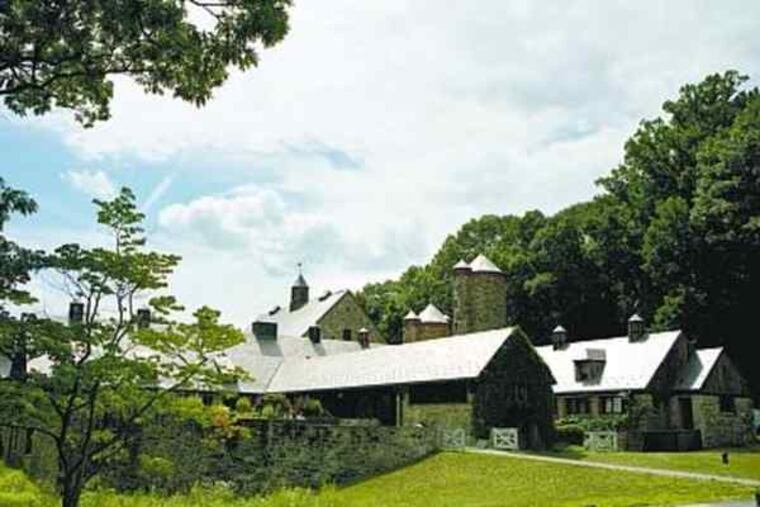
To be sure, Barber has a unique platform. His Pocantico Hills restaurant is nestled in an 80-acre livestock farm that grows and raises much of the food served on the premises.
The Stone Barns land, donated by the Rockefeller family, includes a 23,000-square-foot greenhouse and 22 acres of pasture land where the animals graze on grass. The organic farm produces hundreds of varieties of vegetables - 35 types of lettuce alone. It even has its own bee colony.
Barber's restaurants, which he co-owns with his brother, David, and David's wife, Laureen, are the largest customer of the farms' output. Even so, since he pays the farmers fair-market prices, Barber often must forage in greenmarkets for better deals and snag produce from his own family's Blue Hill Farm, in Great Barrington, Mass.
He's known to forge tight bonds with his farm suppliers, visiting with them and asking about everything from the sprays used to the number of miles they drive to the market.
"I'm kind of the obsessional type," he admits.
Stone Barn's self-sufficiency varies by season, but by late summer it produces 80 percent of the menus at his restaurants. Exceptions are deliveries of fish, citrus that doesn't grow easily in the Northeast and some crops that are hard to grow organically.
Barber makes sure to let his diners know how their meal began. His waitstaff - who highlight the origins of a dish, often in excruciating detail - play a key link between the farmer and the customer.
Eve Felder, an associate dean at The Culinary Institute of America and a former chef at Alice Waters' Chez Panisse Cafe, is a Barber fan, admiring both his food and his commitment.
"To do that type of local growing within a small radius, particularly in a climate that is four seasons, is not easy," she says. "His recognition is due, and I think we will see more people who are committed to local, sustainable food."
Back to basics
Barber, who learned the basics of farming from his grandmother at the family's farm in Massachusetts, graduated from Tufts University and began his cooking career baking bread in California at the La Brea Bakery.
He studied at the French Culinary Institute, in New York, and worked in kitchens in France. Upon returning home, he worked for David Bouley and started a catering business which morphed into the 2000 opening of Blue Hill in the West Village. The Stone Barns spin-off opened in 2004.
Barber likes to say that the farmer determines the menu, and he's not entirely kidding: In the upstate restaurant, the menu is just a list of ingredients pulled from the earth that morning, and diners are encouraged to let the cooks combine them.
"If you come into the restaurant tonight and you don't like asparagus, you're cooked," says Barber. "You're getting asparagus."
And if the customer doesn't like asparagus?
"Come back at another season," he replies.
Barber has faith that the sustainable-agriculture ethic will only get stronger, despite last year's passage of a Farm Bill laden with subsidies that he feels missed a great opportunity to change the way Americans eat.
Until the next bill, Barber believes that cooks - Michelin-starred chefs like him all the way down to home cooks - can make a difference.
His thinking is simple: More cooking means more farming, which translates into better farming. Less cooking means more cash goes to conglomerates that process, package and distribute pre-made meals.
"If you're not cooking in your kitchen, you're not really helping, at the end of the day," he says. Then he smiles and adds: "Of course, I'm saying that as a cook." *