Grow your own mushrooms for flavor and savings
THESE DAYS, with all the emphasis on eating fresh and local, it's not unusual for neighbors in and out of the city to take a stab at keeping bees or collecting eggs from their own free-range yard hens.
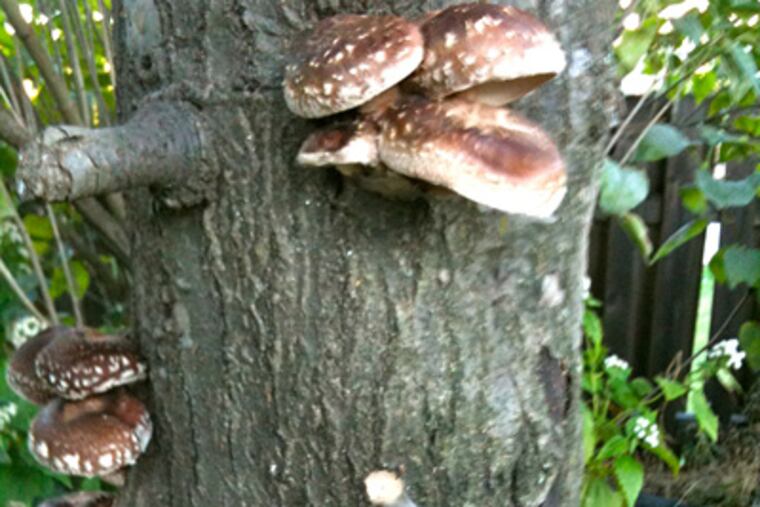
THESE DAYS, with all the emphasis on eating fresh and local, it's not unusual for neighbors in and out of the city to take a stab at keeping bees or collecting eggs from their own free-range yard hens.
What's next on the DIY frontier? Hint: it's growing in a moist and shady place and pairs well with a nice, round pinot noir.
Welcome to the fabulous world of home-cultivated fungi. For mushroom lovers, and there are plenty of them out there, the notion of colonizing an army of shiitakes on a log in the back yard is downright seductive.
Diana Post is smitten. Post, a management consultant based in Belmont Hills, isn't averse to getting her hands dirty when it comes to sourcing good food. She's raised and butchered her own pigs, grows a copious garden and knows her way around a pot-au-feu. So when her friend Rob Aptaker offered a workshop in home cultivation, she signed up.
That was three years ago. Post now inoculates green oak logs with shiitake spawn purchased from Fungi Perfecti, a Washington state-based mushroom product supplier. The spawn consists of living mycelium, a threadlike root structure that feeds off the wood's nutrients and eventually makes mushrooms. For a $20 investment in a five-pound bag of sawdust laced with shiitake spawn, she's already harvested at least 20 pounds of mushrooms. Shiitakes run about $10 a pound at Whole Foods, so the return on investment is swell.
"There's a reason mushroom is a verb," said Post. "Once the mushrooms start fruiting, the yield is fantastic. And the quality is so much better than anything you can get in a produce section."
Aptaker, an Allentown educator, has been growing mushrooms and selling to specialty markets since the early 1990s. Thanks to the freak snowstorm that hit the region in late October, he now has 320 inoculated logs in his back yard. "My wife kind of rolls her eyes," he said. "But I couldn't rest thinking of all the downed oak trees just waiting to be cut into mushroom-growing logs."
Curing 'shroom fear
In his workshops, one of the first issues Aptaker tackles is what he calls "mushroom-phobia." "When I started getting interested in wild edible foods, I was afraid of mushrooms," he recalled. "I thought you had to be a scientist to tell the difference between an edible and a poisonous mushroom. You just have to have somebody show you, and use field guides. I've eaten more than 75 types of wild mushrooms and never even gotten a tummy ache."
"People all over the world collect mushrooms," said State College mushroom expert Bill Russell, author of Field Guide to the Wild Mushrooms of Pennsylvania and the MidAtlantic (Penn State University Press, $17.95 eBook, $24.95 paperback). Russell leads mushroom walks, gives lectures and has eaten 250 wild species without a problem.
Cultivating shiitake spawn at home guarantees that all you'll harvest is gorgeous, meaty shiitakes, prized for their health benefits and delicate flavor. "Each mushroom is an individual organism," Aptaker explained. "Shiitake spawn doesn't and can't cross-pollinate with any other kind of mushroom. It would be like growing peas and corn next to each other, you'll never get a hybrid between the two."
In nature, wind-borne spores land on decayed matter, usually wood, in a single entry point. Over time, they colonize, or spread throughout the wood until mushrooms pop through. "Systematically introducing spawn into wood stacks the deck in your favor. You're going to get mushrooms and since there are multiple entry points, it's not going to take that long," Aptaker said. The process isn't difficult, but for it to work, attention must be paid. (See sidebar.)
Oak logs - shiitake means something like oak-loving mushroom in Japanese - should be cut to lengths of about 36 to 40 inches, with a diameter of about 6 inches. Too big, and it takes too long for the spawn to colonize, and the logs are too heavy to handle. Too small, and the wood's moisture content isn't assured. The oak also has to be freshly felled - storm-damaged trees can be a good source.
"Healthy living trees are not vulnerable to fungus," said Aptaker. "But older wood is too dry, and is often colonized by some other fungi."
Once inoculated, the logs should be stacked in a shady moist place out of the wind and sun. "I've had people take my workshop, do the work, then just forget about their logs and leave them to dry out," said Aptaker. "This isn't hard, but it takes some management."
The logs that Post recently inoculated, with the help of her Polish mushroom-loving neighbor Peter Dobczynski (full disclosure: he's also this writer's husband), are in a dormant stage until the weather maintains a consistent 50-degree temperature.
"At that point, I'll take the logs and soak them for a few days in a trash can full of water," said Post. "Then you wake up the mycelium by banging the logs on the ground a couple of times to get the fruit production going."
"You'll have mushrooms in about three or four days," said Aptaker. About 45 days after you harvest, your log will be ready to produce again. A typical inoculated log will produce one year of fruit for every inch of diameter; 4-5 inches yields four to five years of mushrooms.
"It becomes a passion," said Aptaker. "The process of inoculating is absolutely therapeutic. I think the same way gardeners find weeding meditative. And the results are so delicious."
Other than paying attention to the cues along the way during the process, Aptaker said, the only other tricky thing about back yard mushrooming is keeping your inoculated logs out of harm's way. "Even though they have little wax holes all over them, to the average person, they look like firewood. I had one guy in my class who left all his logs in a good spot, only to have his sister come home with her friends and decide to have a bonfire. All that work and all those mushrooms went up in smoke."