Our new Mr. Italy
The Vetri acolyte is suddenly wood-oven hot, slapping a new pizzeria into shape, writing "Eating Italy," about a New Hampshire boy's culinary awakening.
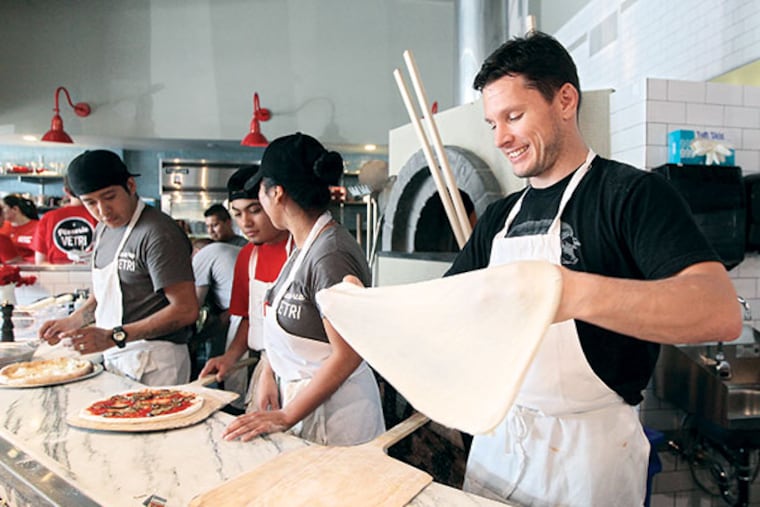
Jeff Michaud was at full throttle, flinging flour on the Neapolitan doughs, stretching them, saucing them. He banged them out, pie after pie after pie (Sicilian tuna! Bufala mozzarella-and-prosciutto crudo! Eggplant-burrata!), chanting to the wide-eyed staff: "This one is the Sicilian . . . !" "This one is the . . . !"
And things were not running - not yet - what you'd call smoothly.
It was less than a week before pocket-size Pizzeria Vetri opened in a stretch of glassy new storefronts at 19th and Callowhill.
It had been a matter of 48 hours or so since the tiled pizza oven (just fine-tuned by the Texas craftsman Renato Riccio) had been fired up, split oak burning on one side, gas flame on the other.
So Michaud - temporarily putting his cheffing duties at Osteria on hold - was boot-camping the soon-to-be-tested pizzaioli. They stood by, sliding peels in the oven. "Onions are cut too thick," Michaud barked. "Yes, chef," they said.
A pizza emerged, its entire crust charred: "We can't have burnt pizzas! No burnt pizzas!" Michaud boomed, then jabbed a mock kidney punch at the back of a pizzaiolo named Manny.
This had been consuming him for weeks. He corrected a Spanish-speaking cook who was neatly spacing cheese cubes around the rim of a crust: "No, do it random!" Michaud said, waving his hand in a sprinkle.
He sighed; he could see he'd be spending some long nights here, many long nights, before the place got its groove on.
And it certainly wasn't about to be accorded the grace of a soft opening: On its first Friday, Saturday, and Sunday, the kitchen was called on to knock out close to 700 pies each day, stopping only when it ran out of dough.
Michaud is a protégé of chef Marc Vetri, the city's reigning North Italian master. It was Vetri who in 2001 first took him to Italy, to his old staging ground in northern Bergamo. And Vetri who, after vetting him as a sous chef at his high-end Ristorante Vetri, anointed him to run Osteria, the warm wood-grill room on North Broad Street.
In his first few years there, he would win the James Beard Award as best Mid-Atlantic chef. But with all that, Michaud, now 36, remained the sidekick, overshadowed by the towering Vetri reputation. Until recently.
Suddenly, it's the era of Michaud Unchained. The native of Nashua, N.H., who at 13 was making after-school pizza in a Greek joint around the corner from his house, is on a tear. Along with his buddy Brad Spence, the chef at the Vetri family's Amis trattoria, he now owns a piece of the action, and floats as a culinary director among the Vetri properties - Osteria, Alla Spina, Amis, and now Pizzeria Vetri - while his new chef de cuisine, Brad Daniels, puts the food on the daily table at Osteria.
(The Vetri crew is thick. Michaud works out with other chefs at a boxing ring once a week; thus the well-aimed kidney punch. And he, Spence, and Vetri train at a jujitsu martial arts center in Gulph Mills. In his belted kimono, Michaud placed second in July in a competition with younger 18- to 29-year-olds.)
He has a brand-new cookbook out, Eating Italy, the adventure of his three-year voyage of discovery in the butcher shops, subalpine restaurants, and home kitchens across a magical Lombardy. (There's another in the works.)
His opening line: "At first I knew nothing about Italian food." By the end, he knows a great deal - the secrets of pork-neck cannelloni and homey bread dumplings called canederli with cabbage and speck, chickpea cakes with warm lemon crema, and rich, grandmother-style rabbit over soft polenta.
You've seen this movie before. The fresh-faced 23-year-old from New Hampshire who, with charmingly halting Italian, makes his way butchering and cooking and feasting across Italy, falling in love with the food, the characters, the lifestyle, and eventually the woman - in this case, Claudia, whom he marries. The wedding party there lasts late into the night as he watches, finally, her Italian uncle stuff a warm panini in the mouth of his New England uncle.
The recipes in Michaud's book are set in a winning narrative (crafted by food writer David Joachim), affecting accounts of his awe and delight at the markets and cafes and haunts he visits. I ask him about his paean to Venice. What was his favorite eatery there? Not any one in particular, he says. Rather, Claudia and his mother-in-law, Pina, would go to the market and buy small fish, fry or grill them at Pina's apartment, toss them on brown paper, sprinkle them with salt and a squeeze of lemon, "and just eat them."
And of course there is the intimate story of his romance that starts with the touch of toes under a table, and continues with a courtship that includes a G-rated chapter called "Sex on the Italian Riviera." The only hint of the sex part is that the couple doesn't roll out of bed until 3 p.m. ("That's all Claudia would let me write.")
Nowadays, the couple lives near Graduate Hospital with their toddler, Gaia. Claudia, who owned a video rental store in Italy, works at the Tiffany's on Walnut Street.
What does Michaud like to eat when he's not eating Italy? Simple, wood-grilled meats or fish, he starts. Then he adds, "There's my wife's chicken Milanese."
"I'll even eat it cold when I get home at 11:30 at night," he says, "right out of the refrigerator."
Whole Roasted Pork Shoulder With Pickled Vegetables
Makes 10-12 servings
EndTextStartText
1 bone-in, skin-on pork butt or picnic ham (about 8 pounds)
1 cup kosher salt
1 cup sugar
3/4 teaspoon ground fennel seeds
3/4 teaspoon freshly ground black pepper
1/2 cup vincotto (see note)
1 packed cup light brown sugar
5 cups torn romaine lettuce
5 cups mixed pickled vegetables for garnish
EndTextStartText
1. Rinse the pork, and then pat it dry. Combine the salt, sugar, fennel, and black pepper, and rub the mixture all over the pork in a tub or large resealable plastic bag. Cover or seal, and refrigerate overnight.
2. Preheat the oven to 275 degrees. Transfer the pork to a large Dutch oven and add 2 cups of water. Cover and braise in the oven until the meat is tender, about 190 degrees internal temperature, 4 to 5 hours, checking periodically and adding water, as necessary, to keep the liquid level about three-quarters of the way up the meat.
3. Carefully transfer the shoulder from the pan to a rimmed baking sheet and cover with foil. Save the cooking liquid in the pan. The liquid should measure about 1 quart. Add the vincotto and brown sugar to the liquid, and bring to a boil over high heat. Boil until the liquid reduces in volume by about half and becomes a thin syrup, 20 to 25 minutes.
4. Preheat the oven to 375 degrees. Brush the vincotto syrup all over the pork shoulder. Heat the pork in the oven until warmed through, 20 to 30 minutes. Raise the heat to 500 degrees. Cook until the pork is hot and the skin is crisp, 10 to 15 minutes, stopping every 5 minutes to brush the glaze from the bottom of the pan over the pork. You may need to add about 1 cup of water to the pan to keep the syrup from burning as it cooks.
5. Line a platter with the lettuce and carefully transfer the pork to the platter. Garnish with the pickled vegetables and serve the meat whole drizzled with any remaining glaze. Let guests crack the skin and pick off pieces of the meat, dragging them in the glaze and alternating with bites of pickled vegetables.
Note: Vincotto is "cooked wine" that's reduced until it's thick, sweet, and syrupy, sort of like balsamic syrup. You can find it at good Italian specialty shops.
Per serving (based on 12): 605 calories; 40 grams protein; 25 grams carbohydrates; 22 grams sugar; 37 grams fat; 153 milligrams cholesterol; 4,852 milligrams sodium; 1 gram dietary fiber.EndText
Pear and Treviso Salad With Taleggio Dressing
Makes 4 servings
EndTextStartText
For the pear and Treviso salad:
12 ounces Treviso radicchio (1 head)
4 ounces Belgian endive (1 large head)
1 tablespoon sherry vinegar
3 tablespoons extra-virgin olive oil, plus more for drizzling
Salt
1 Bartlett pear, peeled, seeded, and finely chopped
1 tablespoon chopped mixed fresh herbs (parsley, rosemary, and thyme)
For the Taleggio dressing:
1/2 cup whole milk
2 ounces Taleggio cheese, grated (1/2 cup), see note
1 large egg yolk
1/2 cup extra-virgin olive oil
1 to 2 teaspoons sherry vinegar
Salt and freshly ground black pepper
EndTextStartText
1. For the pear and Treviso salad, cut the Treviso lengthwise into quarters and the Belgian endive lengthwise in half. Then cut both crosswise on a diagonal, leaving the pieces pretty big (1 to 2 inches long), and place in a large bowl.
2. Put the sherry vinegar in a small bowl and whisk in the 3 tablespoons of oil until blended. Season with salt to taste. Drizzle about half of the vinaigrette over the greens and toss until coated. Add the pear and mixed herbs to the remaining vinaigrette and toss to coat.
3. For the Taleggio dressing, put the milk in a small saucepan and bring to a boil over high heat. Turn off the heat and whisk in the Taleggio until it melts and incorporates. Pour the mixture into a blender and blend in the egg yolk, then slowly drizzle in the oil and 1 teaspoon of the sherry vinegar. Taste and season with additional sherry vinegar, salt, and black pepper, as needed.
4. Divide the Treviso mixture among plates and drizzle with a generous amount of the Taleggio dressing, about 2 to 3 tablespoons per plate. Drizzle with some olive oil, 1 to 2 teaspoons per plate, then scatter the pears over the salad and serve immediately.
Note: Find Taleggio cheese at cheese shops and better grocery stores.
Per serving: 351 calories; 7 grams protein; 12 grams carbohydrates; 6 grams sugar; 32 grams fat; 70 milligrams cholesterol; 349 milligrams sodium; 3 grams dietary fiber.EndText
Chickpea Cakes With Warm Lemon Crema
Makes 8 servings
EndTextStartText
For the chickpea cakes:
3 cups cooked or canned chickpeas (drain and rinse if using canned)
10 tablespoons sugar
Zest of 1 lemon
2 tablespoons tipo 00 flour or all-purpose flour
Pinch of salt
1 large whole egg, plus 4 large eggs, separated
For the lemon sauce:
Juice of 3 lemons
1 cup plus 2 tablespoons sugar
4 large egg yolks
4 ounces (1 stick) unsalted butter
1/2 cup heavy cream
To serve:
Olive oil, for drizzling
Confectioners' sugar, for dusting
EndTextStartText
1. For the chickpea cakes, preheat the oven to 375. Butter and sugar eight 4-ounce ramekins or baking tins and place on a baking sheet.
2. Puree the chickpeas in a food processor or blender until relatively smooth, scraping down the sides once or twice. You should have 2 cups of thick chickpea puree. Transfer the puree to a large bowl and add the sugar, lemon zest, flour, salt, whole egg, and egg yolks. Gently whisk until smooth. Whip the egg whites in a stand mixer on high speed until medium-stiff peaks form when the beaters are lifted. Gently fold the whites into the puree mixture. Spoon the batter into the prepared ramekins and bake until the cakes are set and golden brown, 12 to 15 minutes.
3. For the lemon sauce, whisk together lemon juice, sugar, and egg yolks in a heatproof bowl until light and pale yellow. Heat butter and cream in a heavy saucepan over medium heat until it begins to simmer, then remove from heat. Whisk half of the hot cream mixture into the yolk mixture until incorporated, then return combined mixture to pan. Return pan to low heat and stir constantly but gently until sauce thickens slightly and registers a temperature of 165 degrees on a candy thermometer, about 5 minutes. Remove from heat and stir for about 2 minutes, or until sauce thickens to the consistency of heavy cream. Strain through a fine-mesh sieve into a bowl and let stand a few minutes, stirring occasionally. You should have about 2 cups of sauce.
4. To serve, spoon a pool of warm lemon sauce on each plate. Turn out a warm cake onto each plate. Drizzle a little olive oil around the plate, then dust the cakes with confectioners' sugar.
Per serving: 658 calories; 20 grams protein; 86 grams carbohydrates; 46 grams sugar; 28 grams fat; 262 milligrams cholesterol; 183 milligrams sodium; 13 grams dietary fiber.EndText
Pinzimonio With Tarragon Vinaigrette and Goat Cheese
Makes 8 servingsEndTextStartText
1 packed cup fresh tarragon leaves, plus 5 to 6 leaves for garnish
1 to 2 tablespoons red wine vinegar
1 cup olive oil
Salt and freshly ground black pepper
21/2 pounds assorted vegetables, thinly sliced
(8 cups)
About 4 ounces fresh, soft goat cheeseEndTextStartText
1. Put the tarragon and vinegar in a blender and blend until the tarragon is finely chopped, 1 to 2 minutes. With the motor running, slowly drizzle in the oil until thickened, 2 minutes. The mixture should be green and medium thick. Season with salt and pepper, then taste and adjust the vinegar and other seasonings as needed.
2. Toss the vegetables in the vinaigrette in a big bowl and season with salt and pepper. Arrange the vegetables on a wooden board or platter. I like to put them in a narrow line down a long board. Use two dinner spoons to scoop and shape the goat cheese into two football shapes (quenelles). Place them on opposite sides of the vegetables. Garnish with the remaining tarragon leaves and a drizzle of the tarragon vinaigrette remaining in the bowl.
Per serving: 341 calories; 8 grams protein; 13 grams carbohydrates; 4 grams sugar; 31 grams fat; 15 milligrams cholesterol; 184 milligrams sodium; 4 grams dietary fiber.EndText