Browned, crusty gratins are perfect comfort foods
Plenty of oven-baked dishes are worth romanticizing about, especially during a bracingly cold winter. Their aromas and warmth can permeate an entire home, even one with old bones and scanty insulation, like mine. They seem to take care of themselves, at least in those final stages of cooking. And they promise warming, savory comfort for the table.
Plenty of oven-baked dishes are worth romanticizing about, especially during a bracingly cold winter. Their aromas and warmth can permeate an entire home, even one with old bones and scanty insulation, like mine. They seem to take care of themselves, at least in those final stages of cooking. And they promise warming, savory comfort for the table.
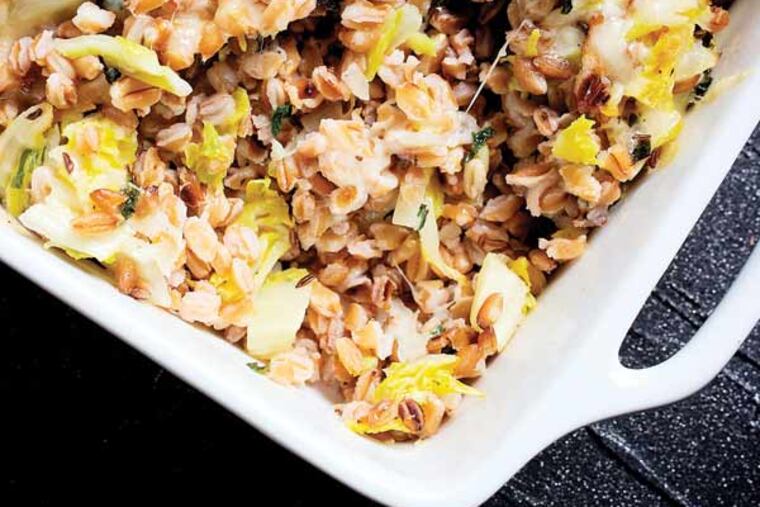
A gratin, though, can do even more. It emerges from the oven not only fragrant and bubbling hot but with a browned, crisp crust crowning the luxurious goodness underneath. What I've come to appreciate most is the gratin's ability to make something special out of ordinary ingredients, on any ordinary night. Consider a casserole of meaty borlotti beans, their juices concentrated beneath a shaggy coat of bread crumbs, or a jumble of toasted farro and ruffly savoy cabbage, baked until the center is lacy with melted cheese and the top is chewy and crisp. These dishes come together like weeknight meals, but they're dressed up just enough to taste like something more.
That in itself seems like nourishment.
But the gratin seems to suffer from an image problem: We view it largely as a side dish, a very special, rich one, most often built of potatoes. We imagine heavy cloaks of cream, cheese, or bread crumbs, if not all three. In other words, the term "gratin" conjures up something delicious, but also something rather heavy, something you ought not eat a lot of, or very often. That is less an unfair portrayal than an incomplete one.
Perhaps the most revered is the gratin dauphinois, with its layer upon layer of thinly sliced potatoes, poured over with cream, seasoned and baked until a delicate golden crust forms over the sumptuous whole. It is a marvel of transformation that owes its delectability not just to cream, but also to the starch the potatoes exude as they bake.
That dish, the royalty of gratins, obscures the preparation's potential for versatility. The only feature the gratin truly requires is a browned, crisp topping - and, to achieve it, a shallow enough baking dish with sufficient surface area.
The word itself translates as crust, originally derived from the French verb gratter, meaning to scratch or scrape. Depending on whom you ask, that action refers to either the actual grating or scraping of cheese or bread crumbs on top, or the onetime practice of scraping the crusty bits from the side and bottom of the baking dish back into the whole.
Regardless, it is the upper crust that makes the gratin so irresistible. (That explains the French idiomatic usage of the term le gratin to refer to a society's or particular group's elite.)
Beyond that qualification, the gratin is practically limitless, as flexible as pasta, or stew: You can convey any number of flavors with any number of ingredients, depending on what you have a taste for and what's in your pantry.
"The gratin really is a blank canvas," said Clotilde Dusoulier, author of The French Market Cookbook and the blog Chocolate & Zucchini. "You can use whatever scraps you have in the fridge and give them new life in a gratin."
Dusoulier, who is French, grew up with the gratin. Her mother's routine dish was of cauliflower, dressed in a béchamel sauce (a lighter, more workaday alternative to heavy cream) and finished with Comte cheese. She made another with pureed pumpkin as the base. In her own Paris kitchen, Dusoulier prepares gratins conventional and less so: a silky, burnished dauphinois she makes lighter by replacing much of the traditional cream with milk; quickly assembled weeknight dishes of spaghetti squash with mozzarella and bread crumbs, or macaroni with béchamel.
South from Paris, gratins veer lighter, often taking the name tian for the flared, shallow dish in which they are baked. They often feature olive oil in lieu of cream, and many of the vegetables we associate with summer: tomatoes, zucchini, peppers, eggplant.
"Beans and pasta make a great gratin," said Deborah Madison, chef and author most recently of "Vegetable Literacy." "And the combination is good for people who aren't too sure about eating beans, because they're reassured by the pasta."
And though none of my recipes include meat - I'm vegetarian - gratins are a great place to slip in shreds of leftovers, such as last night's roast chicken. Bacon or sausage, too, can add punctuations of flavor.
The gratin is, in other words, open to interpretation, gracious, perhaps even a little charitable. It is not the speediest of dishes from start to finish - leave that to a quick pasta sauce - but low-maintenance relative to its rewards. Assembly can be leisurely; later, in the oven, saved from the cook's poking and prodding and stirring and messing, the dish is left to gently transform itself while the rest of the meal is being prepared.
"I talk to my students a lot about making food relax," said Loomis. In a gratin, she explained, ingredients are resting, exchanging flavors.
That pace can, and should, carry into serving. To wit: Never serve a gratin straight from the oven, no matter how tantalizing it looks. Apart from the obvious hazards to the roof of the mouth, most gratins benefit tremendously from a short rest, during which the juices redistribute and settle, yielding a more uniformly moist result.
Most gratins, additionally, lose very little by being made in advance. Some, Dusoulier said, are actually all the better for it, so long as any reheating happens in the oven and not the microwave. Depending on its constituents, a gratin might not require rewarming at all. A leftover gratin of zucchini and tomatoes, for example, is lovely at room temperature. Years ago, I picked up a tip from Madison to spread such remnants on grilled or toasted pieces of bread, and I've never looked back.
For the cook's part, using an earthenware baking dish is a nice gesture (some would argue essential), not only because it distributes heat evenly and keeps the food warm but also because it doubles gracefully as a serving dish, which, as Madison points out, is one of the gratin's most charming attributes. And you do want to bring the gratin to the table intact, its crust lovely and golden. Give it a chance to show off. It doesn't ask for much.
Savoy Cabbage and Farro Gratin With Fontina
Makes 4 servings
EndTextStartText
1 cup semi-pearled farro (may substitute semi-pearled barley or rye berries)
Pinch, plus 1/2 teaspoon kosher salt
1 small or 1/2 large savoy cabbage, cored (may substitute green or firm napa cabbage or lacinato kale)
2 tablespoons extra-virgin olive oil, plus more for the baking dish
1 large shallot, minced
1/8 teaspoon freshly ground black pepper
3/4 teaspoon caraway seed, toasted (see note)
1 cup homemade or no-salt-added vegetable broth
11/2 teaspoons fresh thyme leaves
5 ounces fontina cheese, freshly grated or shredded (may substitute raclette cheese)
EndTextStartText
1. Toast half of the farro in a large, heavy saute pan over medium heat for 5 to 7 minutes, until lightly browned and fragrant, shaking the pan as needed to avoid scorching. Transfer to a medium saucepan; repeat with the remaining farro.
2. Cover the farro with water by a few inches and add the pinch of salt. Bring to a boil over medium-high heat, then reduce the heat to low; partially cover and cook for about 30 minutes or until tender yet still a bit chewy. Drain in a colander.
3. Coarsely chop the cabbage.
4. Heat the oil in the same large, heavy saute pan over medium heat. Once the oil shimmers, add the shallot and cook for 3 to 5 minutes, until translucent, stirring a few times. Add the cabbage, the 1/2 teaspoon salt, the pepper and the toasted caraway seed, stirring to incorporate.
5. Stir in 3 tablespoons of the broth; reduce the heat to low, cover and cook for 7 to 10 minutes, until the cabbage has wilted yet remains moist and somewhat plump. Stir occasionally and add broth if the mixture seems dry. Remove from the heat and stir in the drained farro and thyme leaves.
6. Add 4 ounces of the cheese and toss gently to incorporate.
7. Preheat the oven to 375 degrees. Use a little oil to grease a 21/2-to-3-quart baking dish.
8. Spread the cabbage mixture evenly in the baking dish, then pour 2/3 cup of the broth over it. Sprinkle with the remaining ounce of cheese. Bake for 25 to 30 minutes or until the cheese is melted, the cabbage is browned in spots and the gratin is bubbling. Wait for 10 minutes before serving.
- From Emily C. Horton, Washington Post
Note: Toast the caraway seed in a small skillet over low heat for 3 minutes, until fragrant, shaking the pan occasionally. Remove from the heat.
Per serving: 410 calories, 18 grams protein, 43 grams carbohydrates, 4 grams sugar, 18 grams fat, 40 milligrams cholesterol, 590 milligrams sodium, 6 grams dietary fiber.EndText
Bean and Winter Squash Gratin
Makes 4 servings
EndTextStartText
1 cup dried borlotti (cranberry) beans (or tiger's eye or any pinto-style bean)
Fine sea salt
1 bay leaf
5 tablespoons extra-virgin olive oil
Water (optional)
3 ounces country-style white or whole-wheat bread (crusts removed)
Flesh from 1 pound winter squash, such as kabocha or Hubbard, cut into 1-inch pieces
1 medium yellow onion, cut into small dice
2 large carrots, scrubbed and cut into small dice
2 teaspoons dried thyme
1/2 teaspoon fennel seed
1 dried arbol chili pepper, seeded and crumbled (may substitute 1/2 teaspoon crushed red pepper flakes)
1/8 teaspoon freshly ground black pepper
1 clove garlic, cut in half (any green sprout removed)
EndTextStartText
1. Place the beans in a pot with water to cover by several inches; bring to a boil, and boil for 1 minute. Remove from the heat, cover the pot and let the beans soak for 1 hour. Alternatively, they can be left to soak in tepid water to cover by several inches for 8 to 12 hours.
2. Add to the beans and their soaking liquid a generous pinch of salt, the bay leaf and 1 tablespoon of the oil. Add water if necessary to keep the beans submerged by 2 to 3 inches. Cook over medium-high heat; once the liquid starts to bubble, reduce the heat to medium-low, partially cover and cook, stirring occasionally, until the beans are just tender, 45 minutes to 1 hour. The beans might take longer than 1 hour to cook, depending on their freshness. Leave them in their soaking liquid while you finish preparing the rest of the gratin.
3. Tear the bread into chunks and place them in a food processor; pulse into crumbs. Transfer to a bowl and drizzle with 2 teaspoons of the oil, tossing to coat evenly.
4. Preheat the oven to 400 degrees.
5. Toss the squash pieces with 1 tablespoon of the oil and 1/4 teaspoon of fine sea salt. Roast for 20 to 30 minutes, turning them once with a spatula after about 15 minutes, until lightly golden and tender.
6. Heat 1 tablespoon plus 1 teaspoon of the oil in a large, heavy saute pan over medium heat. Add the onion and carrots, stirring to coat; cook until tender and just beginning to turn golden, about 7 minutes. Stir in the thyme, fennel seed and dried arbol chili pepper; cook for 2 minutes, then gently fold in the squash just until incorporated.
7. Discard the bay leaf in the beans; drain the beans, reserving 1 cup of the cooking liquid, and gently stir them into the squash mixture. Season with 1/4 teaspoon salt and the black pepper.
8. Rub the bottom and sides of a shallow 2-quart baking dish with the cut halves of garlic; discard the garlic or reserve it for another use.
9. Transfer the bean-squash mixture to the baking dish. Pour 3/4 to 1 cup of the reserved bean-cooking liquid evenly over the top of the dish and drizzle with the remaining tablespoon of oil. Sprinkle with the bread crumbs.
10. Bake for 25 to 30 minutes, until the mixture is bubbling and the crumbs are golden. Wait for at least 15 minutes before serving.
Per serving: 420 calories, 15 grams protein, 54 grams carbohydrates, 5 grams sugar, 18 grams fat, no cholesterol, 420 milligrams sodium, 15 grams dietary fiber.