Fresh start for an old mill
Castle Valley Mill now uses 19th-century technology to produce some rather trendy, old-fashioned products: whole-berry emmer, rye and spelt, and stone-ground hard- and soft-wheat flours, grits, and cornmeal. And the mill is now supplying the kitchens of ambitious restaurants like Fork, Fitler Dining Room, and Avance, as well as making products packaged for retail or ground to customers' specifications.
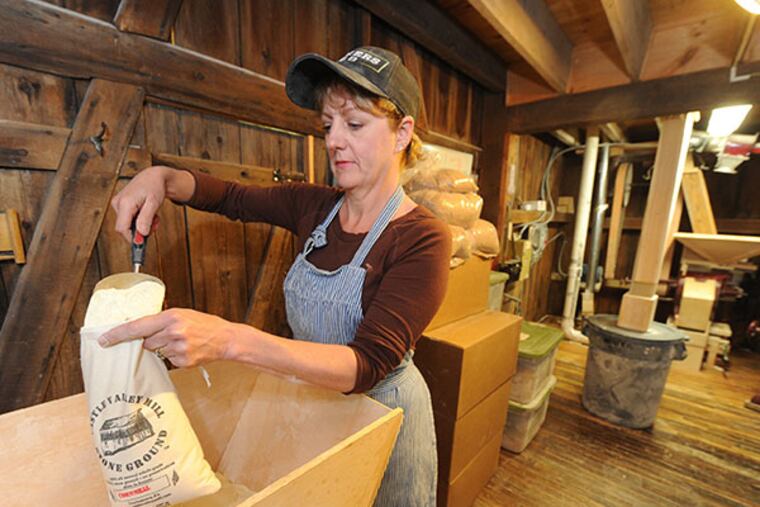
Trained as an electrical engineer, Mark Fischer spent most of his career focused on 21st-century technology. Then, three years ago, he reversed course - and went back to the 1800s.
Fischer and his wife, Fran, had lived for years in what had been his grandparents' home, a picturesque but dilapidated 1730 gristmill complex on the Neshaminy Creek in Doylestown. After he left his job, he realized his greatest engineering challenge was right in his backyard: coaxing the mill back to life.
"It was like a four-dimensional puzzle, because it was three dimensions, plus time," he said.
As those pieces fit together, they formed a surprise engine for culinary innovation.
The Fischers' Castle Valley Mill now uses 19th-century technology to produce some rather trendy, old-fashioned products: whole-berry emmer, rye and spelt, and stone-ground hard- and soft-wheat flours, grits, and cornmeal. And their mill is now supplying the kitchens of ambitious restaurants like Fork, Fitler Dining Room, and Avance, as well as making products packaged for retail or ground to customers' specifications.
Ellen Yin, who runs Fork, High Street on Market, and a.kitchen with chef Eli Kulp, said Castle Valley is preserving a tradition that was nearly lost to mass production, especially in this region - and making a better-tasting product.
"Grains were a huge component of our agricultural past in this area, and much of that has been displaced," she said. "Castle Valley Mills, they're trying to rediscover it."
Fischer, who began the restoration as a hobby, was only picking up where his grandfather, Henry Fischer, had left off.
An immigrant from a German milling family, his grandfather had owned a moving company but was a miller at heart.
As many of the 300 mills that once dotted Bucks County were shut down, Henry had traveled around, using his inherited know-how (and, on slow days, his moving crew) to salvage the machines. He started restoring them, but never finished.
Half a century later, Fischer began picking up the scattered pieces he'd left behind. He had advantages his grandfather did not: classes from the Society for Preservation of Old Mills and online patent databases that contained schematics for many of the machines. (He also had help from his 16-year-old son, Curran, who became a certified miller, too.)
"We came home from visiting other mills and started looking around, and said, 'Oh my gosh! We have one of those,' and, 'I know what that's for.' "
One by one, they fixed up the wooden machines that Fischer's grandfather had collected, rigging up Rube Goldberg-esque pulleys and pipes.
Now, the mill's built-in elevators move grains up to the top floor; gravity pulls them down through various wooden sifters and sorters that remove twigs, dirt and the coarsest bran.
Castle Valley mills a thousand pounds of grains a week. The next goal is to produce that much in a day, Fran Fischer said.
"The timing just seemed to be right, with everyone being more concerned about where their food comes from and what's in it," she said.
She wasn't so certain back when they first brought their products to an area farmers' market.
But almost immediately, they drew interest from local chefs. Jonathan Adams, then cooking at Pub and Kitchen, put in the first order, and word of mouth spread fast.
Now, the Fischers work with six farmers, all of them within 100 miles and some of them just down the road. It's creating a new market for more nutritious and higher-revenue crops, Mark Fischer said.
For example, after customers demanded non-genetically modified cornmeal, farmer Nevada Mease of Meadow Brook Farm in Bucks County went on a hunt for the hard-to-find seeds.
Castle Valley Mill products are perishable, unlike conventional flour, which is stabilized by the removal of the oils, bran and germ in roller mills. But the whole berries and stone-ground products are also more nutritious and flavorful, she insists. (Retailers, which include various co-ops and farm stores, sell the products in the refrigerated section.)
Fran, never a much of a foodie before her days as a miller, said it's changed the way she cooks.
"The boxed cornmeal, it has no flavor. It's cardboard. Ours, when you cook it, you can actually smell the corn," she said. She uses it in skillet corn bread and corn pudding.
Emmer and rye berries, she tosses into soups and stews, or cooks up a high-protein salad with fresh herbs and vegetables.
The Fischers' customers are even more creative. Longtime clients like Philly Bread, which orders custom-ground flour with even the coarsest bran left in for its whole-wheat "Philly muffins," come themselves to pick up custom orders and check out what's new at the mill.
And there's always something new. Next, Fischer wants to bring online his large French buhr stones, which now sit idle amid the shuddering wooden sifters and scalpers. While the machines now run on electricity, that will change. He plans to reinstall the turbine, and let the Neshaminy Creek do the heavy lifting.
Fischer knows one thing: His grandfather would have loved to see that.
"I can sort of see his game plan," he said. "We've got one of everything we need" to completely restore the old mill.
Castle Valley Mill Emmer Farro Salad
Makes 6 to 8 servings.EndTextStartText
2 cups emmer berries
1/3 cup red wine vinegar
1 onion (red or white), chopped
1/3 cup extra virgin olive oil
1 cup tomatoes, chopped
1 cucumber, chopped
1 cup basil, chopped
1/3 cup Kalamata olives, chopped
3 ounces feta, crumbledEndTextStartText
1. In a large pot, soak emmer berries overnight in enough water to cover. (Berries will not quite double in volume.) The next day, add more water if needed and bring to a boil. Reduce heat and simmer, covered, for about 30 minutes. Drain and rinse.
2. Put chopped onion in vinegar about 10 minutes to cut sharpness.
3. Combine all ingredients except feta in a large bowl. Add more oil and vinegar if needed and salt and pepper to taste. Toss well.
4. Chill and serve with crumbled feta cheese.
-From Fran Fischer
Per serving (based on 8): 324 calories; 9 grams protein; 41 grams carbohydrates; 2 grams sugar; 13 grams fat; 9 milligrams cholesterol; 460 milligrams sodium; 8 grams dietary fiber. EndText
Cornmeal Chips
Makes 30 chips or 4-6 servingsEndTextStartText
1/2 cup water
11/2 tablespoons butter
1/4 teaspoon chili powder
1/8 teaspoon garlic powder
1/8 teaspoon salt
2/3 cup yellow cornmealEndTextStartText
1. Preheat oven to 375.
2. Lightly grease baking sheet.
3. Heat water, butter, and seasonings to boiling. Remove from heat. Stir in cornmeal and mix well.
4. Divide dough into 30 portions, using about 1 teaspoon dough each. Roll each portion into a ball about 3/4 inch in diameter.
5. Place balls on baking sheet, about 3 inches apart. Cover with waxed paper and press with bottom of a glass until very thin, about 21/2 inches in diameter. Remove waxed paper.
6. Bake until lightly browned and crisp - about 15 minutes.
7. Cool on rack. Store in airtight container.
Per serving (based on 6 servings or 5 chips): 75 calories; 1 gram protein; 11 grams carbohydrates; no sugar; 3 grams fat; 8 milligrams cholesterol; 77 milligrams sodium; 1 gram dietary fiber.
215-854-5053
@samanthamelamed