A sad harvest
As neighborhoods improve, the community gardens that helped better them are being forced out.
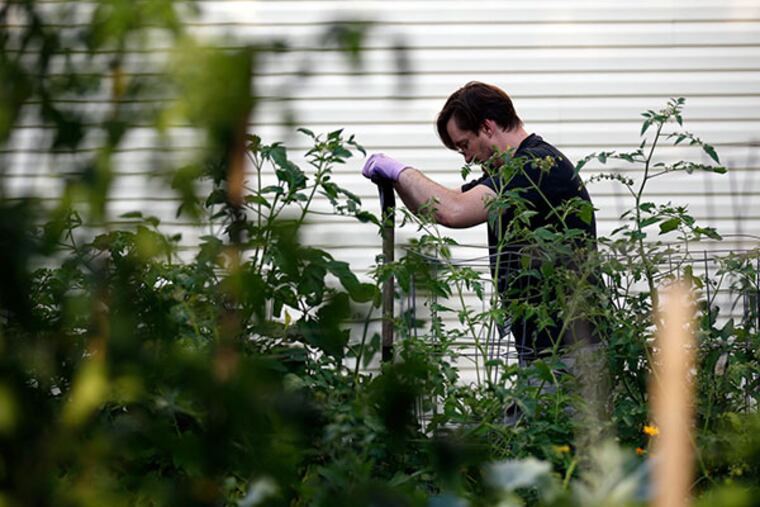
DANCE like no one's watching. Sing like no one's listening. Plant like no one's about to build a spiffy single-family home on top of your napa cabbage.
That last one probably isn't getting much love as a high-school yearbook quote. But for urban horticulturists all over town, these are optimistic, if uncertain, words to live and dig by.
As areas of the city long flush with unused land experience a renaissance of residential demand, DIY gardens that sat unbothered for years have eyeballs all over them. This twists the green thumbs responsible for conversion and cultivation into a compromising position, since it's often not their dirt to begin with. Government agencies and developers are left to toe the tightrope between business interests and neighborhood relations.
It's complicated, in the most Philadelphian manner possible.
Take Cohocksink Community Garden, on the corner of Thompson and Mascher. Shaded by mature pine, plum and apricot trees, the well-tended space, named for the creek that flows beneath these South Kensington streets, has a scattering of humble raised beds loaded with crops, like rhubarb, kale, tomatoes, peppers, beets, leeks and Brussels sprouts.
Both old-timers and newcomers tend to plots, a third of which are dedicated to City Harvest by way of the Pennsylvania Horticultural Society, providing the nonprofit Take a Sistah to Lunch with organic vegetables.
The lot, a garden in the past, fell into disrepair for years, until music teacher Krista Yutzy-Burkey and a group of nearby neighbors relaunched it in 2010. Research revealed that its ownership was, well, classic Philly.
"You might have a block with five different parcels, and each one is owned by someone different," said Jeffrey Barg, a PHS director who oversees the Neighborhood Gardens Trust, currently protecting 34 gardens throughout the city.
That's the setup at Cohocksink.
Of its five distinct parcels, four are cleared for indefinite use, thanks to PHS protection and handshake agreements with the Kensington South CDC. The fifth, however, was recently purchased by an individual who has expressed interest in building on it.
Though it's just one plot, new construction would likely mean the end of the garden, in Yutzy-Burkey's eyes. "It's on the corner," she said. "Once a house goes up there, I don't see it being a sustainable place to grow."
This Saturday, the gardeners will host a $10-a-plate cookout to raise funds for potential preservation efforts.
Amy Laura Cahn, an attorney who operates the Garden Justice Legal Initiative via the city's Public Interest Law Center, comes across situations similar to Cohocksink's constantly. "Some owners will just hold the land for 10 years, not do any maintenance on it and just wait until their moment," Cahn said. "In South Kensington, this is their moment. And that sucks."
Yutzy-Burkey speaks for the whole of Cohocksink's members in emphasizing that there is no sense of entitlement on the gardeners' part, only hope that a compromise can be struck. "We're all aware that this wasn't ours to begin with," she said. But "the investment that we've put in has really benefited the neighborhood. Now, it's up to other people to determine whether or not that's worth saving."
Thanks to civic holding patterns - the long-awaited Philadelphia Land Bank, signed into law in 2013, will not be up and running until 2015 at the earliest - gardeners faced with pressing complications often have trouble getting answers. That's where advocates like the NGT and Garden Justice Legal Initiative come into play.
In Southwest Philly, Cahn is currently consulting with Farm 51, where a portion of their garden, tax-delinquent since the '80s, has just gone up for sheriff's sale. They own the remainder of the planted space, as well as their residence on that land.
"We're not expecting to get anything for free just because we garden on it," said Neal Santos, who runs 51 with his partner, Andrew Olson. "We're realistic, but we want to go through a fair process."
But Cahn is up front about the fact that issues with city-owned plots are much easier to navigate than issues with land that's privately controlled.
In South Kensington, Cohocksink is joined by the nearby Fairgrounds, maintained by the art collective Little Berlin, in facing an unsure future due to new ownership. "Folks, when they're on privately owned land, are really in a limbo state," she said.
"Hopefully what happens is, gardens are able to settle these conundrums before it reaches the level of someone bringing a backhoe in," said Barg, who points out that the NGT is in the early stages of establishing alliances with local agencies that manage tax liens, with the goal of acting as a pro-green conduit between active gardeners and the sheriff's sale system.
Yutzy-Burkey and her fellow Cohocksink gardeners are well-aware of, but unfazed by, their shaky status. They're still getting their hands dirty in the garden.
"We all recognize the need for development of the neighborhood," she said. "But part of the reason many of us moved here is opportunities like this."