Reinventing pump house as eatery proves daunting
Maybe it's not really La Peg's fault. It's still getting its sea legs - perhaps "river legs" would be a better descriptor - at the foot of the Ben Franklin Bridge, just across the hiss of Columbus Boulevard from the Race Street Pier.
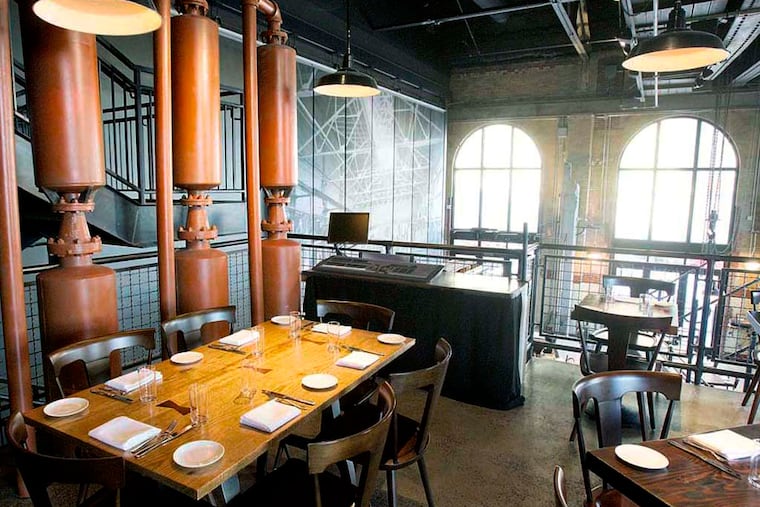
Maybe it's not really La Peg's fault. It's still getting its sea legs - perhaps "river legs" would be a better descriptor - at the foot of the Ben Franklin Bridge, just across the hiss of Columbus Boulevard from the Race Street Pier.
But my first experience in the soaring space in the reimagined 1903-vintage redbrick FringeArts Building - months before the La Peg move-in, and the rise of its menu of what chef-owner Peter Woolsey calls "French-ish" brasserie fare, and its beer garden strung with lights - was so uproarious that, well, La Peg seemed in my recent visits like a wallflower at its own party.
In the space where I'd once watched tubas huffing and dizzying Serbian circle dancing after a Fringe folk opera in the adjoining theater; and where I'd gobbled naughtily oily stuffed cabbage and slugged down, I think it was Pabst Blue Ribbon, here was a mainstream restaurant (on a Tuesday) of steady, well-behaved demeanor.
Then on another visit (on a recent Sunday evening), one got the impression from waitstaff stranded on the nearly empty mezzanine that despite a romantic view of the bridge, lit up and swooping to Camden, they would have been happier to see a chopper descending to spirit them away.
It's not easy reigniting the past. And Woolsey - scaling up from his snugly charming Bistrot La Minette in Queen Village (less than half the size of the 100-indoor-seat La Peg) - would hardly argue that this audacious new venue is a work completed.
It is not quite two months into its voyage.
He's still revamping the ovens in hot pursuit of a crustier, more-authentic baguette.
He shows off the wall-sized photograph of the building's original, 280-horsepower pumps: It faces the Fringe theater that will, in the best-case scenario, pump regular surges of customers into La Peg.
He ducks outside, at the behest of one of them, to check on the moon the evening before a lunar eclipse that, if the visibility is right, will turn it coppery red, into the so-called Blood Moon.
It goes without saying that converted venues in this city - mothballed brokerage houses, abandoned factories, art deco office towers from the Mad Men era, and of course the case in point, a high-pressure pump house that changed the face of America's firefighting a century ago - have special challenges. (Walls can be bulging. Plumbing problematic. Flooding a downpour away.)
But they have special charms, too - patina, for one, a whiff of history, a matchless singularity, and, beyond the dense forest of mirrored office buildings, a sudden peek at the full moon rising over a slate-black river.
It's one thing to go to dinner on the regenerating fringes of the city: The Greek-revival Water Works soldiers on along the Schuylkill's banks to the west, and the Vetri group's Lo Spiedo is about to light up the Navy Yard's nights.
It's another matter to make it vaut le voyage, as the French might say, "worth the trip."
La Peg, named for Woolsey's French-born wife Peggy, is still working on that last part, getting staffing settled, getting its pacing down (we were given a round of free appetizers because our roasted chicken - fine in the end - was stalled in the kitchen so long), trying to import some of the magic from Bistrot La Minette.
It is no mean feat, more than one stressed restaurateur has found, to scale up from your starter cafe to a grander space. Neil Stein once made the leap with aplomb at the late Striped Bass (now Butcher & Singer) in a marble-columned brokerage house on Walnut Street. A fresher success story is Talula's Garden in the revived art deco N.W. Ayer building at the edge of Washington Square, with more than 10 times the seating of its baby forebear - Talula's Table in Kennett Square.
Talula's Garden created an identity and at least a hint of intimacy by offering small-farm, local cheeses, hanging drum lamps handcrafted by Galbraith & Paul, and adding quirky window frames from the Chester County set of an M. Night Shyamalan film.
La Peg has a harder row to hoe. It has sprung up - or maybe taken a bold gamble - in the fallow land across a highway from the riverfront. And without the French curios that warm up Bistrot La Minette, there's an almost off-the-rack quality in the dining room, despite the towering Palladian windows, the mural of those brawny pump engines, and, from a few seats, the occasional glimpse of the Delaware.
That its menu takes liberties with disciplined bistro classics doesn't help matters. My bowl of Vietnamese beef-noodle pho consomme was cloyingly sweet. And while my wife was happy with her steak-frite, as was I with a small plate of roasted striped bass, my choucroute garnie - so wonderful when the sauerkraut is cooked long and slow enough to soak up the flavors of the sausage - tasted as if a bag of crunchy, coarse-cut kraut had been warmed up at the last minute, then layered with grilled sausage, entirely missing the point of the dish.
Upstream always on Fishtown's Frankford Avenue, massive warehouses and garages are getting recast, too - as La Colombe's new cafe-coffee-roastery-rum distillery; Fette Sau's sprawling barbecue barn; and Stephen Starr's open-air German beer garden, Frankford Hall, where crowds get on the nerves of first-wave pioneers.
But La Peg's postindustrial space boasts the most heroic pedigree: It was once home to a magnificent pump house so successful when it debuted in 1903 that it instantly cut fire losses (and insurance rates).
It was the pride of the city's High Pressure Fire Service, which, in a nutshell, gulped huge swallows of water from the Delaware, then blasted them through dedicated steel pipes with such force that, within two minutes after an alarm sounded in Center City's business district, firefighters could spray a two-inch stream of water 230 feet straight up.
It was called on only infrequently to perform at maximum effort.
But every day - Tuesdays and Sundays included - it was primed and ready.