'The Minute Kitchen' schools Asian students in traditional Chinese cooking methods
According to an August report by D.C. think tank the Brookings Institution, nearly 285,000 Chinese students entered the country on F-1 visas between 2008 and 2012, making China the largest source nation of foreign students pursuing degrees at American universities.
ACCORDING to an August report by D.C. think tank the Brookings Institution, nearly 285,000 Chinese students entered the country on F-1 visas between 2008 and 2012, making China the largest source nation of foreign students pursuing degrees at American universities. Schools in Philadelphia, home to the second-largest Asian population on the East Coast, attracted upward of 7,100 of these students in this time period - quite the community, although it's one that average citizens have little exposure to if they operate outside academia.
A small group of Chinese-born students and journalists on staff at Bala Cynwyd's Metro Chinese Weekly are looking to change that with a new, bilingual web series capitalizing on our purest commonality: food.
A long way from home and home cooking
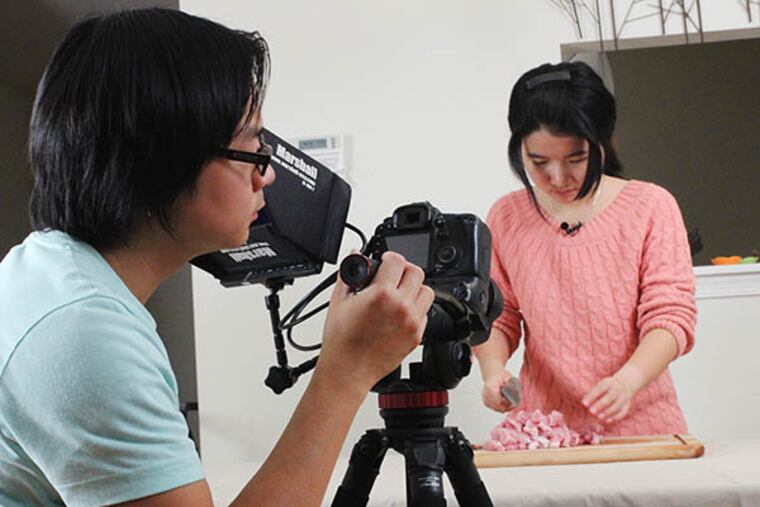
Launched in late October, "The Minute Kitchen" (theminutekitchen.com) aims to showcase the home-cooking skills of this underexposed sliver of Philly's student population, in an accessible, easily digestible YouTube format.
The project came about as Metro publisher Dan Tsao, who founded his Chinese-language publication in 2007, looked for ways to take advantage of a small production department formed with staffers skilled in multimedia.
Familiar firsthand with the culinary explorations of Chinese-born American students, Metro writer/editor Bole Yuan, a native of Jinan who studied journalism at Temple University, suggested a cooking-themed video series centered on students.
In China, Yuan explained, it is uncommon for kids living under their parents' roof to be actively involved in meal preparation, a departure from the American tradition of chopping, straining and whisking together as a family. That means that they're left to fend for themselves in the kitchen once they leave the nest for the States - a steep learning curve standing between them and a proper dinner.
"Some of us didn't have any cooking skills when we came here. We learned it all ourselves," he said. "No one cooks for us here."
Eager to share
With the help of Metro videographer Hiu Kwong Yau, a Temple alum from Hong Kong; intern Kaihan Chang, a Taipei native currently studying at Temple; and intern Haojun Liu, a Drexel student from Shenzen focusing on television production, Yuan began approaching Chinese students in Philly with the idea, which was met with immediate enthusiasm.
"I don't know anybody who's denied our request," he said. "Everybody's eager to share."
Some of that might have to do with the fact that many of the students featured in the series - there are four episodes online so far, with more to come on a weekly basis - started in the same entirely self-taught place. It was no different for Chang and Liu, who picked up the basics through observation.
"I didn't cook in Taiwan," Chang said. "When I moved here, I basically knew nothing, so I tried to learn from my friends."
Some of these friends, it turned out, were perfect candidates for "Minute Kitchen" videos. Duo Duo, Chang's former roommate, kicked off the series a month back, preparing a steamed dough and red-bean paste snack from Beijing called Rolling Donkey. (No actual donkeys were rolled in the making of the dish.)
Dinner parties and potlucks are a common occurrence among Chinese-born students in the U.S., serving as both a social and cultural function. "What we think of as food is not just food," said Chang. "It's time we can share with each other."
Make it fast
Given students' tight schedules, the "Minute Kitchen" staff strives to keep the series true to its name: as short, straightforward and uncomplicated as possible. But producing the videos still requires some serious time. The typical video shoot, often hosted in the subject's home kitchen, takes three or more hours, between showcasing the cooking and a brief interview segment touching on the personality of the featured cook.
Afterward, the real work begins. While Yau edits the video content, Yuan and co-worker Linda Nguyen write subtitles and on-screen copy, which appears in both English and Chinese.
This portion of postproduction eats up the most time, but Yuan feels strongly about it. "I'm a staunch supporter for bilingual content," he said. "Food is what I recognize most connects English speakers and Chinese speakers." The series' target audience, Yuan said, is not just Chinese students, but also English speakers hoping to learn more about Asian home cooking.
Family style
Although the starting point is Chinese, the team has worked non-Chinese and even Western dishes into the series, with more to come. Staffer Nguyen, for example, will soon be featured preparing Vietnamese pho.
Zhengnan Han, an architecture student, created a steak and scallop dish with homemade basil and portobello mushroom sauces. Another future episode will feature Dangwei Zhao, owner of Hiro Ramen, in Center City, cooking a Japanese dish.
Chenkun Liu, a history major studying at Drexel, bridged East and West, preparing two renditions of pumpkin pie - the traditional American version, found on Thanksgiving tables, and a Chinese variation, which worked butternut squash into a steamed dough.
"The difference between East Asia and North America is huge," said Liu, from Shenzen. "Cooking helps me adapt to the new environment, and it shortens the potential distances between my American friends and me."
For these students, food also plays an immeasurable role in lessening a more tangible distance, between their old home and their new one. "You have to build your family here," said Yuan. "And you always cook for your family."