Philly pig share: Local chefs living high on a single hog
Aldines George Sabatino couldnt possibly use all of his father-in-laws Hereford hog. So he shared it.
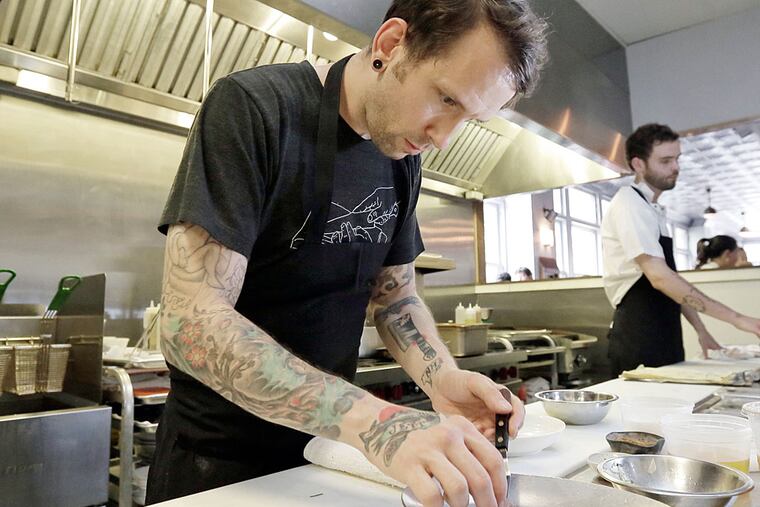
THEIR intentions shrouded by the cloak of deep night, the drivers hurried up the interstate. The body, sawed into four pieces, sat motionless in the back of the pickup, hidden from plain view. When they finally reached their destination, they heaved the fleshy quarters onto a metal table in a silent kitchen, where a tattooed man with a sharp, sharp knife went to work. Hours later, after the body was butchered beyond recognition, the man called his friends, each of whom grew giddy when told they were allowed to pick their favorite parts and play with them.
It sounds like an early treatment for season three of True Detective, but it's a little less sinister than that. The man with the knife was George Sabatino. The drivers were his mother-in-law and brother-in-law. The body? A 250-pound heritage breed hog from just outside of Tampa. And his friends? Fellow Philadelphia chefs, gifted with the opportunity to prepare this very special pork the way they wanted.
Whole hogs
Sabatino, who owns Aldine in Center City with his wife, Jennifer, likes to do things from scratch, seeing them through from start to finish. It's something he has in common with Jennifer's dad, Steve Conley, who lives in Valrico, Fla.
A security auditor who owns his own consulting firm by day, Conley is the type of guy to immerse himself in intense hobbies outside the office. He bred high-caliber German shepherds for years. He built his own Go-Karts. He kept beehives. He got really into archery. He earned a pilot's license.
About eight years ago, he and his wife, Sally, decided to make an effort to "start living more off the land," he said. The couple transformed their seven-acre estate into a small-scale working farm. One particular avenue that piqued his interest: raising pigs, especially the varieties championed by chefs for their unmistakable meat and fat.
Conley started with five animals, not-your-average classifications, such as Hereford, colored a vibrant white and red, and Mulefoot, an extremely rare breed distinguished by its non-cloven hooves. He developed a distinct diet plan for them, feeding them brewers grains and local fruit on top of what they could scrounge up in their pens. He also began cross-breeding them to build up their quality and his stock (he currently tends to about 15 animals).
The fledgling hog-meister picked up all the certifications and registered a name: Alafia River Heritage Farms. The plan: to market this "boutique swine," as he calls it, to the chef community. And even though he lived five states and a thousand-plus miles away, he knew that his son-in-law, so fixated on quality, was the best place to start.
Ridiculous yield
After taking one of his male Herefords through the certified slaughter-and-butcher process, Conley packed the pork, still in four parts, into ice (regular and dry) for the 15-hour drive from Florida to Philly. Sally, along with Jennifer's brother, Scotty, did the drive straight through. When they arrived, Sabatino and the Aldine kitchen crew knew they had their cutting work cut out for them.
The yield was ridiculous. Belly, trotters, shoulders, ribs, chops - the meat a deep, almost beef-like red far different in makeup than your average pallid supermarket pork. And fat - "the clearest, most beautiful I've ever seen," according to Sabatino - so flavorful that he's taken to whipping it up and serving it in lieu of butter with bread service. (People love it.)
In addition to the whole Hereford, Conley threw in a couple of extra pigs' heads into the order for good measure. Sabatino, suddenly, had more gorgeous pork than he knew what to do with. "My biggest fear was having some of it go to waste," he said.
Nose to toes (trotters)
For Sabatino, the solution to his so-much-meat problem - worse things have happened to a chef - was to hit up other chefs. "I reached out to the guys I'm closest to," he said. "The restaurants I eat at the most." Each would be allowed to grab some of the Hereford, free of charge, and do whatever they wanted with it.
Greg Vernick, whose Vernick Food & Drink is just a couple of blocks away from Aldine, swung by and called dibs on a head. He and his cooks boiled it in aromatics ("I was a little worried I wasn't going to have a pot big enough," he said), slipped on gloves and separated the bones, meat and fat by hand. It served as the basis for two specials that sold out immediately - a Sunday gravy-type pork-face ragu, with spaghetti and asparagus; and a headcheese with apricot mostarda.
Though Michael Solomonov doesn't typically serve pork at Zahav (it's not a kosher restaurant; he just generally avoids it), he snuck three dishes featuring the Hereford onto his Wednesday chef's counter menu - a merguez-style sausage, wrapped in grape leaves; a slow-roasted shoulder with apricots and chanterelles; and a pig-face schnitzel.
Scott Schroeder, the South Philly Tap Room and American Sardine Bar chef who's working on opening The Hungry Pigeon in Queen Village, opted for the back legs. He seasoned them and strung them up in the curing room at Le Virtu, in South Philly; on July 1, 2016, they'll officially be prosciutto.
Pat O'Malley, Schroeder's partner in The Hungry Pigeon, got lard from Sabatino. He plans on using it to make biscuits and "lardy cake," which is an English version of kouign-amann.
Philly pig share
The chef having the most fun, of course, is Sabatino himself. He's styled out both his happy-hour and a la carte menus with Hereford plates all over the map: the unmistakable belly, fried and served with squid and black rice crackers; Cotechino and fresh garlic-and-chive sausage over various sauces; and his favorite - crispy pig face, ear and snout and cheek and fat, breaded and fried and accompanied by mustard, salsa verde, pickles and salad. "Sticky, crunchy, unctuous," he said, grinning. "I didn't make it user-friendly at all." (And more dishes, from Aldine and elsewhere, are on the way - Conley hopes to make the Philly pig trip a regular thing.)
To those who don't understand how or why Philly chefs are as tight as they are, the move might come off odd. Why would Sabatino supply restaurants that are technically his competitors with a lofty, expensive product he could just keep for himself? It might be like that in other cities, but here, at least among Sabatino's circle, collaboration is community. "I didn't want to get all this pig, break it down and just put it in a freezer somewhere," he said. "I wanted it to be used."