Gelatin jogs, jiggles memory
It's the food you've shunned that has the greatest potential to surprise. Take this summer when I made, on a whim, Dorie Greenspan's citrus berry terrine for a family gathering. Despite the fancy name, it was a straight-up gelatin mold, flavored simply wi
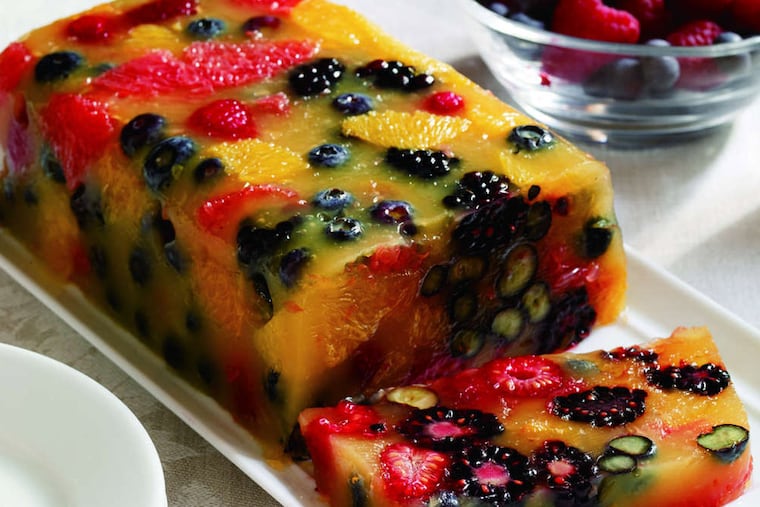
It's the food you've shunned that has the greatest potential to surprise. Take this summer when I made, on a whim, Dorie Greenspan's citrus berry terrine for a family gathering. Despite the fancy name, it was a straight-up gelatin mold, flavored simply with orange juice, though the jewellike flashes of segmented fruit in every slice made it look fancy and complicated. If I'd told my guests in advance what I would be serving, they might have scoffed, flashing back to pretzel and mandarin-orange studded rings of yesteryear, but their reaction to this fresh-tasting dessert was pure delight.
"It's a childhood memory so many of us have with gelatin. That refreshing taste and texture can be very nostalgic," says Abigal Dahan, pastry chef of Parc.
Besides the way-back factor, there's a lot to love about a fruit and gelatin combo in summer. It's light, (usually) low in calories, and palate cleansing. It's easy to whip up at home, and it makes an impressive presentation when set in a loaf pan, goblet, or even that old-fashioned ring. (If you want to go full-on retro, vintage molds abound on eBay and Etsy.)
Gelatin has also become more popular of late with the Paleo crowd, who rhapsodize about collagen's nutritional benefits for skin, joints, and digestion. (For vegetarian diners, there are animal-free alternatives such as agar agar, which have fewer health benefits but deliver a similar consistency.) Yet, aside from some novelty cookbooks, and the diehards who still make their jellied sweets from a little blue box, it hasn't really been embraced as a real dessert alternative.
Which is too bad because if approached with a more modern sensibility, gelatin can be a versatile canvas for flavors, lending itself to infinite variations of base liquids and fruits. "The greatest thing about gelatin is that it provides such a unique texture and mouth feel that also melts at right around body temperature. When used properly, it also has a very 'clean' taste, and thus can work with virtually any flavor," says Michael Laiskonis, consulting pastry chef for the Garces Group.
Author David Lebovitz's champagne gelée, originally conceived with winter's citrus, adapts wonderfully to a mix of sunny stone fruits and berries. Green grapes, lychee, mango, or kiwi could also work. If you think of it as a sophisticated take on the Jell-O shot, the effervescent champagne can be swapped out for light-tasting liqueurs, like elder flower or ginger, or other sweet wines like Marsala, port, and muscat. Note, as Laiskonis points out, that alcohol can change the gelling properties. "With alcohol or acidic liquids, its effect is lessened, but a slight increase [of gelatin] can fix that problem," he says. Dahan says it's best to add alcohol later on, or dilute it with water if it's directly mixed with the gelatin. For a booze-free version, tea - either black, green, or herbal - can serve as a delicate foil for the fruit.
The basic technique for suspending fruit is to soften (or "bloom" if you want to speak the language of pastry chefs) the gelatin with water and set it in the freezer or refrigerator until gelled. Then gently stir in raw or lightly sweetened fruit and set again in the freezer or refrigerator to re-gel. It's actually a much more forgiving substance than many people realize. If it gels too quickly, as it did once for me, set the mixture in a saucepan and warm it back up until dissolved and chill again.
To remove the mold from its host container, put the whole mold into a bowl of hot water for a few seconds and then carefully shake it from side to side. Set a plate on top of the mold and then flip it over, gently shaking again to remove the final product. Repeat if needed until the gelatin breaks free.
There's no reason not to break the proverbial mold, either. A small layer of gelatin can be incorporated into other fruit desserts, as with Daniel Boulud's lime gelée parfait, layered with strawberry puree, sliced strawberries, whipped cream, and vanilla ice cream. "When it's a small part of a constructed dessert, it can be a really nice, modern element," Dahan says.
Most of the pastry chefs I spoke to said they wouldn't dare serve a whole dish of gelatin as dessert in their restaurants - only as a side element, if at all. Maybe it's the technicolor food dyes it's been associated with, or its routine appearance on hospital trays, but there is just too much stigma attached to justify asking diners to pay $10 or more for a slice of translucent jiggliness.
"Gelatin is one of those old-school foods that hasn't exactly made its way back from obscurity yet," says Jessica Nolen, pastry chef of Brauhaus Schmitz and the newly opened Whetstone Pub.
That doesn't mean it's not worth a revisit. Nolen thinks it might well be time for gelatin's comeback, at least in households. "Of course there are going to be naysayers who will just think of weird colors and candied cherries, but there are plenty of people who still have a soft spot in their heart for good old J-E-L-L-OOOOO."
Citrus-Berry Terrine
StartText
Makes 10 servings
EndTextStartText
Segments from 2 navel oranges, cut into bite-sized pieces
Segments from 1 pink grapefruit, cut into bite-sized pieces
1/3 cup cold water
2 packets unflavored gelatin
2 cups orange or grapefruit juice
1/3 cup sugar
About 3 cups mixed blueberries, raspberries, and blackberries (if you want to add strawberries, look for small berries or cut larger ones into bite-sized pieces)
EndTextStartText
1. Put a double layer of paper towels on a cutting board and spread the citrus pieces out on the paper. Cover with another double layer of towels and set the pieces aside until you're ready for them. If the paper gets very wet, change it.
2. Put the cold water in a large bowl, sprinkle over the gelatin, and let it soften.
3. Meanwhile, bring the juice and sugar to a boil, stirring to dissolve the sugar. Pour some of the juice over the gelatin, gently stir to dissolve, and then stir in the rest of the juice. Put the gelatin mixture in the refrigerator and let it chill, stirring occasionally, until it thickens slightly, about two hours. You're looking for a mixture with the texture of egg whites.
4. Rinse a 9-by-5-inch loaf pan with cold water and shake out the excess. (I use a Pyrex pan.) Gently stir the reserved citrus segments and the berries into the lightly thickened gelatin mixture, and scrape everything into the pan. Jiggle the pan a little to settle the gel and chill for at least four hours or up to overnight.
5. When you're ready to serve the terrine, dip the pan into a bowl or sinkful of hot water for a few seconds, and run a blunt knife around the edges of the pan. Wipe the pan and unmold the terrine onto a platter.
Per Serving: 94 calories; 2 grams protein; 23 grams carbohydrates; 18 grams sugar; trace fat; no cholesterol; 3 milligrams sodium; 3 grams dietary fiber.EndText
Sparkling Wine Gelée with Stone Fruits
StartText
Makes 6 servings
EndTextStartText
1/2 cup plus 1/2 cup cold water
2 envelopes unflavored gelatin
1 cup sugar
1 bottle sparkling wine
Juice of 1/2 lime, plus more to taste
2 tablespoons sugar
1/2 cup water
1/2 cup blueberries
2 cups total peaches, nectarines, plums, or a mixture, thinly sliced
EndTextStartText
1. To make the gelée, into a large bowl pour ½ cup of the water. Sprinkle the gelatin evenly over the water and allow it to soften and swell for 5 minutes.
2. Meanwhile, in a small saucepan, warm the remaining ½ cup water with the 1 cup sugar, stirring until the sugar dissolves to create a syrup.
3. Pour the warm sugar syrup over the gelatin and stir until the gelatin completely dissolves. Add the sparkling wine (it will foam up; hence the large bowl) and the lime juice. Taste and add additional lime juice, if desired. Cover and refrigerate until jelled, at least 6 hours.
4. To prepare the fruit: In a small saucepan, warm the 2 tablespoons of sugar and remaining ½ cup water, stirring to dissolve the sugar. Remove from heat and gently (use a rubber spatula if possible) stir in all of the fruit, allowing it to soak for 15 minutes.
5. To serve, spoon some of the chilled gelée into 6 wine glasses or goblets. Add some berries and a few slices of fruit and layer with the gelée, repeating until each glass is full. Serve immediately or chill until ready to serve.
Per Serving: 274 calories; 3 grams protein; 46 grams carbohydrates; 43 grams sugar; trace fat; no cholesterol; 8 milligrams sodium; 1 gram dietary fiber.EndText
Tangy Strawberry Parfait with Lime Gelée
StartText
Makes 4 servingsEndTextStartText
1 teaspoon unflavored gelatin
1/2 cup sugar
1/4 cup fresh lime juice
1 teaspoon finely grated lime zest
2 pints strawberries, hulled and thinly sliced
1/2 vanilla bean, split lengthwise and seeds scraped
1/2 cup heavy cream, chilled
Vanilla ice cream, for serving
EndTextStartText
1. Set 4 martini glasses or shallow dessert bowls in the freezer. In a small cup, sprinkle the gelatin over 1 tablespoon of cold water and let stand until softened, about 3 minutes. Fill a medium bowl half full of ice water.
2. In a small saucepan, combine 1/4 cup of the sugar with 2 tablespoons of water and simmer over moderate heat just until the sugar is dissolved into a syrup. Remove the sugar syrup from the heat and whisk in the softened gelatin until dissolved. Stir in the lime juice and 1/2 teaspoon of the lime zest. Set the saucepan in the ice water bath and stir the gelée until cooled. Pour the gelée into the chilled glasses and freeze until firm, about 15 minutes.
3. Meanwhile, in a medium saucepan, combine 1 cup of the strawberries with 2 tablespoons of sugar and 1/4 cup of water and bring to a boil. Let cool slightly. Transfer the strawberry mixture to a blender and puree until smooth. Pour the puree into a bowl and stir in the remaining strawberries and half of the vanilla bean seeds; let cool.
4. In a medium bowl, whisk the heavy cream with the remaining 2 tablespoons of sugar, 1/2 teaspoon of lime zest and vanilla bean seeds until soft peaks form. Spoon the strawberry puree over the lime gelée. Top the strawberry puree with a scoop of vanilla ice cream and a dollop of the whipped cream and serve immediately.
Per Serving: 359 calories; 6 grams protein; 57 grams carbohydrates; 49 grams sugar; 14 grams fat; 52 milligrams cholesterol; 73 milligrams sodium; 4 grams dietary fiber.EndText