Red-, white- and blue-plate special at NCC
A new exhibit at the National Constitution Center explores how government policies have shaped the American diet - and waistline.
Wilbur Olin Atwater, considered to be the godfather of food science in this country, thinks "well-to-do" Americans have too much fat, too much sugar and not nearly enough physical activity. The many modern conveniences of the food supply have rendered the population unhealthy; we'd all do much better with a more reasonably balanced diet and regular rigorous exercise, the doctor and researcher concluded.
He drew that conclusion in 1890.
So, maybe our kinship with lousy-for-you foods and the associated laziness hasn't evolved all that much over the past 125 years. But so many other aspects of America's relationship with food have. The government has shaped how, what and why we eat more than many of us realize, whether we're talking the complexities of standardized food safety or the say our highest-ranking leaders have had on the contents of our refrigerators.
This very topic is the subject of a new exhibit at the National Constitution Center that takes a deep dive into Big Gov's hold over the food system, from the slaughterhouse to the White House.
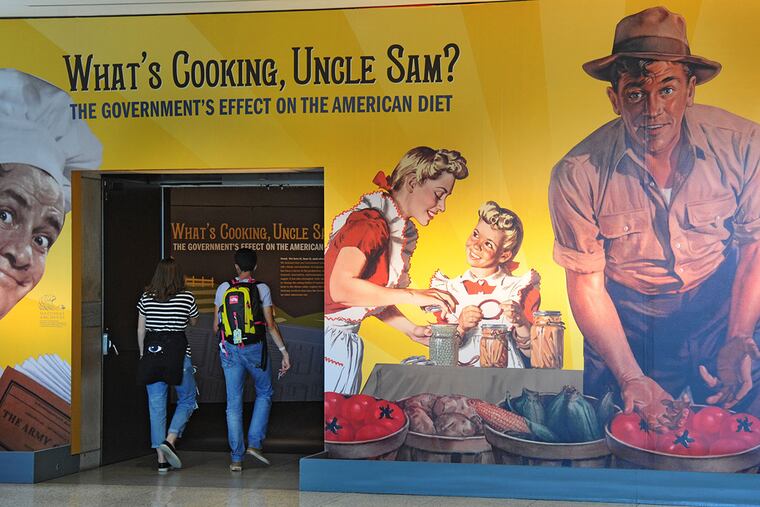
"What's Cooking, Uncle Sam? The Government's Effect on the American Diet," which opened last Friday, is a visiting exhibit from Washington, D.C.'s National Archives Museum, where it was first introduced in 2011. Digging up examples of government's attempts to "inspire, influence and control what Americans eat" was curator Alice Kamps' primary goal; the materials, hopefully, would illustrate how officials, overtly or not, strove to keep their citizenry well-fed.
"These documents and images reflect our current concerns about food safety and nutrition, and illuminate the origins of government programs and legislation aimed at ensuring that the foods Americans eat are healthy, safe and ample," said Kamps.
"Uncle Sam," an interactive multimedia exhibit set up on the NCC's ground floor, is organized into four specific areas of focus: "Farm," "Factory," "Kitchen" and "Table."
Far afield
Since the United States was, and still is, an agricultural nation, the exhibit's introductory section takes a look at how the government has attempted to collaborate with the American farmer, from setting prices on commodity crops to introducing hybridized plants more resistant to climate, pests and disease.
It's interesting to note just how many fruits and vegetables that we consider everyday supermarket staples were uncovered by intrepid, government-sanctioned explorers, then shared with American growers. ("The greatest service which can be rendered any country is to add a useful plant to its culture," Thomas Jefferson said.)
Kamps is fond of calling one of the most prolific of these explorers, Frank Meyer, "the Indiana Jones of the Department of Agriculture." Between 1905 and 1918, the adventurous, Dutch-born Meyer was responsible for introducing something like 2,500 new plants to American soil. The Meyer lemon, originally from China, is named after him.
The exhibit's "Factory" portion deals with a slightly less-romantic period of American food production, when concerns over product safety and consistency rose along with the industrial output of modernized food factories. The Pure Food and Drug Act and the Federal Meat Inspection Act, both instituted in 1906, were direct governmental responses to injuries and deaths suffered by both workers and consumers.
One particular point of interest here: The Jungle author Upton Sinclair's 1906 letter to Theodore Roosevelt, imploring the president to regulate the meatpacking industry.
Portion control
The "Kitchen" and "Table" sections of Uncle Sam take a more granular look at the American diet. Much of the research performed by groups like the USDA was designed to target the typical homemaker of the time, as she was considered the primary decision-maker when it came to her family's eating habits.
Big Food's intentions, however, weren't always scientifically sound. Look for the Department of Agriculture's circa-1992 food pyramid, hung right alongside a much older chart outlining the "Basic 7" food groups - one of which is butter. ("As a girl from Wisconsin, I am fully behind having butter on equal footing with fruits and vegetables," joked Kamps.)
In addition to explaining how school lunch programs and armed-forces-issued nutritional plans led to the widely accepted "meat-starch-veg" format of American meals, the "Table" category will be of particular interest to American presidential buffs, as it delves into the culinary proclivities of the POTUS throughout the decades.
Here, you can find JFK's New England fish-chowder recipe; a feature on Ronald Reagan's obsession with Jelly Belly jelly beans; avid grillmaster Dwight Eisenhower's instructions for an elaborate vegetable soup; and even a scone recipe from Queen Elizabeth II, provided to the White House at Eisenhower's request.
"What's Cooking, Uncle Sam? The Government's Effect on the American Diet," through Jan. 3. "What's Cooking? An Evening with American Chefs," an America's Town Hall event with national health policy expert Dr. Ezekiel Emanuel, 6:30 p.m. Oct. 21. National Constitution Center, 525 Arch St., $14.50, $13 seniors, students and ages 13-18, $8 ages 4-12, active military and ages 3 and under free, constitutioncenter.org, 215-409-6600.
Drew Lazor has been writing about the local food scene since 2005. His twice-monthly column focuses on unexpected people doing unexpected things in Philadelphia food. If you come across a chef, restaurant, dish or food-related topic that bears investigation, contact him at andrewlazor@gmail.com or on Twitter @drewlazor.