A chat with a global chef
Renowned London chef-restaurateur Yotam Ottolenghi has a new cookbook. That's is not surprising, of course, as he has already given the world four cookbooks in just about as many years: Plenty and Plenty More plus Ottolenghi: The Cookbook and Jerusalem with chef Sami Tamimi.
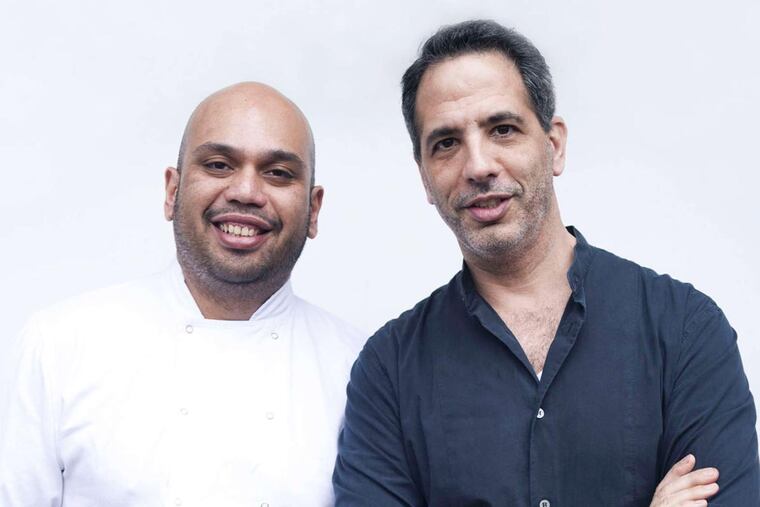
Renowned London chef-restaurateur Yotam Ottolenghi has a new cookbook. That's is not surprising, of course, as he has already given the world four cookbooks in just about as many years: Plenty and Plenty More plus Ottolenghi: The Cookbook and Jerusalem with chef Sami Tamimi.
His latest is NOPI: The Cookbook (Ten Speed Press, $40). It is as gilded as the upstairs dining room at his Soho restaurant and as casual as the communal tables in the downstairs dining room overlooking a kitchen where chef Ramael Scully, coauthor of this book, creates globally seasoned dishes such as those in the book: lemon sole with burned butter, nori, and fried capers. Seared scallops with pickled daikon and chili jam. Burrata served with blood-orange slices, coriander seeds, and lavender oil. A coriander and ginger martini.
Credit Scully for adding another dimension to Ottolenghi's pantry at NOPI (that's "north of Piccadilly"). Ottolenghi, an Israeli native who pursued a culinary career at Le Cordon Bleu in London and who has several restaurants and delis there, has won raves for his mix of Mediterranean and Middle Eastern flavors and his casual approach to plating. Scully, born in Malaysia, honed his culinary skills at top-notch restaurants in Australia and now adds his appetite for Asian ingredients to the NOPI menu and cookbook.
Ottolenghi recently to chatted with us from London about the new book and the role food has among the humanities. This interview has been edited for space.
In your new book, you write about culinary baggage. Is this purely taste memory, or are there other elements packed in our culinary baggage?
Obviously, there are all those recollections and flavors of your distant past, your childhood. But there is also baggage that relates to how we tend to cook as an adult. . . . It's my job. It's what I do often when I come home from work and when I have guests over. Everything is connected. So when I talk about baggage, I mean all those aspects of food that I am exposed to or actively pursue in my daily life. . . . They obviously inform the way you cook, the dishes you make up, and how you present them and how you like them seasoned.
You also write about developing recipes with Scully, and, well, his culinary baggage. So, if each of you were a suitcase would you be the Louis Vuitton and Scully a rucksack?
I guess, if you look at me, you would think I would be a Louis Vuitton person. And Scully would be looking more like a rucksack. But if you look at the way we cook, I'm more of the rucksack and he's more Louis Vuitton. Scully is a bit more formal in his cooking. He's been working in formal restaurants for longer than me, and he's restaurantly minded, while I'm much more of a domestic cook these days. I'm more free form, less complicated processes, and less structure on the plate.
Your books have always had a freewheeling approach. This cookbook seems slightly more structured, while still encouragingcooks to step outside the recipe.
I do like breaking the boundaries, because I don't think I've grown up in a very strict culinary tradition. . . . I don't feel I'm deeply entrenched in one food culture or one culinary culture. So I find it quite easy - almost natural - to go in between culinary cultures. . . . And I enjoy doing this because it's fun; it's fun to play with food. . . . If you want me to make a little generalization about the world, I do think that more people these days are like me, rather than the other way around, only because we are so exposed to so many types of food because of the ease of communication and travel.
So are the recipes more complicated than your previous books?
We tried to really make it doable for people in their home. If you have a bit of knowledge, a bit of experience, then you can make any recipe in the book. If you have very little experience, you can probably make about 50 percent of the recipes in book. . . . There are some recipes that do take time, in the sense they have several elements that need to come on the plate together and you need to start preparing them in advance. . . . It was very important to me that people would actually carry this book into the kitchen and use it.
I try to, as much as I can when I test the recipes, predict difficulties and issues that readers might have when trying to cook the dishes. And I try to preempt those questions myself by giving as much information as I can in the recipe. My recipes are the least vague recipes I can think of - and that's on purpose.
Why should food be an element of a humanities festival?
My theory is that food has been lifted out of a certain cultural ghetto over the last 10, 20 years. . . . Food has become, especially in the English-speaking West, more than fuel. But it hasn't had its day in other creative arenas. People are realizing this is an area where humans create. Food had to join all those creative arts because it's one of those things that most people actually enjoy. In the other arts, you kind of have partial participation. With eating, you've got hands-on participation. Everybody participates. And people are doing very creative stuff. It makes sense to have people who are constantly working on enriching our culinary lives to showcase their creation.