Historic Cliveden expands its story beyond its famous battle to ... kitchens
One day last month, a staffer was startled to see what appeared to be at least 25 - a full platoon! - fit-looking, short-haired young men gathered under the flowering dogwoods off Germantown Avenue on the lawns of Historic Cliveden.
One day last month, a staffer was startled to see what appeared to be at least 25 - a full platoon! - fit-looking, short-haired young men gathered under the flowering dogwoods off Germantown Avenue on the lawns of Historic Cliveden.
They were Marines (in civilian dress), up from Quantico, Va., on a tour of Revolutionary War battle sites. And Cliveden, a stop rarely missed, is the scene of the Battle of Germantown, a particularly ferocious engagement that left its walls pocked by musket shot and streaked, in one bedroom, with British blood.
It wasn't so much that the visit was odd. It was that it was unexpected, and the staff was busy that day, concentrating more on butter than guns. Cliveden was adding a new wrinkle to its brand, getting ready to open the latest exhibit - on its workaday history, not simply its military past.
There were meat grinders to the right, a charred colonial hearth to the left; recipes pinned down, the cramped quarters of the estate's enslaved Africans, so long hidden in shadow, were about to undergo closer inspection.
It was about kitchens. And how they - and the workers who toiled there, and the food raised in kitchen gardens and plantations across Pennsylvania, Delaware, and Maryland, and the march of gadgetry, and the imperatives of laundering - shaped lives and history as much as, perhaps even more enduringly than, that single, horrific battle in 1777.
The battle, offered David Young, the site's director, "was 2½ hours" in the 250-year history of Cliveden.
"We were leaving out a couple of centuries."
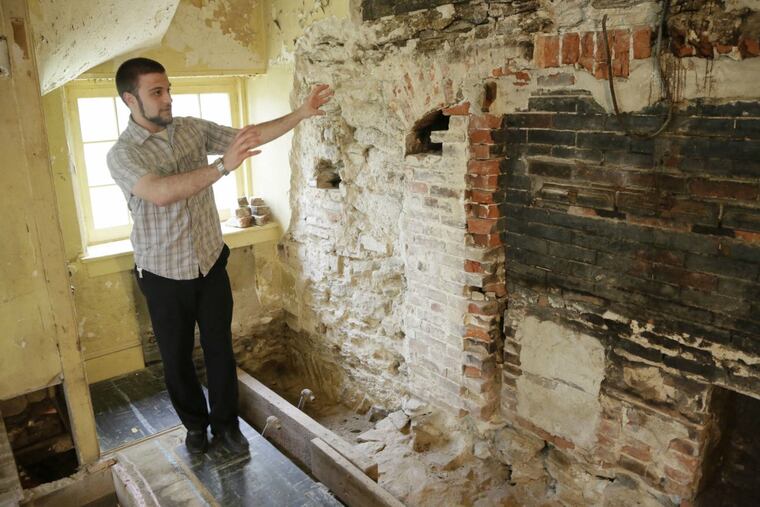
Not long after the Marines left that day, one could find a squad of preservationists digging about in Cliveden's kitchen house - the so-called Kitchen Dependency, dating to 1767.
This, too, was being readied for the tour. In the dirt crawl space beneath the floor, preservation director Libby Hawes was bagging bones sliced with cleaver cuts. Philip Scott, another researcher, held up a rusted knob he'd just found, presumably from the cast-iron range that replaced the hearth whose brickwork had been concreted over to accommodate the newfangled stove.
There were more than a few questions on the table: Who cut those bones? What were the meals like? What was it like in the confines of the kitchen's upstairs, where the kitchen help slept? How did that differ from the lifestyle in Cliveden's "Big House," where Benjamin Chew, the wealthiest landowner and largest slaveholder in the colony of Pennsylvania, once entertained the Marquis de Lafayette at a legendary post-Revolution banquet?
Finally, could the site's Living Kitchens project, funded by a grant from the Pew Center for Arts and Heritage, succeed in writing a new chapter of Cliveden's story of the War for Independence? Could it add its lesser-known, off-menu role in the struggle for black liberation, the struggle for freedom from human bondage?
The answers may become clearer as staffers sift through more than 200,000 pages of documents donated by family heir Samuel Chew. They may become more nuanced, too, as current residents of Germantown and beyond - belatedly invited into the conversation - share their own family histories.
Still, as important and compelling as Cliveden's narrative of wealth and elegance, exploitation and war is, it can seem to reside at a bit of a remove.
"Whereas," Young pointed out, "everyone has a kitchen."
A couple of days after the Marines landed, the Living Kitchens' new community exhibition - "Mixing Memories: Sharing History" - opened in Cliveden's airy stone carriage house.
Times had changed, indeed. Nearby, the old hearth and subsequent iron stove had been superseded. A 1959-vintage prefabricated kitchen with enameled sea-foam-green cupboards, double-decker oven, and dishwasher had long since been added to the mansion (where Chew family members lived until the early 1970s).
It is just steps away from the colonial-era hearth, providing a convenient physical timeline with which to measure the impact of technology - for better or worse - on hand work.
In a display case were objects that locals had donated from their kitchens - a table-mounted, hand-cranked meat grinder, a conical metal sieve called a chinois, a yellow plastic egg separator.
There were vintage recipes - one for lemon dumplings. And well-used ones: Mary Ann Lancaster Tyler shared one for "Lite and Hi Hotcakes" along with a 1949 photograph of her parents, who once ran Mary Ann's Lunch Bar & Tea Room three blocks east of Cliveden.
So went the pace of Cliveden's "emancipation" - as its own literature calls it - from an incomplete history. Already, the kitchens project has featured talks by a visitor who got inspiration from sleeping in the old slave quarters; an academic who had found a surprising degree of domestic power and autonomy wielded by enslaved cooks; a discourse on colonial tavern workers (Philadelphians consumed nine gallons of hard liquor per capita annually in colonial days, fully four gallons more than today's national average); an examination of how domestic architecture affected workers on rural plantations; and, later, how Jell-O parties came to be markers of status. (They were a sign you'd replaced the icebox with modern refrigeration.)
"History depends on where you're standing," Young said. "And history looks different when you're standing in the kitchen."
For more information on Cliveden and its Heritage Award celebration, go to cliveden.org.