Why local barkeeps have fallen in love with sherry
A curious collection of small bowls were laid out on a table at Jamonera the other day: Marcona almonds, boquerones, red grapes, olives, flatbread crisps, pimento cheese spread, chorizo, salt cod, pork rillettes, three cheeses, walnuts, and squares of Hershey's chocolate.
A curious collection of small bowls were laid out on a table at Jamonera the other day: Marcona almonds, boquerones, red grapes, olives, flatbread crisps, pimento cheese spread, chorizo, salt cod, pork rillettes, three cheeses, walnuts, and squares of Hershey's chocolate.
Terence Lewis, the sommelier at this Midtown Village restaurant, had assembled the foods to illustrate for the waitstaff the complexities of one wine: sherry.
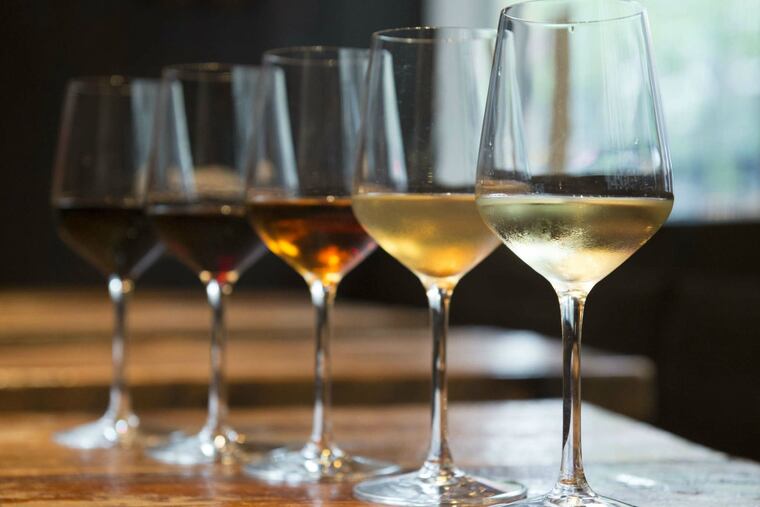
Ten glasses of the aperitif were lined up. One was the color of clarified butter; another, apple juice; yet another, motor oil.
Aided by maps and graphics, Lewis launched into an explanation of the Spanish wine's convoluted history and production process that touched on the Moors, trade winds, yeast, and oxidation. He chronicled the nuances of 10 styles of sherry, beginning with a bone-dry varietal and ending on a sticky-sweet note. The last wine, a syrupy Pedro Ximenez, smells and tastes like raisins. But take a sip alongside a bite of funky blue cheese and it makes perfect sense.
Jamonera may be the sherry epicenter of Philadelphia (it carries 47 variants), but the centuries-old fortified wine has gently muscled its way out of the Spanish-restaurant stereotype and into the repertoire of the city's booze-savvy set. Its broad spectrum of flavors has helped the multifarious white wine shake a bad reputation acquired over recent decades.
Local barkeeps and restaurateurs have incorporated sherry into drink menus and wine lists, stirring it into cocktails and serving it straight. Yet the wine's resurgence might be chalked up to passion more than demand. Whether that enthusiasm can successfully trickle down to customers remains an unanswered question.
Sara Justice, head bartender for the Franklin Bar and the Upstairs Bar, first encountered sherry when she began mixing it into concoctions at the Rittenhouse speakeasy around 2012. During a later stint in New York City, she would return to her Brooklyn apartment after bartending and sip an amontillado, a lighter style.
"Sometimes, you get off work and you just want a really easy, simple beer," Justice said. "That's how I equate it in my mind."
That's a marked shift from past portrayals of sherry as a nightcap or nerve-settler for Frasier Crane from Cheers and the dowager countess on Downton Abbey - or as the dusty bottle of Taylor cooking wine in the back of the liquor cabinet.
"I think the perception of fortified wine previously was the trashy stuff," Lewis said, citing tooth-achingly sweet cream sherries and Madeira as possible culprits.
But the current quest among mixologists for novel offerings has pushed Philadelphia bartenders to draw on unconventional ingredients, and sherry fills the bill. Its diverse flavors and relatively low alcohol content (usually between 15 percent and 22 percent alcohol by volume) lends it to mixing.
Sherries are great for spring and summer drinks, said Pete Venuto, general manager of Charlie was a sinner. "You get the flavor, but they're not heavy." Venuto adds orange bitters to Dios Baco amontillado and Carpano Antica vermouth to make an Adonis, a pre-Prohibition cocktail. He uses the same sherry as a base in a Mr. Banks, a citrus-heavy cocktail he plans to feature on the vegan restaurant's menu.
"The orange flavors tend to go well with the sherries," Venuto said.
At the Franklin, Justice calls on the briny characteristics of fino sherry to bring out the spicy, vegetable qualities in a tequila punch. Though she came to sherry through cocktails, Justice knew she wanted to serve it neat when she and her staff opened the Upstairs Bar last fall. At first, the Franklin's aboveground neighbor offered sherry by the pour. But the wine didn't sell well enough; it is selling better by the bottle. The Upstairs Bar sells six varieties of sherry by the bottle (375 ml, about $20 to $30).
Seth Biederman, an account manager for the Wine Merchant, a Pennsylvania wine distributor, sells sherry to the Upstairs Bar, as well as to high-profile restaurants such as Alma de Cuba, Volver, Barclay Prime, and Townsend. But he also sells it to lower-key establishments, like Pub & Kitchen, Fitler Dining Room, Southwark, and Plenty Cafe.
An importer got Biederman hooked on sherry five years ago. After that, he determined to pitch it to clients, whether they wanted to listen or not. "I didn't even care if they bought it," he said.
But then, he said, "unexpectedly, people in places that I didn't think would buy it . . . they actually were like, 'Yeah, let me try that.' " Establishments with no connection to sherry would order it for curious, engaged customers in search of something fresh.
"It's the one thing that people kind of remember," Biederman said. "They forget about the endless gallons of chardonnay they drink, but they remember the two ounces of fino they had that one time."
For those still thinking about sherry as what grandma drank, Justice has a response: "Well, your grandmother's probably awesome, then. You should want to be more like her."