Lavender where you'd least expect it
Certain herbs seem to belong in certain dishes: Sage defines poultry stuffing. Tarragon dazzles in sauce béarnaise, and, as it happens, lavender is killer in pork fried rice.
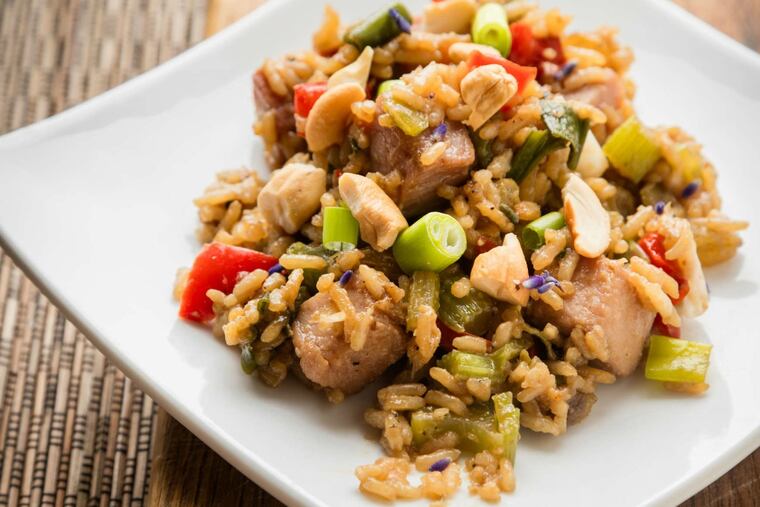
Certain herbs seem to belong in certain dishes: Sage defines poultry stuffing. Tarragon dazzles in sauce béarnaise, and, as it happens, lavender is killer in pork fried rice.
Oh, wait. You don't put lavender in your fried rice? Well, you're missing out.
Those who taste my lavender-enhanced version often comment on its herbal element, but they never can identify it, perhaps because it seems refreshing and modern and not at all how they imagine lavender tastes. I'm obliged to clear things up for you: Lavender does not have to taste like it smells in lotions and soaps.
In fact, this herb has a chameleonlike spicy, citrusy, piney character that mingles with and amps up the flavor of fruits, nuts, creamy cheeses, and meats. It can lend a palate-pleasing pop in far more dishes and cuisines than you would ever guess.
I began experimenting with lavender in baking a decade ago and was soon hooked. Like vanilla, lavender added a little something extra to nearly every pudding or cake or meringue. In recipes with oranges, lemons, or honey, that something extra was significant. Today, I wouldn't consider preparing orange marmalade, lemon pots de crème, or sublime candied pecans without it.
But I didn't see the potential of lavender in contemporary savory dishes until more recently, thanks to Yotam Ottolenghi's lavender-infused burrata with blood oranges. At his high-profile London restaurant, Nopi, customers order this signature appetizer 1,000 times each month. The recipe appears in his award-winning Nopi cookbook. "It's never left the menu," he told me during a recent phone interview from his home.
"When we were creating it, we felt it was missing something aromatic. And we really like using aromatics," he says. "As soon as we tried lavender, we knew it was right." Its pungency nicely balances the sweetness of the fruit and the creaminess of the cheese.
Another Ottolenghi dish that demonstrates lavender's power includes peak-of-season apricots or peaches roasted with honey and garnished with tiny lavender blossoms. "The fruits caramelize, and the aroma and flavor are wonderful," he says. I liked the sound of the dish so much, I riffed on it in my own stove-top version.
Like rosemary and cilantro, lavender is potent, so less is often more, especially for those who've never tasted it. Also, when you are ready to cook with it at home, make sure it's designed for the kitchen, not for crafting. Fresh and dried lavender buds typically can be used interchangeably, but fresh is more potent and infuses mixtures more quickly. Good sources for culinary dried lavender are gourmet and health food stores, and online. Although the herb's harvesting season is winding down, you might still find fresh and newly dried lavender at local farms and farmers' markets.
Fresh lavender bunches begin drying out almost immediately after being cut, and once fully dried, all bunches are harvested the same way: Simply rub the spikes between your fingers over a large plate to capture the fragrant buds that fall away. The aroma and taste are extra zingy, and the vivid purple bloomlets look lovely strewn across a sweet or savory dish. But be sure to use only pesticide-free plants. Specifically, seek out culinary varieties: The sweetest and tastiest of all are the "English" angustifolia lavenders; alternatively, go for the "French" lavandin (hybrid) lavenders such as the famous "Provence."
Avoid all the "Spanish" or stoechas lavenders (those with pine-cone-shape spikes and little floral topknots) and the ones labeled "fern-leaf" or "denta." Those are too peppery and resinous to eat.
Innovative chefs are always looking to deliver novel flavors and bigger, bolder sensory experiences for their diners, which is doubtless why lavender is having a moment. A few ways to jump-start your lavender immersion:
Like tea, lavender flavor is best when the fresh spikes or dried buds are combined with barely boiling liquid and allowed to stand. Steeping it in hot water, oil, cream, or other liquids is a common way to extract lavender's flavor for cooking. Taste the infused mixture occasionally, and once the lavender flavor has reached the desired strength, strain the liquid through a fine-mesh sieve. It's then ready to use. Avoid a long infusion or lengthy cooking of lavender, as that can make the herb taste harsh and stale.
Crushing, grinding, or mashing lavender into dry ingredients such as salt, sugar, and flour using a mortar and pestle or food processor is another handy infusion method. For fine texture, strain the mixture through a fine-mesh sieve to remove any remaining lavender bits before adding the mixture in a recipe.
Try substituting lavender in recipes that call for rosemary or thyme. Lavender has a somewhat similar scent and pungency yet is a nice change of pace, especially when paired with lamb, pork, smoked meats, duck, and poultry. Like rosemary leaves, dried lavender buds often are a bit too coarse to add as-is to some recipes. You can chop them or crush them using a mortar and pestle. Or prepare a large quantity in advance by putting at least 1/4 cup in a food processor; process for four or five minutes, or until coarsely ground. (The same job will take about a minute in a spice grinder.)
Pluck the tiny bloomlets, called corollas, from fresh lavender spikes and use them to add beautiful color and tempting little pings of flavor to dishes. You can also garnish using whole sprigs and chopped tender leaves; the latter are less potent than the spikes.
Baggett is the author of numerous cookbooks. Her next work will be "The Art of Cooking With Lavender," coming late this fall.
Lavender Pom-Berry Sorbet
StartText
Makes 1 quart, or 8 servings
EndTextStartText
2 cups fresh or frozen/defrosted blackberries, coarsely chopped
11/2 cups water
11/4 cups pure bottled pomegranate-blueberry juice, plus more as needed
6 tablespoons sugar
1/2 cup clover honey, plus more as needed
1 tablespoon chopped fresh culinary lavender spikes (bloom heads) or 1 tablespoon dried culinary lavender buds (see recipe for Candied Lavender Pecans)
1/3 cup fresh lime juice
EndTextStartText
1. Thoroughly stir together the blackberries, water, pomegranate-blueberry juice, sugar, and honey in a medium nonreactive saucepan. Bring to a boil over medium-high heat, stirring. Adjust the heat so the mixture boils gently, and cook until the berries are soft, 5 to 7 minutes. Stir in the lavender and lime juice, then remove from the heat.
2. Taste, and thoroughly stir in a little more honey, as needed. Let stand at room temperature for 1 hour (fresh lavender will infuse much more quickly than dried buds). Taste; if the lavender flavor is pronounced enough, strain the mixture through a sieve into a 4-cup measure. Press down with a spoon to extract as much liquid as possible. For more intense lavender flavor, refrigerate, tasting occasionally, for up to 3 hours before straining. Stir enough additional pomegranate-blueberry juice into the measure to yield a generous 33/4 cups.
3. Refrigerate, covered, until well chilled. Pre-chill a storage container to hold the finished sorbet. Process the mixture in an ice cream maker following the manufacturer's directions. Immediately put the sorbet in the chilled freezer container and freeze until firm, at least 1 hour, before serving. Freeze for up to 2 weeks. - From cookbook author Nancy Baggett and the Washington Post
Note: The berry-juice mixture needs to infuse for at least 1 hour and up to 3 hours. The sorbet needs to firm up in the freezer for at least 1 hour before serving, and it can be frozen in an airtight container for up to 2 weeks.
Per 1/2-cup serving: 140 calories, no protein, 37 grams carbohydrates, 34 grams sugar, no fat, no cholesterol, no sodium, 2 grams dietary fiber.EndText
Pan-Grilled Apricots With Honey-Orange Lavender Syrup
StartText
Makes 5-6 servings
EndTextStartText
For the syrup:
2/3 cup clover honey
1 teaspoon finely grated orange zest
1/2 cup plus 1 tablespoon fresh orange juice or blood orange juice
1 tablespoon chopped fresh culinary lavender spikes (flower heads) or 1 tablespoon dried culinary lavender buds
1 teaspoon coarsely crushed coriander seed
For the fruit:
6 or 7 medium, just-ripe peaches or nectarines, or 8 or 9 large just-ripe apricots
1 tablespoon unsalted butter
1 teaspoon olive oil or safflower oil
Pinch fine sea salt
EndTextStartText
1. For the syrup: Stir together the honey, zest, juice, lavender, and coriander seed in a medium nonreactive saucepan until well blended. Bring almost to a boil over medium-high heat, stirring occasionally. Remove from the heat and let stand 1 hour to allow the flavors to infuse. Taste; if a more pronounced flavor is desired, cover and continue infusing the syrup for up to 4 hours, until the desired flavor is developed.
2. Reheat the syrup over medium-low heat until warmed through, then strain through a fine-mesh sieve into a glass jar or other nonreactive storage container. Discard any solids. The yield is 1 generous cup; you'll need 1/3 to 1/2 cup for this recipe (to taste). The rest can be refrigerated in an airtight container for up to 2 weeks.
3. For the fruit: Thoroughly wash the fruit and pat it dry. Cut each peach or nectarine into 5 or 6 wedges; cut apricots in 4 or 5 slices. Discard the pits.
4. Heat the butter, oil, and salt in a large skillet over high heat until bubbling and hot but not smoking. Add the fruit pieces, flesh sides down; sear them until nicely browned, about 2 minutes. Stir in 1/3 cup of the honey-
lavender syrup, reduce the heat to medium and cook, stirring and gently turning the fruit, for 2 to 3 minutes more until the liquid boils down and begins to caramelize but the fruit pieces still hold their shape. Use a slotted spoon to immediately transfer the fruit to a plate.
5. Add 2 or 4 more tablespoons of syrup (use the larger amount with tarter fruit) to the skillet. Cook, stirring, until reduced and slightly thickened. Let cool in the skillet.
6. When ready to serve, return the fruit to the skillet and cook over medium-low heat, gently stirring, just until reheated and well coated. Strew the fruit with fresh lavender "bloomlets" before serving, if desired. Pass syrup at the table, if you like.
- From cookbook author Nancy Baggett
Note: The syrup mixture needs to infuse for at least 1 hour and up to 4 hours.
Per serving (based on 6, using apricots, olive oil, and 1/3 cup syrup): 110 calories, 1 gram protein, 21 grams carbohydrates, 19 grams sugar, 3 grams fat, 5 milligrams cholesterol, 45 milligrams sodium, 1 gram dietary fiber.EndText
Quick Ham-Fried Rice With Lavender
StartText
Makes 2 to 3 servings
EndTextStartText
2 tablespoons safflower oil, sesame oil, or other vegetable oil
1 cup thinly sliced scallions (white and green parts), plus 11/2 tablespoons coarsely chopped scallions (white and light-green parts), for optional garnish
1 cup chopped celery
1/2 cup seeded, chopped red bell pepper
1 to 11/4 teaspoons finely minced fresh culinary lavender spikes (bloom heads) or coarsely ground dried culinary lavender buds
11/4 teaspoons minced or grated peeled fresh ginger root
1 to 11/2 cups trimmed and coarsely diced thick-sliced baked ham or pre-cooked ham steak
21/2 cups cooked and cooled long-grain white or brown rice
1/2 cup golden or dark seedless raisins, or a combination
21/2 to 3 tablespoons low- sodium soy sauce, or more as needed
1/4 to 1/2 teaspoon freshly ground black pepper
11/2 tablespoons salted peanuts or cashews, for garnish (optional)
EndTextStartText
1. Heat the oil in a large skillet or wok over medium-high heat. Once the oil is shimmering, stir in the cup of sliced scallions, the celery, bell pepper, lavender (to taste), ginger, and ham; cook, stirring frequently,
2. Thoroughly stir in the rice, raisins, 21/2 tablespoons of the soy sauce, and the black pepper (to taste). Continue cooking, stirring, for 3 to 4 minutes, until the vegetables are crisp-tender and the rice is heated through. Taste, and add more soy sauce, as needed.
3. Transfer to a serving bowl or divide among individual plates. Garnish with the chopped scallions and peanuts or cashews, if using. Serve right away.
- From cookbook author Nancy Baggett
Per serving (based on 3, using safflower oil, baked ham, brown rice and golden raisins): 420 calories, 15 grams protein, 63 grams carbohydrates, 17 grams sugar, 14 grams fat, 30 milligrams cholesterol, 900 milligrams sodium, 6 grams dietary fiber.EndText