The BBQ pork rib, that fine piece of swine
Bring on the rubs and mops - ribs can take 'em. But keep that grill temperature uniform.
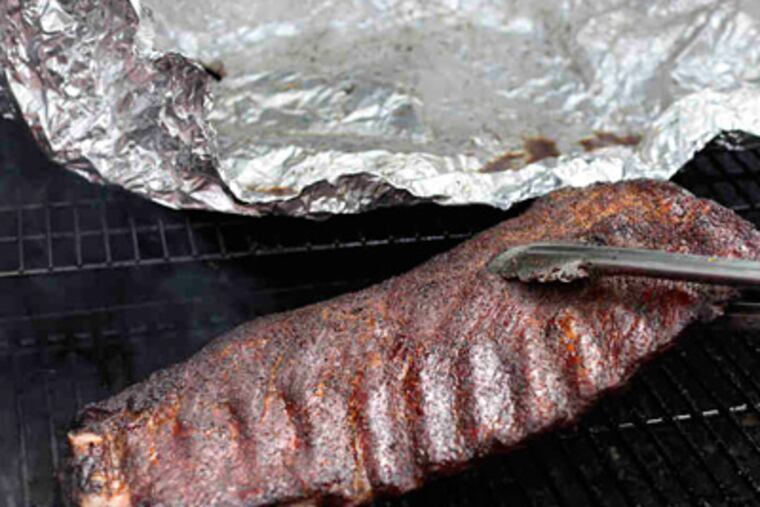
For years, Lou Cantolupo would coax magic from his backyard smoker for the barbecues he and his wife held for relatives and friends.
Fortunate to be among the chosen gaggle, I'd park in front of his house and follow my nose across the lawn, hypnotized by the wafting scent of slow-smoked pork shoulder, brisket, sausage, and ribs.
Of the glistening meats he'd pile onto platters, none so enraptured me as the racks of mahogany-hued spareribs. Before biting into one, I would regard it for a second or two, lost in reverie: This royal bone, this meat of majesty, this Pork Rib.
And then I would tear into its juicy, smoky, tender flesh like a crazed dog.
The best ribs are tender but not submissive. They make you work just a bit for their reward. What you are aiming for is a juicy rib with a little tug. Some chew helps you savor a rib's deep, rich pork flavor.
Basically, there are three varieties: baby backs, spareribs, and St. Louis-style ribs.
"Baby back" is the common term for top loin ribs, which start just below the backbone and extend down about four or five inches. They are succulent and mild in flavor. (Actual baby backs, which come from young hogs, are far less common.)
Spareribs are more flavorful than baby backs. They're also tougher, but when cooked properly they yield the perfect combination of flavor and texture. About three or four inches longer than baby backs, they include the gnarly tips, a flap of meat known as the skirt or brisket, and a triangular end piece called the point.
St. Louis-style ribs are spareribs trimmed of the tips, skirt, and point. They're deep in flavor, but if you like to gnaw, you'll miss those tips. The rack is fairly rectangular in shape, thus easy to flip, move, and cook uniformly.
Regardless of the type you get, make sure they're fresh. After getting them home, opening them up, and waving away a foul odor, I have taken ribs back to even high-end grocery stores. Some stores get ribs frozen, others fresh. If you are buying fresh, make certain you know the delivery days. You don't want to buy a rack on Tuesday morning that came in on Friday. These days, if ordering fresh ones from the meat counter, I always ask to smell them first.
A great thing about ribs is that they are forgiving. Rub them with seasonings. Plunge them into marinade. Mop them with sauce. Grill them, smoke them, do pretty much whatever you want with them. Ribs can take a lot of what you dish out. It is their compliant nature.
That doesn't mean you can treat them willy-nilly. Abuse them by cooking them too fast or by not keeping your fire steady, and they'll turn tough and dry.
"The key is temperature," says Lonnie "Bubba" Smith. "Make sure the temperature is uniform."
Smith ought to know. His family-and-friends team, Bubba Grills, has won numerous awards and, most recently, took first prize this year in the ribs category at the Memphis in May barbecue contest, one of the biggest such competitions in the country. The 49-year-old engineer, who manufactures his own line of grills, learned to barbecue while growing up in Georgia, where he still lives. "I started out watching my great-uncles raise the pigs, shoot them on Saturday morning, and put them on the grill till Sunday," he says.
His advice? "Be a sponge," he says. "Soak up everything that everybody does. We keep a journal of everything we do. You have to take notes, and go on what worked and what didn't."
But as exacting as he is, he acknowledges that cooking ribs is also about feel. "It's an art and a science," he says. "The ambient temperature outside makes a big difference. A 100-degree day is a lot different from a 70-degree day, and a 70-degree day is a whole lot different from a 50-degree day."
Lou Cantolupo, meanwhile, won't be holding backyard court this summer. Last summer he moved to France, where he lives in an apartment and is prohibited from grilling or smoking. And he's none too happy about it. "Oh, man. I want to barbecue."
Texas-Style Salt-and-Pepper Spareribs
Makes 3 to 4 servings
EndTextStartText
2 tablespoons kosher salt
2 tablespoons freshly ground black pepper
1 teaspoon cayenne pepper (optional)
12 ounces beer, such as a lager (optional)
1 rack (about 3 pounds) pork spareribs
EndTextStartText
1. If using a smoker, start a charcoal fire in the firebox. If using a charcoal grill, prepare the grill for indirect or two-zone grilling: Light the charcoal in a chimney starter and let the briquettes burn until the flames subside and a light layer of ash covers the briquettes (about 20 to 25 minutes). Dump the lighted coals into 2 mounds (or, preferably, into 2 half-moon-shaped briquette baskets) on opposite sides of the grill. Place a drip pan between the piles of coals.
2. Whisk together the salt, black pepper, and the cayenne pepper, if using, in a small bowl. If using the beer, pour it into a bowl.
3. Place the ribs on a cutting board. There is a thin membrane on the bone side. Some folks say it prevents flavor from penetrating the meat and is papery to chew on. But pulling it off can be a little tricky, and a lot of ribs are served with the membrane still on. The choice is yours. If you opt to remove it, slide a small knife beneath the membrane to cut it enough so you can grab it with your hands and pull it off. The best place to insert the knife is in the midsection, so you can tear off first one side, then the other.
4. Coat both sides of the ribs liberally with the seasoning mixture and rub it into the meat.
5. To cook in the smoker: When the coals turn ashen, open the chimney completely and add 2 split logs or 6 hardwood chunks. Let them burn for about 10 minutes or until they start to flame for a couple of minutes; close the firebox door. When the logs or hardwood chunks start smoldering and smoking, set the ribs on the grate, bone side down, in the cooking chamber, as far from the fire as possible. Shut the chamber door and close the chimney one-half to three-quarters of the way; adjust to maintain the temperature inside the smoker between 225 and 250 degrees. Add 2 logs or 6 hardwood chunks as needed after roughly 2 hours. If the fire gets too hot (325 degrees or higher), close the chimney completely until the temperature falls to about 250 degrees. If the fire falls below 225 degrees, add another log or two, and make sure they catch fire before you close the firebox.
6. To cook in the grill: When the grill is set up as directed above and the coals are ashen, place 2 or 3 hardwood chunks (or a cup of the soaked wood chips; see Note) on the coals, place the grill rack in position and cover the grill. When the hardwood chunks start to smoke, place the ribs on the grill rack above the drip pan, bone side down. Maintain the temperature inside the grill between 225 and 250 degrees. Add charcoal and hardwood chunks/chips as needed, about 1 cup after the first 2 hours and 1 cup after 4 hours.
7. To cook in a gas grill: Place the wood chips in a smoker box or a foil packet with fork holes puncturing the top to let smoke escape. Preheat the grill to high. When smoke appears, reduce the heat to medium.
After 11/2 hours, if using the beer, baste or mop the meat side, then turn the ribs over and baste the bone side. Close the lid after each subsequent basting. Repeat the procedure 11/2 hours later. If you don't use the beer, you don't need to turn the ribs over.
8. After a total of 3 hours, wrap the ribs in aluminum foil. Move the wrapped ribs back over to indirect heat, bone side down, for 2 hours. Remove the foil; if using the beer, baste on both sides. Place the ribs bone side down and leave them alone for 1 hour.
9. Use tongs to transfer the ribs to a cutting board; let them rest for about 10 minutes. Use a sharp knife to cut between the bones. Serve as is or dipped in your favorite sauce.
Note: You'll need to soak 2 cups of hardwood chips in water for at least 1 hour, or use 4 to 6 split logs or about 8 to 12 hardwood chunks, preferably oak, hickory, pecan, or a combination.
Per serving (based on 4): 1,130 calories, 83 grams protein, 2 grams carbohydrates, no sugar, 86 grams fat, 345 milligrams cholesterol, 2,660 milligrams sodium, 1 gram dietary fiber.EndText
Mop-Sauced Baby Back Ribs
Makes 2 to 4 servings
EndTextStartText
For the ribs:
2 tablespoons salt
2 tablespoons freshly ground black pepper
2 tablespoons light brown sugar
1 tablespoon sweet paprika
1 tablespoon ancho chile powder
1 tablespoon garlic powder
1/2 teaspoon cayenne pepper, or more to taste
1 rack (about 2 1/2 pounds) baby back ribs
For the mop sauce:
1/2 cup apple cider vinegar
2 tablespoons prepared mustard (such as French's or a Dijon-style)
2 tablespoons freshly squeezed juice of 1/2 or 1 lemon
1/2 teaspoon Worcestershire sauce
EndTextStartText
1. For the ribs, whisk together the salt, black pepper, brown sugar, paprika, ancho chile powder, garlic powder, and cayenne pepper in a small bowl. Taste, and adjust the seasoning as needed.
2. For the mop sauce, combine the cider vinegar, mustard, lemon juice, and Worcestershire sauce in a separate bowl, whisking until smooth.
3. Place the ribs on a rimmed baking sheet, meat side down. There is a thin membrane on the bone side. Some say it prevents flavor from penetrating the meat and is papery to chew on. But pulling it off can be a little tricky, and a lot of ribs are served with the membrane still on. The choice is yours. If you opt to remove it, slide a small knife beneath the membrane to cut it enough so you can grab it with your hands and pull it off. The best place to insert the knife is in the midsection, so you can tear off first one side, then the other.
4. Coat both sides of the ribs with the rub, working it into the meat. Cover with plastic wrap and refrigerate for at least 1 hour and up to 24 hours.
5. Prepare the grill. If using a smoker, start a charcoal fire in the firebox.
If using a charcoal grill, prepare the grill for indirect grilling: Light the charcoal in a chimney starter and let the briquettes burn until the flames subside and a light layer of ash covers the briquettes (about 20 to 25 minutes). Dump the lighted coals into 2 mounds (or, preferably, into 2 half-moon-shaped briquette baskets) on opposite sides of the grill. Place a drip pan between the piles of coals.
6. To cook in the smoker: Once the coals turn ashen, fully open the chimney and add 2 split logs or 6 hardwood chunks. Let them burn for about 10 minutes or until they start to flame for a couple of minutes; close the firebox door. When the logs or hardwood chunks start smoldering and smoking, set the ribs on the grate, bone side down, in the cooking chamber, as far from the fire as possible. Shut the chamber door and close the chimney one-half to three-quarters of the way; adjust to maintain the temperature inside the smoker between 225 and 250 degrees. Add 2 logs or 6 hardwood chunks as needed after roughly 2 hours. If the fire gets too hot (300 degrees or higher), close the chimney completely until the temperature falls to between 225 and 250 degrees. If the fire falls below 225 degrees, add another log or two, and make sure they catch fire before you close the firebox.
7. To cook in the grill: When the grill is set up as directed above and the coals are ashen, scatter a cup of the soaked wood chips (see Note) on the coals, place the grill rack in position, and cover the grill. Place the ribs on the grill rack above the drip pan, bone side down. Maintain the temperature inside the grill between 225 and 250 degrees. Add charcoal and chips as needed, about a cup after the first 2 hours.
To cook in a gas grill: Place the wood chips in a smoker box or a foil packet with fork holes puncturing the top to let smoke escape. Preheat the grill to high. When smoke appears, reduce the heat to medium. Place the ribs, bone side down, on the far side of grill, away from the fire. Close the lid.
8. After 11/2 hours, baste the meat side with the mop sauce and close the lid. An hour later, baste again, then turn the ribs over; baste the bone side and close the lid. After 30 minutes, turn the ribs over; they should now be bone side down. Baste the meat side and close the lid. After 1 hour, baste the meat side, then close the lid. Cook the ribs, covered and undisturbed, for 10 minutes. Total grill time is at least 4 hours.
9. Using tongs, take the ribs off the grill and set on a cutting board to rest for about 10 minutes. Use a sharp knife to cut between the bones. Serve hot, either as is or dipped in your favorite sauce.
Note: The seasoning rub can be kept in an airtight container for up to 1 month, and the mop sauce can be refrigerated in an airtight container for up to 2 weeks. The ribs need to marinate in the refrigerator for at least 1 hour and up to 24 hours. You'll need to soak 2 cups of hardwood chips in water for at least 1 hour, or use 4 to 6 split logs or about 8 to 12 hardwood chunks, preferably oak, hickory, pecan, or a combination.
Per servings (based on 4): 890 calories, 56 grams protein, 11 grams carbohydrates, 6 grams sugar, 68 grams fat, 270 milligrams cholesterol, 3250 milligrams sodium, 2 grams dietary fiber.EndText
Coffee BBQ-Sauced St. Louis-Style Ribs
Makes 3 to 4 servings
EndTextStartText
For the ribs:
2 tablespoons salt
2 tablespoons freshly ground black pepper
1 tablespoon sweet paprika
1 tablespoon garlic powder
1 tablespoon onion powder
1/2 teaspoon cayenne pepper
1 rack (about 2 1/2 pounds) St. Louis-style pork ribs
For the sauce:
1 cup tomato puree
1 tablespoon honey
1 tablespoon dark brown sugar
1 tablespoon freshly squeezed lemon juice
1/2 teaspoon Worcestershire sauce
1/4 teaspoon cayenne pepper
1 chipotle pepper in adobo, chopped
1 cup strongly brewed coffee
1/2 teaspoon salt
1/4 teaspoon freshly ground black pepper
EndTextStartText
1. For the ribs, whisk together the salt, pepper, paprika, garlic powder, onion powder, and cayenne pepper in a small bowl.
2. For the sauce, stir together the tomato puree, honey, brown sugar, lemon juice, Worcestershire sauce, cayenne pepper, chipotle in adobo, coffee, salt, and black pepper in a medium saucepan over medium-high heat. Bring to a boil, then reduce the heat to medium or medium-low and cook uncovered for about 20 minutes, stirring occasionally, until slightly thickened. This will yield about 13/4 cups, enough for the ribs and for passing at the table.
3. Place the ribs on a baking sheet, meat side down. There is a thin membrane on the bone side. Some say it prevents flavor from penetrating the meat and is papery to chew on. But pulling it off can be a little tricky, and a lot of ribs are served with the membrane still on. The choice is yours. If you opt to remove it, slide a small knife beneath the membrane to cut it enough so you can grab it with your hands and pull it off. The best place to insert the knife is in the midsection, so you can tear off first one side, then the other.
4. Coat both sides of the ribs with the seasoning blend, working it into the meat. Cover with plastic wrap and refrigerate for at least 1 hour and up to 24 hours.
5. Prepare the grill for two-zone direct grilling. If using a charcoal grill, light the charcoal in a chimney starter and let the coals burn until the flames subside and a light layer of ash covers the briquettes (about 20 to 25 minutes). Dump the lighted coals onto one side of the grill. Place a drip pan beneath the grate on the other side of the coals. Place the ribs on the grill rack above the fire, meat side down. Maintain the temperature inside the grill between 325 and 350 degrees. Add charcoal as needed, maybe a dozen pieces after the first hour.
If using a smoker, use the cooking chamber in the same way as described above.
6. To cook in a gas grill: Preheat the grill to high for about 15 minutes, then reduce the heat to medium. Place the ribs, meat side down, directly above the fire.
After about 20 minutes, use tongs to lift the ribs in order to check them for blackening. If the ribs are just flecked, keep them where they are and check again in 10 to 20 minutes. When the ribs have a nice sizzle and are taking on a deepening red hue with some blackening, turn them over and repeat the procedure, but in approximately half the time. It's OK if you get some flames, but if they are high flames or if they leap, immediately move your ribs to the cool side of the grill and let the fire cool down.
After about an hour, when both sides have been over the fire, move the ribs, bone side down, to the cool side of the grill over the drip pan. Close the lid and open the vents. Cook for about an hour. If the ribs have a nice mahogany color, move them back over the fire for 10 minutes. Turn them over and cook for 10 minutes. Flip them back again and, this time, brush sauce on them. Cook for 10 minutes. If you want them a little crisp, turn them over one final time so that they are meat side down, and let them sizzle over the coals for about 5 minutes.
7. Use tongs to transfer the ribs to a cutting board; let them rest for about 10 minutes. Use a sharp knife to cut between the bones. Serve warm, either as is or with sauce at the table.
Note: The seasoning blend can be composed well ahead of time; sprinkle it on the ribs just before you're ready to cook them. The barbecue sauce should be made and refrigerated a day in advance so its flavors can marry. It can be refrigerated for up to 1 month. The ribs need to marinate for at least 1 hour and up to 24 hours.
Per servings (based on 4, and using all of the sauce): 650 calories, 63 grams protein, 20 grams carbohydrates, 12 grams sugar, 35 grams fat, 165 milligrams cholesterol, 3,400 milligrams sodium, 3 grams dietary fiber.EndText