What's new in BBQ: Cookbooks bring cookout up to date
During my first flip-through of celeb-chef Barton Seaver's new grilling cookbook, Where There's Smoke, I was surprised by a dish I had never seen before: grilled tuna spines.
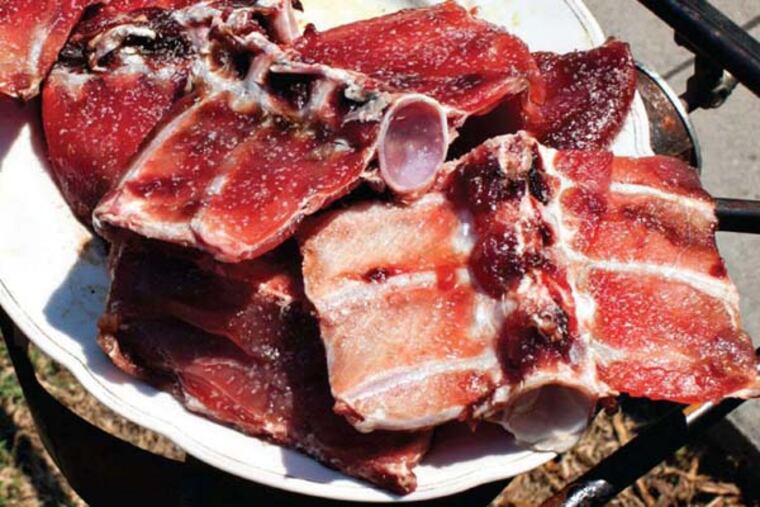
During my first flip-through of celeb-chef Barton Seaver's new grilling cookbook, Where There's Smoke, I was surprised by a dish I had never seen before: grilled tuna spines.
Clearly, the old-fashioned American cookout menu is changing, and a fresh crop of grill-focused cookbooks is introducing a food-savvy generation to the pleasures of contemporary outdoor cooking.
Where There's Smoke is joined by Bobby Flay's Barbecue Addiction; a paperback edition of Mario Batali's Italian Grill; and All Fired Up: Smokin' Hot BBQ Secrets From the South's Best Pitmasters, by the editors of Southern Living magazine. These books reveal a trendier, more health-conscious (well, some of them) take on flame-cooked foods.
Where There's Smoke best represents the current grilling zeitgeist.
Consider the tuna spines - sections of the fish's vertebrae flanked by meat, similar to ribs. A note accompanying the recipe advises: "Any good fishmonger can get tuna spines for you with a couple of days notice."
Skeptically, I went to my neighborhood fishmonger, Ippolito's Seafood in South Philadelphia, and asked owner Anthony D'Angelo if I really could special-order some. There was a bit of confusion when I said "tuna spines," but I showed him the photo from the book and he knew instantly what I meant. To him, they were "racks," or just "bones."
"Oh, yeah, those are great!" he said. "Sushi chefs like to scrape the meat off these for maki rolls, and other chefs sometimes grill them up like pork ribs."
One of the best parts, he explained, is the rich marrow hidden in the bones.
"I could have some for you tomorrow," he assured.
Known for his dedication to sustainable seafood, author Seaver considers the finer points of the eco-conscious grill in Where There's Smoke. He points out, for example, that using a charcoal grill produces twice the carbon emissions of a gas grill.
Even those tuna spines embody the nose-to-tail, waste-nothing values of modern chefs and cookbook authors.
Throughout his book, Seaver advocates for a vegetable-focused style of cooking and eating. His grilled broccoli with pecan pesto and parmesan might be the best thing to happen to this maligned vegetable since it got together with cheddar and bacon in a crock of soup.
Batali offers a robust grilled-vegetable salad. Highlights of Flay's extensive plant-based section include char-kissed corn and asparagus.
Each of these books is packed with recipes for vegetables on the grill - there's nothing in the CSA box that doesn't meet the flames here.
In some cases, such as Seaver's salt-brined potatoes, vegetables are cooked nestled into the embers of the fire. It's a fashionable restaurant-chef technique so easy, it's surprising more home cooks don't use it more often. It imparts the deep smoky flavor you'd otherwise need a Big Green Egg or another expensive smoker to achieve.
Another major trend apparent in these books is the ardor for the ingredients and flavors of the American South.
Flay, whose food empire was built on his love of the Southwest and its myriad chiles, embraces Southern influences with the most enthusiasm. He even tops a burger with a smear of pimento cheese - a mixture of cheese, mayo, and red peppers that's ubiquitous south of the Mason-Dixon Line.
Deviled eggs, which I did not expect to see in grilling cookbooks, appear in both Flay's and Seaver's books. Even Batali, whose book is Italian, draws inspiration from the American South, adding a sweet glaze to his version of porchetta (grill-roasted pork).
For true Southern authenticity, All Fired Up offers advice from award-winning pitmaster Troy Black, guiding a virtual tour of Southern barbecue, from Eastern Carolina vinegar sauce to Memphis dry rub to Texas smoked brisket. Along with those classic recipes, the book offers fresh takes for the grill with dishes like Asian grilled salmon and flank steak with rosemary, fig salsa, and Gorgonzola (see recipe).
Each book has plenty of approachable recipes, the kind that cook quickly and don't require a long list of ingredients. But a thread of the current DIY mania is apparent here. Flay includes a recipe for handmade mayonnaise. Seaver invites you to make your own cottage cheese.
Buzzword ingredients abound, firmly orienting the reader in 2013. There's smoked paprika, jicama, sorghum, chutney, and a staggering array of pickles, considering the books are dedicated to the grill.
Each includes vital information for the grilling newbie, addressing the questions of choosing between charcoal and gas and working with wood chips.
Where There's Smoke's primer is the most useful for the beginning cook, with Seaver's extensive guides to ingredients and helpful busting of tenaciously held myths - including the fact that searing doesn't "seal in" juices, and that soaking wood chips is unnecessary.
Some of his guidance will probably enlighten even seasoned home cooks. Who knew that, with a brief word to your fishmonger, you could be grilling tuna spines the day after tomorrow?
Rosemary Flank Steak With Fig Salsa
Makes 6 servings
EndTextStartText
1 tablespoon chopped fresh rosemary
2 garlic cloves, minced
3/4 teaspoon kosher salt
1/2 teaspoon fresh ground pepper
3 tablespoons olive oil, divided
1 pound flank steak
3 cups chopped fresh figs
1 green onion, minced
2 tablespoons chopped fresh parsley
2 tablespoons seasoned rice wine vinegar
Salt and pepper to taste
3 ounces Gorgonzola cheese
EndTextStartText
1. Stir together the first four ingredients and 1 tablespoon olive oil. Rub onto steak. Cover and chill 30 minutes or up to 4 hours.
2. Preheat grill to 400 degrees (high) heat. Toss together figs, next 3 ingredients, and remaining 2 tablespoons of olive oil. Season with salt and pepper to taste.
3. Grill steak, covered with grill lid, 5 minutes on each side or to desired degree of doneness. Let stand 5 minutes.
4. Cut steak diagonally across the grain into thin strips and arrange on a serving platter. Spoon fig salsa over steak and sprinkle with Gorgonzola.
Per serving: 512 calories, 28 grams protein, 66 grams carbohydrates, 48 grams sugar, 18 grams fat, 55 milligrams cholesterol, 522 milligrams sodium, 11 grams dietary fiber.
Grilled Broccoli With Pecan Pesto and Parmesan
Makes 4 servings
EndTextStartText
11/2 pounds broccoli, cut into large florets,
stems reserved for another use
Kosher salt
1 cup pecans, chopped
Finely shredded zest of 1 lemon
1 clove garlic, grated on a microplane or
very finely minced
3 tablespoons extra-virgin olive oil, divided
2 ounces Parmesan cheese, preferably
shaved with a vegetable peeler or
grated
EndTextStartText
1. Bring a large pot of generously salted water to a boil. Add the broccoli and cook for 2 to 3 minutes, then drain and spread the florets on a baking sheet to cool to room temperature.
2. Toast the pecans on a small baking sheet in a preheated 350-degree oven for 8 minutes. Transfer them to a small bowl and add the lemon zest, garlic, and 2 tablespoons of the olive oil. Season with a pinch of salt and toss to combine. Reserve at room temperature.
3. Drizzle broccoli with the remaining 1 tablespoon olive oil and cook directly over the coals of a medium fire until the florets begin to blacken. Do not move the broccoli pieces during cooking, just let them sit, let them burn, have faith.
4. When the florets are nicely colored, after about 10 minutes, remove them to a platter and spoon the pecan pesto over the top. Garnish with a few shavings of Parmesan and serve immediately. This dish is equally good at room temperature; add the pecan pesto as soon as the broccoli comes off the grill to infuse the flavors, but don't add the Parmesan until you are ready to serve.
Per serving: 381 calories, 12 grams protein, 15 grams carbohydrates, 4 grams sugar, 34 grams fat, 10 milligrams cholesterol, 188 milligrams sodium, 7 grams dietary fiber.EndText
Grilled Tuna Spines
Makes 4 servings
EndTextStartText
6 pounds tuna
spines, cut
into 3-rib
sections
Kosher salt
1 cup extra-virgin
olive oil
2 tablespoons capers, drained
Leaves from
1 bunch fresh mint
3 cloves garlic,
sliced
super-thin
8 dried piri piri or Calabrian
chiles or 1
tablespoon
crushed
red pepper
EndTextStartText
1. Season the spines generously with salt, and drizzle with 2 tablespoons of the olive oil. Let them sit in the refrigerator for at least 20 minutes and up to 4 hours.
2. In a small saute pan, heat the remaining olive oil over high heat. Add the capers and cook until they begin to crisp, 5 to 7 minutes. Add the mint, garlic, and chiles. Cook until mint leaves are crisp and garlic slices are golden brown, about 5 minutes. Remove the pan from the heat and set it aside.
3. Sear the spines directly over the coals of a large fire for 5 to 7 minutes. Rotate the grill grate so the spines are away from the coals and continue to cook for 10 to 15 more minutes.
4. When the spines begin to char and the meat along the ribs is cooked to a dark gray, cut each vertebra along the transparent line that separates each joint.
5. Lay the sections flat on a platter with the jellylike marrow exposed. Spoon the hot oil over the joints, evenly distributing the mint, garlic, and capers. Season with a generous sprinkling of salt and serve immediately. (The rib meat attached to the bones is delicious, and the marrow is best eaten with a few bits of the garnish. This is a messy undertaking, just like pork ribs.)
Grilled Shrimp Skewers With Cilantro-Mint Chutney
Makes 4 servings
EndTextStartText
12 jumbo shrimp
Juice of 2 lemons
1 teaspoon garam masala
1 teaspoon red chile powder, such as ancho
or New Mexican
¼ cup canola oil
1 pound large (21 to 24 count) shrimp, tails
left on, shelled and deveined
Cilantro-Mint Chutney
1 cup tightly packed fresh cilantro leaves,
plus more for garnish
½ cup tightly packed fresh mint leaves
4 green onions, white and green parts,
chopped
1 Thai chile, finely minced
Grated zest of 1 lime
1 to 2 tablespoons clover honey, to taste
3 tablespoons canola oil
Kosher salt and freshly ground black pepper
EndTextStartText
1. Heat your grill to high for direct grilling. If using wood skewers, soak them in cold water for at least 15 minutes.
2. Marinate the shrimp: Whisk together the lemon juice, garam masala, chile powder, and oil in a medium bowl. Add the shrimp and toss to coat in the mixture. Let sit for 15 minutes.
3. Make the chutney: Combine the cilantro, mint, green onions, Thai chile, and lime zest in a food processor and pulse until coarsely chopped. Add 1 tablespoon of the honey and the oil and pulse until a slightly loose mixture, adding a little water if needed; season with salt and pepper and the remaining 1 tablespoon honey if needed.
4. Thread 3 shrimp onto each skewer so the shrimp lie flat. Season with salt and pepper and grill until golden brown, slightly charred on both sides, and just cooked through, about 1½ minutes per side.
5. Remove the shrimp to a platter, serve with the chutney, and garnish with cilantro leaves.
Per serving: 375 calories, 27 grams protein, 8 grams carbohydrates, 5 grams sugar, 26 grams fat, 239 milligrams cholesterol, 286 milligrams sodium, 1 gram dietary fiber.
EndText