Kimberly Garrison: For a better lifestyle, weigh vegetarianism
DO CONCERNS about the economy, the environment or your health have you rethinking your lifestyle and eating habits? Is becoming a vegetarian one of your New Year's resolutions? It's a popular lifestyle choice, and many believe it is the optimal diet for human beings.
DO CONCERNS about the economy, the environment or your health have you rethinking your lifestyle and eating habits?
Is becoming a vegetarian one of your New Year's resolutions? It's a popular lifestyle choice, and many believe it is the optimal diet for human beings.
Vegetarianism comes in five primary categories, based mostly on what kinds of animals and animal-based products are consumed:
Ovo-vegetarian: Eats eggs; no meat.
Lacto-ovo vegetarian: Eats dairy and egg products; no meat.
Lacto-vegetarian: Eats dairy products; no eggs or meat.
Vegan: Eats only food from plant sources.
Raw vegetarian: Aka raw foodist, eats only "living foods" such as fruits, vegetables, sprouted seeds and nuts. Nothing is cooked conventionally, but dehydrators may be used.
Some people who have eliminated beef and pork from their diets consider themselves "semi-vegetarians," though they still consume fish and poultry.
Choosing
vegetarianism
People become vegetarians for a variety of reasons. For some, it's a ticket to better health. For others it may be cultural or religious.
Members of the Seventh-day Adventist Church are vegetarians, for example. They also refrain from smoking and drinking. It's interesting to note that Seventh-day Adventists live, on average, a decade longer than the average American.
Still others decide to become vegetarians out of concern for animals or for the environment.
"I became a vegetarian at 12," said 31-year-old Dara Lovitz, a Philadelphia attorney who's now a vegan athlete and advocate. "Once I learned about the dairy and egg industries' abuses, my switch to veganism was both easy and immediate!"
It's been estimated that the average American will consume 20 pigs, 30 cows, 900 chickens and 100 fish over a lifetime. We are a nation obsessed with meeting our protein requirements. But where do the animals we eat get their protein?
The cows, chickens and pigs we consume are primarily - you guessed it - vegetarians. Isn't that funny?
Environmental vegetarians say that our insatiable appetite for meat results in more greenhouse gas emissions than our cars produce.
Meat production absorbs so many resources, from water to crops to energy for production and transportation. And that's just the tip of the iceberg. There's also deforestation to create croplands, and livestock emissions of methane and other toxic gases that some estimate are 30 times more damaging than what's emitted from cars.
Will I get enough protein?
Fear not, a well-planned vegetarian diet can meet your nutritional needs and then some. For example, a diet rich in fruits and vegetables will be high in fiber and low in fat.
A vegetarian diet will help you lower your cholesterol and blood pressure, keep your blood sugar on track and may help you maintain a healthy weight, too.
The American Dietetic Association says we only need 10 to 15 percent of our calories from protein. Based on a 2,000-calorie diet, that would be equivalent to 200-300 calories in protein - or, to put it another way, one 6-ounce chicken breast.
Most of us eat way more meat than that in a day. Or a meal.
What about my muscles?
Others shy away from vegetarianism for fear of losing or not maintaining their muscles. But your muscles won't suffer from a vegetable-based diet.
"In spite of the myths about protein and fuel, becoming vegan has improved my athletic abilities, cardiovascular endurance and strength dramatically," Lovitz said.
Sure, you need protein (amino acids). But who says it has to come from meat?
Contrary to popular belief, muscles get stronger and bigger primarily from being worked. It's the stress, the heavy weight, that causes the muscles to grow (hypertrophy).
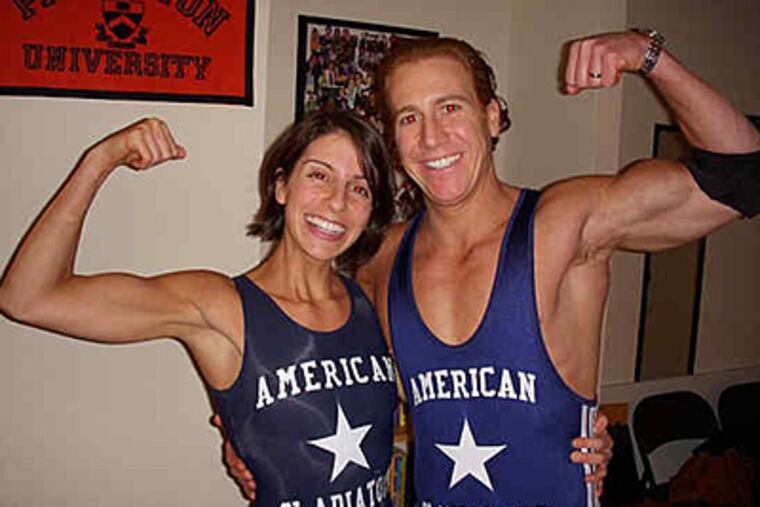
Lovitz, pictured here with her husband, attorney Josh Van Naarden (who eats a semi-vegetarian diet), is a living example that going vegetarian or vegan will not diminish athletic ability or muscularity.
Come on now, if eating tons of meat caused muscles to grow, then most Americans would enjoy abundant health and be outstanding specimens of physical perfection.
Of course, it's just the opposite.
Every 30 seconds someone in this country has a heart attack. Heart disease is the No. 1 killer of American men and women and, sadly, in about 80 percent of cases that outcome would have been preventable, largely through changes in diet and exercise.
Ultimately, going toward a vegetarian or plant-based diet may be our best option for saving ourselves and the planet, too.
What do you think, Philly?
Free fun for 7th-graders
The YMCA of Philadelphia & Vicinity is offering free one-year memberships to seventh-grade students in 2010 at any of the Y's 10 area branches. Find out more online at http:// philaymca.org.
Kimberly Garrison is a certified personal trainer and owner of One on One Ultimate Fitness in Philadelphia (www.1on1ultimatefitness.com). E-mail her at
kimberly@1on1ultimatefitness.com. Her column appears each Thursday in Yo!