Phila. rallies in 'Fight for $15' campaign
On a day when rallies pushing for a $15 minimum wage popped up nationwide like fat spitting out of a french-fry cooker, Mary Kay Henry was having a great day.
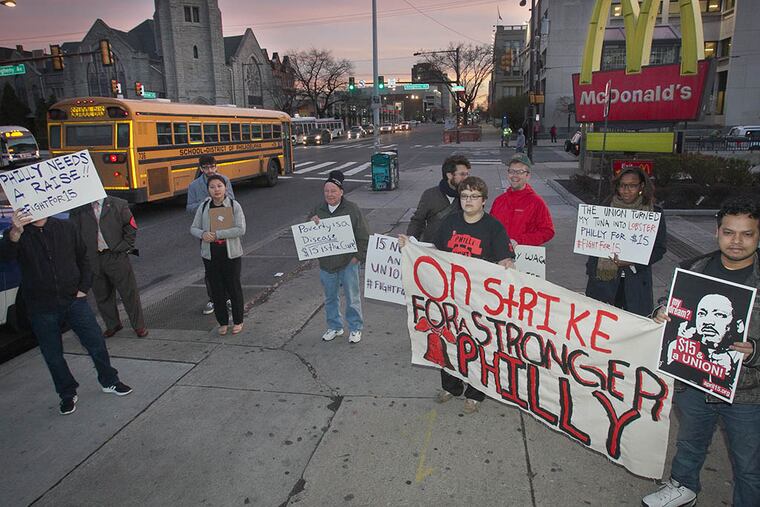
On a day when rallies pushing for a $15 minimum wage popped up nationwide like fat spitting out of a french-fry cooker, Mary Kay Henry was having a great day.
"I find it inspiring," said Henry, president of the Service Employees International Union, the 1.9 million-member organization behind demonstrations, rallies, and protests under the "Fight for $15" flag.
"I think of this as an economic and racial justice movement," Henry said. "It's bigger than the labor movement."
Henry, who started her Wednesday at a 6 a.m. rally outside a McDonald's restaurant in Berkeley, Calif., said she isn't worrying about whether the tens of millions of dollars her union has poured into the fast-food workers campaign will pay off in increased membership and dues.
"We have been a union that for our entire 90 years has been deeply committed to nonunion workers and helping them organize," she said.
Protesters say they want higher wages and access to a union.
Wednesday's events, held in Philadelphia, Camden, and other parts of the country, come at a key moment for McDonald's and unions. Both are struggling.
On its 60th anniversary, with 35,000 stores serving 70 million people daily, McDonald's sales are down and franchisees are telling analysts that they aren't loving the relationship with their mother company.
And union membership is on the decline, even though Wednesday's rallies added some juice to what has been a difficult time for organized labor.
In Philadelphia, a 6 a.m. rally started the day at a McDonald's at Broad Street and Allegheny Avenue.
Smaller events popped up everywhere - marchers trooped along Roosevelt Boulevard, a small crew paraded through Center City in the morning, and union stagehands ceremoniously dumped McDonald's burgers into a Dumpster.
A throng filled a solid half-block on Arch Street, outside the McDonald's at Broad at 3 p.m., before marching south on Broad and west on John F. Kennedy Boulevard toward 30th Street for a traffic-blocking finale.
The pressure on the street may be paying off for workers as companies, including McDonald's, have announced wage hikes for company-owned stores. Whether it will pay off for SEIU is unclear.
"The end game would be bargaining and membership," said Gary Chaison, a labor professor at Clark University. "It's debatable even with the SEIU how much money you should be spending on people who don't [pay] dues."
Henry says her union has a long record of organizing workers who have been considered impossible to unionize, because they are scattered or have complicated employment structures.
The union's playbook relies on public pressure and alliances rather than head-to-head negotiations.
In Philadelphia, Wednesday's protests were attended by unions representing hospital workers, cafeteria workers, and laundry workers. Adjunct professors at Temple University joined in, among them Wende Marshall, 53, who teaches an anthropology course.
"We are really poor," she said. "People resisted recognizing that, because we have fancy degrees and people are calling us 'Professor.' " She estimated that most of her colleagues earn about $13 an hour teaching college students.
For all the protesters, very few - maybe eight or 10 - are actual McDonald's employees, company spokeswoman Terri Hickey said.
McDonald's worker Shakorah Benjamin, 17, said she has walked off the job three times as part of the Fight for $15 campaign. She said she earns $7.35 an hour and has not had a raise in two years.
The first time, "we had less than 10 people" at the McDonald's at Broad and Allegheny. "Now we have almost the whole store on strike," she said.
The owner of that McDonald's, Jo-Dan Enterprises, did not return a phone call and e-mail seeking comment.