LOVE sculpture's base, designed by Philly cop, is being auctioned
Money can't buy you love, but it can buy you the base that held up the "LOVE" sculpture at LOVE Park for the last three decades.
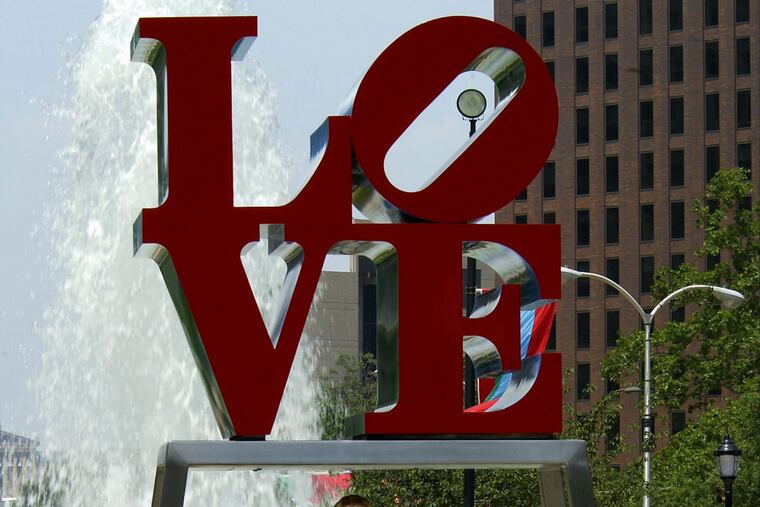
The most famous love handle in Philadelphia is now up for sale online.
The stainless steel base that held Robert Indiana's iconic LOVE sculpture for the last 30 years at John F. Kennedy Plaza has been put up for auction by the City of Philadelphia on Municibid, an online auction website for municipalities. The news came as a surprise Monday to the man who designed the base in the 1980s, Philadelphia Police Sgt. Michael Walton.
"If somebody else can come up with a better design and more people would care for it, so be it," Walton, 61, said. "It's not about the base, it's about the sculpture."
As of Monday afternoon, seven bids had come in for the love nest, with the highest at $330. But with two weeks remaining in the online auction, there's still time to make a love connection.
Margot Berg, public art director for the city, said the old base will be replaced by one estimated to cost around $12,000. The sculpture, which is getting a $50,000 refurbishment, is to return to the plaza — more commonly know as LOVE Park — when it reopens in the fall after renovations.
The base is 4 by 8 feet, is 7 feet tall, and weighs about 1,750 pounds, a strong foundation for love. Prospective buyers must be able to pick up the base and transport it on their own.
"It will take more than a couple of guys and a pickup truck," Berg said.
Placed in the plaza in 1976, the sculpture first sat on a plywood box until philanthropist Fitz Eugene Dixon Jr., the city art commissioner who purchased the sculpture for the city, held a design contest for a base that was open only to Department of Public Property staffers, Berg and Walton said.
Walton, then an architect in training with the Department of Public Property, was not interested in entering the competition, but all the staffers in his office were asked to render and submit ideas, so he sketched a trapezoidal design on an 8½ by 11 sheet of paper.
"I did it all in a day, submitted it, and forgot about it," he said.
Much to Walton's surprise, Dixon picked his submission, but he didn't win any big prizes for having the chosen design.
"I won the problem of making sure it got done," he said. "I was the project manager."
Walton went on to obtain an architecture degree from Drexel University before he landed his dream job in 1990, when he joined the Philadelphia Police Academy. He now works in the Firearms Training Unit and does architecture work — designing additions and houses — on the side.
For three decades, he has watched tourists pose in front of his design, and he has seen photos of couples who became engaged in front of it. A highlight for Walton was seeing the sculpture and the top of the base he designed on banners for Paul McCartney's Philadelphia concert in 2010.
"I'm the most unfamous famous person," he said, laughing.
Berg, the public art director, said the city is replacing the base because it is worn and because Indiana did not like its trapezoidal shape. The artist preferred that his sculptures were placed on rectangular bases, which the new one will be, she said. Walton said he had never heard the criticism.
What someone might do with the lovelorn pedestal is anybody's guess.
"That park and that sculpture and that pedestal are so well recognized as part of the park, I imagine people will have a lot of creative ideas about how to use it," Berg said.
As for Walton, he doesn't plan on making a bid on the base he designed. He's content with the rendering of it hanging on his bedroom wall.
"I don't need anything else," he said. "It wasn't about me. It wasn't about the base. The sculpture was the number-one thing."
Now that is a labor of love.
