Helen Segall, 87, professor and Holocaust survivor who told of fleeing Poland
In a 2015 speech to college students, Dr. Segall told of fleeing the Nazis during World War II. She and her mother ate sugar beets, apple cores, and handouts from strangers.
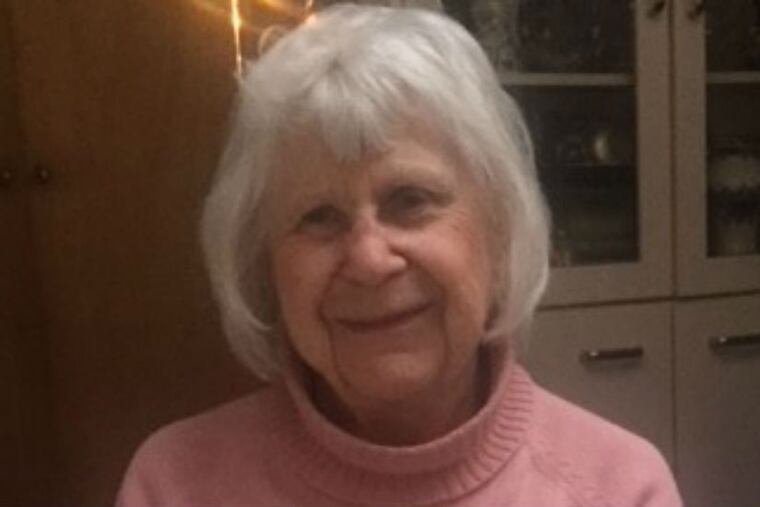
Helen Segall, 87, of Strafford, Chester County, a Russian language and literature professor who as a 10-year-old in Poland in 1941 narrowly escaped the Nazi invaders, and who later spoke and wrote widely on her Holocaust experiences, died Wednesday, Aug. 29, in Hope, Maine.
Dr. Segall arrived in the United States from a displaced persons camp in Germany on Thanksgiving 1949. She was fluent in Polish and Russian, and conversant in German, Ukrainian, and English. She earned a bachelor's degree in library science from Simmons College and a doctorate in Russian language and literature from Bryn Mawr College.
Initially, she taught Russian at Bryn Mawr and New Jersey's Montclair State University, and then spent 24 years at Dickinson College in Carlisle, Pa., where she was professor of Russian and chaired the Russian department. She retired in 2000.
Starting in 1995, she wrote about her childhood experiences during the Holocaust, especially the liquidation of Jews in Dubno and Mizocz, both ghettos created in occupied Poland by the Nazis. Her work was published in the U.S. Holocaust Memorial Museum Encyclopedia of Camps and Ghettos and elsewhere. She spoke on the Holocaust at academic conferences, synagogues, churches, and schools.
Dr. Segall and her husband, Stanley, had a summer home in Maine. The two were taking a late-afternoon swim in Lake Alford when she signaled for help. Her husband pulled her to shore and began CPR. She was pronounced dead at the scene. The Knox County Sheriff's Office said a medical episode contributed to her death from drowning. She had congestive heart failure, her family said.
"She loved swimming," her husband said. "She was doing what she loved."
Her son Hal said, "She lived an upbeat, optimistic life, and her death was kind of consistent with that."
Dr. Segall served as president of the Northeast Modern Languages Association and the Mid-Atlantic Chapter of the American Association for the Advancement of Slavic Studies. She began academic exchanges with the former Soviet Union and Russia, sending Dickinson students to Moscow and bringing Russian faculty to Dickinson.
In a lecture to college students in 2015, Dr. Segall described a happy childhood in Dubno until June 25, 1941, when the Nazis dragged away her father and his two brothers. The three were forced to dig their own graves before being shot to death.
"It was devastating for our family," she told the audience at Dickinson, as reported in the Dickinsonian, the college newspaper.
Intent on escaping Dubno, Dr. Segall's mother obtained forged papers identifying them as Polish Catholics and fled with her daughter to the countryside.
"There was literally nothing to eat," Dr. Segall said. She scavenged apple cores and sugar beets, and begged for food from other families. She recalled a rare, welcome moment when a woman's arm extended from a window of a home, handing her a bean pie.
After becoming separated from her mother in a shuffle between safe havens in October 1942, she escaped from Poland with her aunt. The women were reunited later.
Many in her large extended family were killed by the Nazis. Only Dr. Segall, her mother, Charlotte Schwartz, aunt Natalie Markowski, and an infant cousin, Glenda, survived.
Dr. Segall was energetic and had a great zest for life. She was an avid collector of Russian art, a lover of opera and classical music, a regular at the Metropolitan Opera and the Philadelphia Orchestra, and a gifted gardener.
"She was inspiring to many and will be sorely missed," her family said.
Besides her husband of 64 years and her son, she is survived by another son, Wynn; four grandchildren; and her cousin Glenda Kaufman, who was like a sister to her.
Services were Tuesday, Sept. 4.
Contributions may be made to the United States Holocaust Memorial Museum, 100 Raoul Wallenberg Place S.W., Washington, D.C. 20024 or via https://www.ushmm.org/support.