Trump is playing a dangerous game
The president is all about himself and winning. Defended as inexperienced by his allies, he shows no inclination to learn on the job.
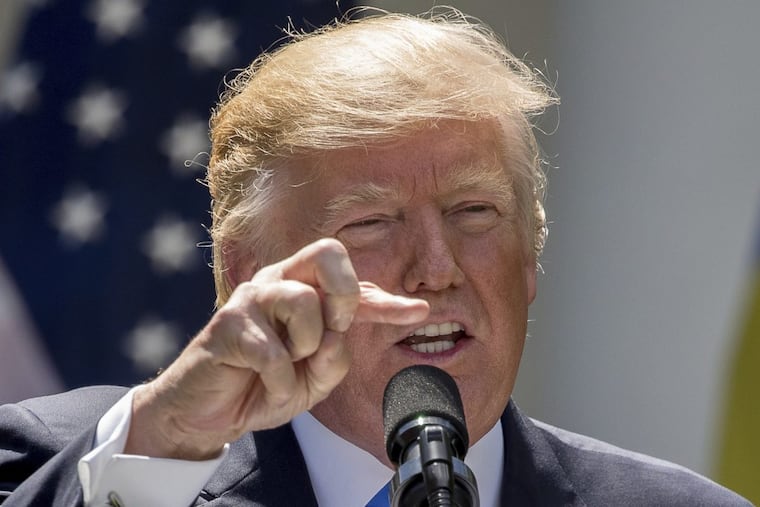
Trump playing a dangerous game
Do you remember Donald Trump saying in his Republican National Convention speech, "Nobody knows the system better than me, which is why I alone can fix it"? Do you remember when he said he knows more about the Islamic State than the generals?
In Saturday's paper, Gov. Christie, House Speaker Paul Ryan and U.S. Sen. Marco Rubio (R., Fla.) said our president doesn't yet understand the protocols, relationships, norms, traditions, and responsibilities of the most important job in the world ("In wake of Senate hearing, GOP leaders call president a political novice"). But then again, the Trump campaign was all about him and about him winning.
The analysis described Trump as a babe in the political woods. NBC's Tom Brokaw wrote on Twitter, "Excuse me? Trump ran as a big time exec, not as an apprentice."
Most elected officials in our cities, boroughs, and townships understand critical matters of governance that elude Trump. And he's done nothing to indicate that he is interested or willing to understand the important matters of governance.
To Trump, it's still all about him and winning. This is not just unfortunate — this is a very dangerous situation for our nation.
— Michael Frank, Doylestown
It’s time for straight answers
President Trump likes keeping people in suspense and being unpredictable. However, those are not qualities that most Americans consider desirable in a president. We have come to admire such qualities as intelligence, preparation, and forthrightness.
While there are times when, as columnist Trudy Rubin points out ("Casting a light on a litany of Trump lies," Sunday), presidents may be deliberately evasive, good ones far more often provide straightforward answers.
In his press conference Friday, Trump provided two examples of delaying a straight answer to shift attention to himself and/or curtail a stream of unflattering news ("Trump: Comey lied to Congress," Saturday). He acknowledged that the United States is committed to the mutual defense of NATO members, something he inexplicably refused to do in Brussels in May, which angered and disappointed our key allies. And he refused to answer the important question of whether his conversations are taped. He raised the possibility weeks earlier in a Tweet, and despite requests from members of Congress and congressional committees for an answer, he has not provided one. Instead, he said Friday, "I'll tell you about that maybe sometime in the very near future."
The issue of taping is important because it bears on the president's credibility.
— Gerald D. Klein, Elkins Park
Obamacare too valuable to lose
I was born 57 years ago with the same heart defect that Jimmy Kimmel's newborn son has. When I was born, there was no surgery to correct it — doctors and medical researchers were inventing it. Most of us born at that time did not survive. But my father worked in a factory with a strong union that had fought for good health insurance for its employees.
So when I was born, my doctors were able to send me to the world-renowned experts at Children's Hospital of Philadelphia. The amazing cardiologists there helped me to stay alive long enough for the science to catch up. Because of my access to their groundbreaking care, I am still alive to write you 57 years later, and babies like Kimmel's can receive immediate treatment that will give them normal lives.
You may think the Affordable Care Act doesn't affect you, but it does. Access to affordable health care impacts everyone. A breakthrough that may save you tomorrow could be discovered today because someone has been able to see a doctor. We all benefit from universal access to health care. That is why we must protect the ACA.
— Brenda Schroeder, Frederick, Md.
Children’s health is at stake
My career in pediatrics and infectious diseases gives me voice about the deficiencies of the Republicans' American Health Care Act.
The House of Representatives' version removes primary care and immunizations from America's most-vulnerable children. Changed criteria for funding through Medicaid might even affect care available for insured children. Insurance companies tend to follow government models to determine the services for the insured.
The House bill would shift responsibility for vulnerable children to the states, where resources would not be guaranteed. Block grants to states — payment calculated per capita — would replace actual expenses. This new formula is a fake. State budgeting frequently comes with political motivation. Federal funding is likely to decrease, and states might not supplement it.
I have experience with a large measles outbreak in Philadelphia, a polio epidemic, and outbreaks of meningitis and pertussis, all because of a lack of immunizations. When immunization access falls off, morbidity and mortality rises.
Congressional leadership is responsible for healthy children. Placing budget reductions on children's health while giving tax advantages to the wealthy would be a serious misdirection of resources.
— Allan M. Arbeter, M.D., Philadelphia
Teach city workers about IRAs
Rather than adopt City Controller Alan Butkovitz's proposal to aid small-business employee retirement with a "city-government-administered plug-and-play system," why not develop and execute an education and empowerment plan that would introduce workers to the benefits of taking personal ownership of the retirement challenge ("Butkovitz: Aid small business retirement," Thursday)?
There are many straightforward Roth and traditional IRA plans available; Vanguard's is among the best. Savings can be automated, and annual account fees can be avoided by registering online and using e-delivery of statements. Perhaps Vanguard would consider waiving the $1,000 minimum to open an IRA as a city-wide, civic-minded initiative.
Workers would receive information about retirement investment options, such as target retirement funds and index funds. The plan would avoid creation of city and/or third-party administration expenses and investment adviser/management fees.
— Dan Drecksage, Philadelphia