A hot dog vendor's life in the dog days | Frank's Place
Before the Phanatic's arrival, Charlie Frank was a kind of mascot. He made TV commercials and appeared in print ads for both the Phillies and local hot dog producers.
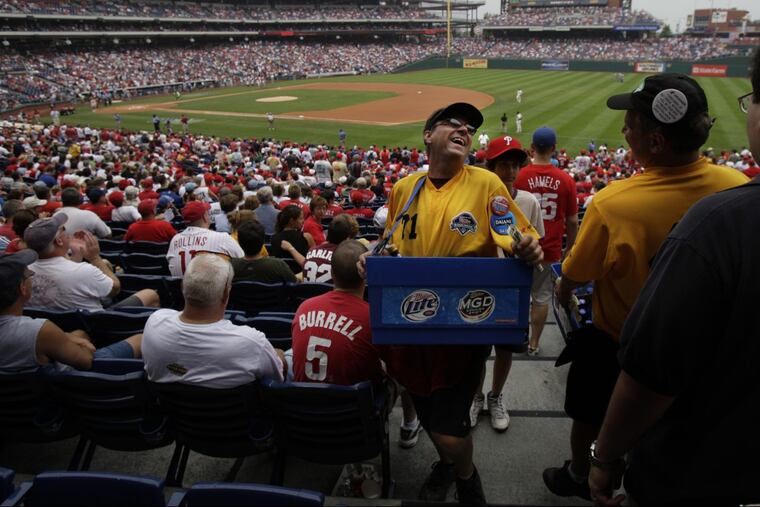
The few fans who showed up for Wednesday night's Phillies-Marlins doubleheader were scattered in little clusters around Citizens Bank Park like patches of foam on a vast blue sea.
Watching the home team's lopsided losses was so difficult that my eyes and sympathies were drawn instead to the ballpark's vendors.
When a season's possibilities disappear, life can be as hard for those who hawk beer and hot dogs as for those who throw and hit baseballs for a living.
But Charlie Frank never let the standings or the calendar interfere with the one thing that he was, as his name might imply, born to do – selling hot dogs.
Frank died in 1991 at 77. But from 1948 until 1979, when he hung up the 20-pound hot dog container he so frequently strapped around his neck, he was must-see entertainment at Phillies, Eagles, and Big Five games.
Born in 1913 near Sixth and Shunk in South Philly, he was a shipper in a curtain factory by day and a celebrity hot dog vendor by night. Joking, chanting, singing "How Much Is That Doggie in the Kettle?," the crusty Frank once sold 1,200 dogs at an Eagles game. Even in the 1960s, when the Phillies sometimes averaged crowds of less than 8,000 for a season, he typically moved 500 to 600 dogs a game.
The hands that made change and lathered mustard on steamed franks were quick as a boxer's. He had a vaudevillian's store of cornball jokes, a high-pitched, Philly-accented voice that constantly cried out "Daaaaaaaahgs!," and, most important, limitless energy.
Frank was the Pete Rose of vendors, relentlessly ascending and descending stadium aisles, never letting the shtick that made him unique slow him down. "Never stop to talk," he liked to tell young vendors.
Over the years, Frank developed a keen sales-detector. He could smell a potential customer half-a-ballpark away
"You look around and you try to get a feeling," Frank told a reporter in 1970. "Once you get the feel, you know the spot to go. Then I run like a maniac."
He began running in 1948, earning $3 on his first night selling sodas at Connie Mack Stadium. By 1965, he was making $3.95 for every container of 60 dogs he sold. Even on bad nights, he sold 10 to 12.
I briefly crossed his path in the summer of 1966, when I too was a Connie Mack vendor. I'd get to the ballpark early to watch batting practice. Frank, eager to get a jump on the night's sales, was often there too.
He'd enter the ballpark through a 21st Street door, climb a steep flight of stairs, and rapidly change into the cheap uniform employees of the concessionaire, Nilon Bros., had to wear.
Usually, as we dressed in a tiny locker room that reeked of unwashed clothing, he was too rushed to talk. Once he had his paper hat in place, he would head for the concession room. There, he would grab a metal container of hot dogs and, even as he was passing through the door and into the dank concourse, begin yelling, "Daaaaaahgs!"
That summer proved to be great training for a future sportswriter. I ate and drank too much, watched too much baseball, and earned too little money. Charlie didn't care about food or baseball, but he had plenty of advice about money.
He couldn't understand why, whenever Phils slugger Dick Allen came to bat, I'd find a seat, grab one of the sodas I'd been hawking, and savor the game.
"What the hell are you doing, Kid?" he asked me one night. "You can read about the game tomorrow in the paper like everybody else. Tonight you're here to make money."
The best time to sell, Frank used to say, was during pitching changes.
"I don't know what it is about them, Kid, but everybody gets hungry," he said.
When he found out I wanted to be a writer, Frank joked that maybe I'd co-author the book he was always threatening to start.
"I'm gonna call it Requiem for a Doggie Vendor," he said.
In it, he said, he would explain why he was such a great salesman and relate such episodes as the time at an Army-Navy game when he intercepted someone he believed was going to grab President Kennedy, or the afternoon he was mugged at Franklin Field, or the time someone stole his hot dog tray.
By 1970, Frank's reputation was such that he and an equally famous Kansas City vendor named Ned "Superdog" Wolf had a well-publicized showdown during an Eagles-Steelers game at Franklin Field. Wolf sold 480 in a half of competition, but Frank, who totaled 420, claimed he had cheated, having sold dozens to fellow vendors.
His star soared even higher when Veterans Stadium opened a year later. Before the Phanatic's arrival, Frank was a kind of mascot. He made TV commercials and appeared in print ads for both the Phillies and local hot dog producers. He was featured in an NFL Films segment. He worked at charity events and Main Line galas.
And because of his longtime work at the Palestra — where he also sold ice cream – Penn in 1970 awarded Frank a degree, a Ph.D – Purveyor of Hot Dogs. Five years later, the Phillies honored him with a "Doggie Man Night," presenting him with a hot dog-shaped trophy before a game when the fans got free dogs.
Frank reluctantly retired in 1979, when complications from diabetes made walking too difficult. Being away from the ballpark, he told a Daily News sportswriter that year, made him miserable.
"I never knew what it was like to not be at the ballpark," he said. "Now I do and I don't like it."
It was exactly how a lot of Phillies fans felt in Charlie Frank's absence.
