A big award for Dawn Staley; a lifetime of words from John Chaney
The John Wanamaker Awards had a Temple flair, with the former Owls hoops coaches taking center stage.
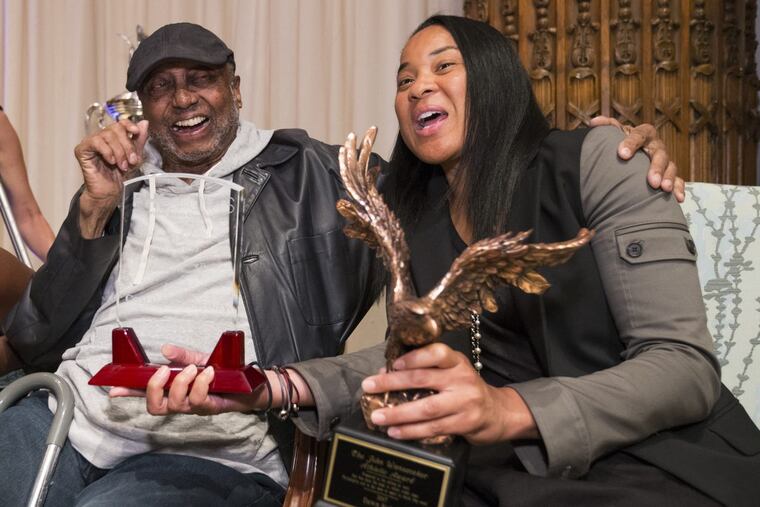
An elevator dropped down from the Crystal Tea Room at the top of the Wanamaker Building right after the John Wanamaker Awards ceremony.
"That was classic,'' said one man as the elevator headed for the lobby.
"You never know what you're going to get when you hand the microphone to an 85-year-old," said the guy next to him.
When the 85-year-old is John Chaney, you sort of do. Presented with a lifetime achievement award at Wednesday's luncheon, the retired Temple legend sounded remarkably like he did when he was, say, 65. Mayor Kenney had it right when he called Chaney a quintessential Philadelphian because "you never have to guess what he's thinking. Never have to guess …"
Dawn Staley was in town from South Carolina to accept the John Wanamaker Award itself, making her the first individual to receive the award three times — joining only the Phillies as a three-time recipient for an award first handed out in 1961, basically for the highest local sports achievement. The coach of the NCAA champion South Carolina Gamecocks spoke for a few minutes about her North Philly roots and how they shaped her, how she appreciated this award most of all because she didn't live in Philadelphia anymore.
Then Staley said she didn't want to keep talking, since she wanted to hear what Chaney had to say.
There also had been awards for community service, to the late Wayne "Coach Wiz" Allen of the North Philly Aztecs for sports volunteer of the year. Allen was movingly represented by his sister. And the Robert Levy community service award went to Team Up Philly, a sports program for girls in the city.
Organizers knew what they were doing putting Chaney last. He already had given a little preview of what was on his mind during interviews before the ceremony. A question about his legacy wound toward the political shape of the nation.
He'd given thought to what he wanted to say, with a great sampling of his former Cheyney and Temple players in the audience. It wasn't all politics, or even mostly politics. Chaney quipped about his Cheyney days, which included a College Division national title, how everybody knew everybody at Cheyney.
"If you walk into a place where everybody knows everybody,'' Chaney said, "nobody paid to get in."
He talked of Rollie Massimino, who died last week, how Massimino supported him while he was at Cheyney, and listened to his zone thoughts, and took one of his "center-out" zone plays and used it against Temple when Massimino was at Villanova.
He got to Staley, without mentioning her by name at first. ("There's my coachie-woachie,'' he joked when he first saw his former Temple counterpart before the ceremony.)
"I"d like to know, who in the state of Pennsylvania has four gold medals?'' Chaney said as he began. "In the city, who's got three?''
Staley has three Olympic gold medals as a player, one as a USA assistant coach. She'll try to add to that list as head coach of the 2020 U.S. Olympic women's team.
Chaney spoke with pride about how his summer basketball camp with Sonny Hill was one of the first to have boys and girls, pointing out that it was an overnight camp, which worried them: "We managed to get through it without a lawsuit."
Ticking off some of the other great local women's players such as Yolanda Laney and Marilyn Stephens, Chaney said the counselors would take on the girls, how Staley was already a handful, first time he saw her, this little guard from the Raymond Rosen Projects. "Foul her, foul her,'' Chaney remembers yelling. "You've got to stop her some kind of way."
You get to a point in life when you're somewhat successful, Chaney then said, and you forget the things that got you there.
"She never forgot,'' Chaney said. "Never."
Staley had talked about getting up and going to some of Chaney's early-morning practices when she first took the Owls job, how maybe coaching in the morning was partly to give the women their fair court time. (There was some truth in that. Temple players could tell you they would tell their women's counterparts to come on out to the court, that Chaney would think it was time for the women's practice and cut off his own workout.)
Chaney asked if the mayor was still there. He'd just left. Chaney joked about how mayors always left before he spoke.
He was just warming up. Anyone who has spent time with the man can't be surprised when Chaney started talking about Beavis and Butt-Head. If you guessed Beavis and also Butt-Head currently hold high national political offices, you're on track. A woman over to the side sort of gasped when he said those names, but Chaney knew he was among friends, not that he cared.
He wasn't just aiming for shock value. He spoke of the principles he has always held dear, the need to lift up. He took his talk to Houston, about the generosity of spirit he has seen down there in the wake of the hurricane.
Chaney went on, but he didn't go on and on. He'd thought about how he wanted to talk. He stayed in his seat. Health issues had him in a wheelchair coming in. He stayed in his zone, talking about a painting he'd once bought in Delaware for $35, of a little kid on a bed with no sheets, holes in the mattress. On the side of the bed was a football. The painting, he said, was titled Dreams.
Chaney closed with a favorite poem by Yeats, adapting the lines just a bit.
"To all, I've been born poor. I spread my dreams under your feet. Walk softly, for you just might step on my dreams."
The guy in the elevator was right.