The risk and reward of drafting Joel Embiid
Taking chances to fulfill great ambition - which has been the dominant philosophy of the Philadelphia 76ers under general manager Sam Hinkie - invites two companions along for the ride: great risk and the need for great luck.
Taking chances to fulfill great ambition - which has been the dominant philosophy of the Philadelphia 76ers under general manager Sam Hinkie - invites two companions along for the ride: great risk and the need for great luck.
In Hinkie's world, the risks are carefully analyzed and calculated, of course. That's no shock at this point. Hinkie wouldn't eat lunch without calculating the most optimal time to do so.
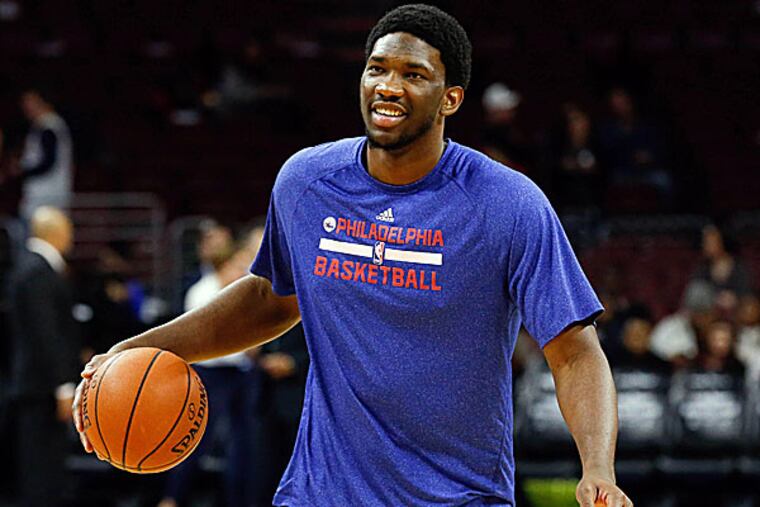
A year ago, the analytics clearly showed that obtaining center Joel Embiid, a first-pick talent, with the third pick in the NBA draft was a coup in the comparison of value versus price. Players with his ability and potential are both rare and usually unobtainable with anything but the top selection.
Just as the year before, when the Sixers were able to use the sixth pick to grab Nerlens Noel, another who might have been the first pick, the Sixers made the risk/reward calculation on Embiid and said it was an easy call.
Hinkie has been open about the uncertain nature of building a roster. Not every chance worth taking pans out. The news Saturday that the fractured navicular bone in Embiid's right foot is still not healed - a year after it was repaired with the surgical insertion of two screws - was more than just a twig snapping in the forest.
If Embiid is unable to get on a basketball court and stay there, it won't be because analytics failed the Sixers. It will be physics, and specifically the pounding that a nearly 300-pound man can exert on what might be an exceptionally fragile skeletal system. Before the foot fracture was discovered prior to last year's draft, Embiid had missed the final weeks of his lone college season and the NCAA tournament because of a stress fracture in his back.
All of this was known when Hinkie and his analysts performed the calculation that two bone injuries, plus the bargain of not having Embiid for at least one season, was still an acceptable risk. What wasn't known, and still isn't now, was whether those two injuries were isolated bad luck for Embiid or an indication of chronic problems that would dog his basketball career.
As we look at it today, the answer to that question could go either way. Embiid might recover fully and be the dominant player his skills indicate. Then again, he might not.
"We're not going to bat 1.000 on every single draft pick. We have them by the bushelful in part because of that, because we don't have any hubris we will get them all right," Hinkie said at the February trade deadline. "We're not certain we have an edge over anyone else. We're not certain we have an edge at all. That's OK. It's a hard league, with 30 teams trying to clamber to the top of the same mountain."
Embiid's condition - and there is no guarantee the Sixers are being entirely forthcoming about its severity, not that they should be - puts next week's NBA draft, in which the team again holds the third pick, in an entirely new light.
Previously, the assumption was the Sixers would take a lead guard, either D'Angelo Russell or Emmanuel Mudiay, a pair of 19-year-old, 6-foot-5 prospects with their own sets of risks and rewards. Given the state of the team's backcourt, that made a lot of sense.
Predicting the draft, and predicting Hinkie, is not light work, however. There is a growing suspicion the Lakers will take Russell with the second pick, a suspicion based largely on Russell's cancellation of a private workout with the Sixers just days after meeting with the Lakers.
If so, that would leave the Sixers a choice among Mudiay, center Jahlil Okafor of Duke, and a 7-foot-1 Latvian power forward named Kristaps Porzingis, also 19, whose stock rose appreciably after a recent workout for NBA executives that showed he can shoot, dribble and dunk when unguarded. On Hinkie's scouting forays abroad last season, he made several stops in Spain to see Porzingis play.
Will Embiid's setback lead the Sixers to claim another big man next week, or would they take one in any case if he met their strict best-talent-available credo? Had Porzingis played in the NCAA instead of Europe last season, some scouts feel he might have emerged as the top pick. If Hinkie shares that opinion and can get him with the third pick instead, that would make three straight years in which the Sixers felt they got a bargain at the top of the draft.
Shopping in the dent-and-ding bin is dicey, though. (As is shopping in the European bin.) Hinkie is aware of that, but he does the calculations and decides what risks are acceptable. Unfortunately, there are no screws that can be inserted into the formula to ensure that the results will be as sturdy as the analysis.
@bobfordsports