Scene Through the Lens with photographer Tom Gralish.
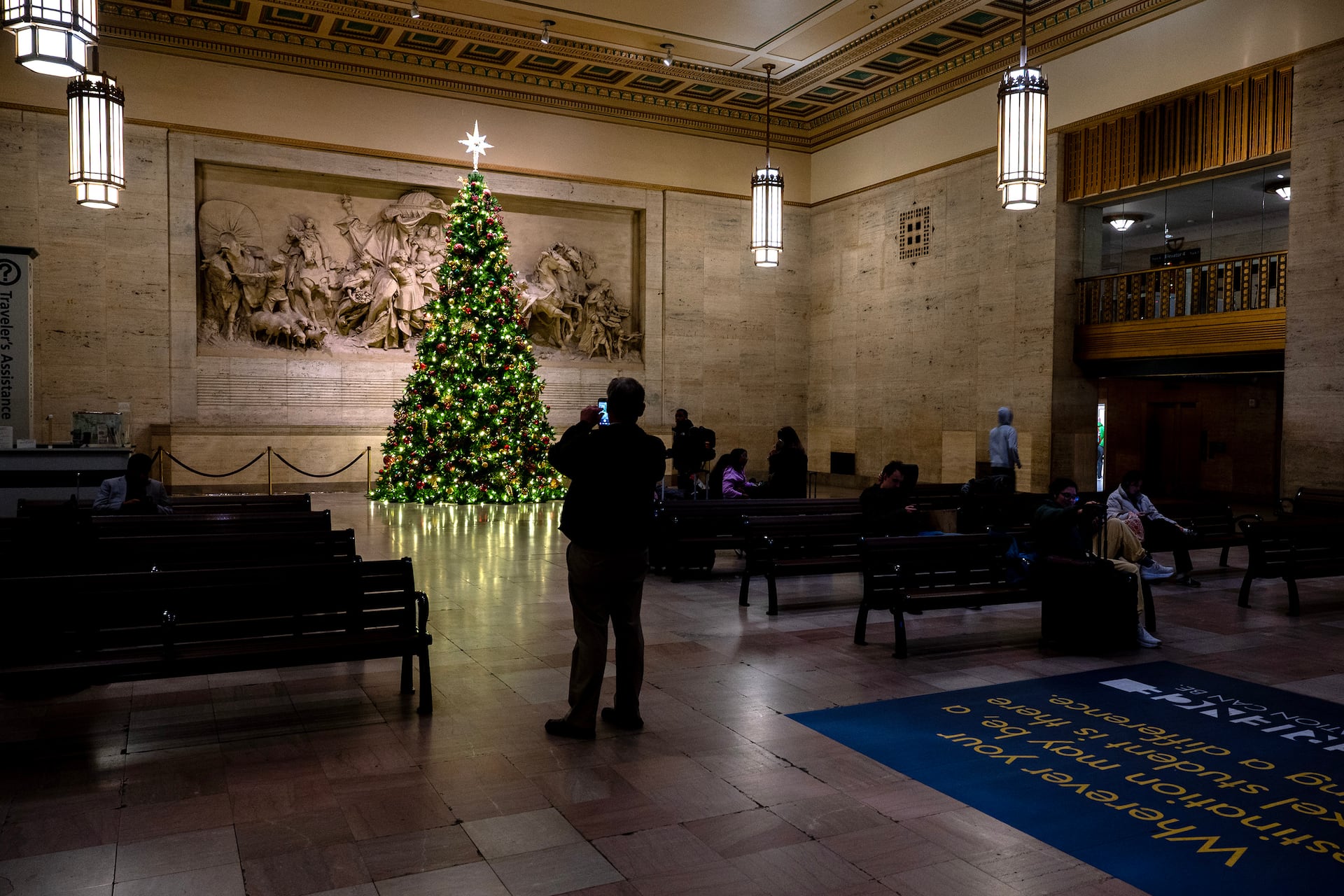
The old waiting room at 30th Street Station that most people only pass through on their way to the restrooms has been spiffed up with benches - and a Christmas tree. It was placed there this year in front of the 30-foot frieze, “The Spirit of Transportation” while the lobby of Amtrak's $550 million station restoration is underway. The 1895 relief sculpture by Karl Bitter was originally hung in the Broad Street Station by City Hall, but was moved in 1933. It depicts travel from ancient to modern and even futuristic times.Read moreTom Gralish / Staff Photographer
Thanksgiving is always the busiest travel time of the year and as always, the AAA has come up with their annual projection: this year a record 81.8 million Americans will be going somewhere, at least 50 miles from home.
6 million people will get there by plane, train, bus, or cruise, but nearly 73 million will travel by car, representing almost 90% of all holiday travelers.
I will not be among them. I get a lot of photo enjoyment out of road trips, but holiday travel is not the seeing-the-USA-in-your-Chevrolet or getting-your-kicks-on-Route-66 kind.
While my newspaper print column has been around since 1998, this online version actually started during the summer of 2007 with three or four posts every week (back then it was called blogging) as I traveled the region’s roadways with my camera, bent upon discovery.
After 9/11, like most Americans, I looked at my country in a new way. Inspired by the 200th anniversary of the Lewis and Clark expedition, I set out to retrace their 3,700 mile journey, known as the Corps of Discovery, on my own epic cross-country road trip across America.
The westward view from inside Thomas Jefferson’s Monticello in Virginia. Jefferson had one of the best libraries in the new world there and Meriwether Lewis began his crash courses in scientific education while visiting.Read moreTom Gralish / Staff Photographer
The American Bison is the largest land animal in North America. Mature bulls can easily weigh up to a ton, yet can still out-run a horse, turn on a dime, and jump a six foot fence. Lewis and Clark described endless herds of these buffalo charging across the vast prairie. Today there are about 300,000 - some in a handful of parks, like this one in T. Roosevelt National Park, but most are in private herds.Read moreTom Gralish / Staff Photographer
Arikara Indian Shannon Fox wears a buffalo headdress for a powwow on the Ft. Berthold Indian Reservation, North Dakota. Tribes are stressing their role in the success of the expedition. Amy Mossett, a Mandan-Hidatsa from Ft. Berthold and co-chair of the Circle of Tribal Advisors for the bicentennial, says: "In the past, most Americans believed that Lewis and Clark succeeded on their own in the monumental mission, when in fact they wouldn't have survived without the tribes."Read moreTom Gralish / Staff Photographer
Vacationing with his family, seven year-old Bret Farrell of Roselle, Illinois, reaches for "The World's Largest Buffalo" statue in Jamestown, North Dakota. The wilderness Lewis and Clark saw when they opened the American West to exploration and settlement remains intact in places, but great herds of bison no longer roam the prairiesRead moreTom Gralish / Staff Photographer
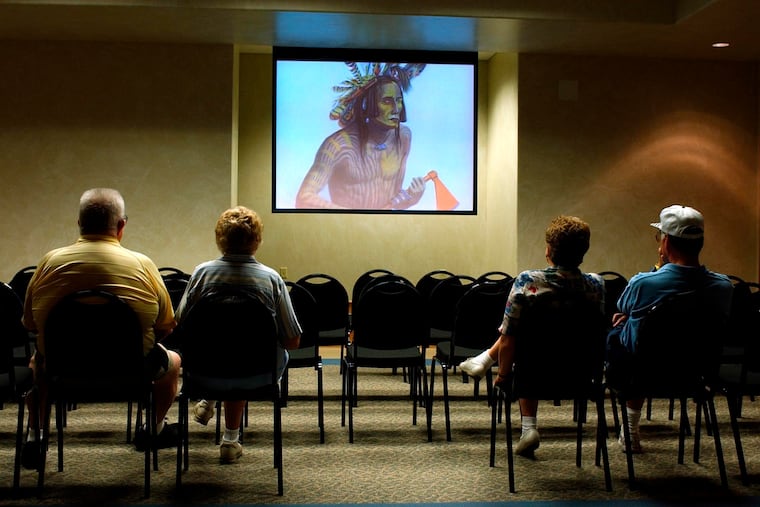
Tourists at the Lewis and Clark Interpretive Center in Washburn, North Dakota watch a short Ken Burns video on the expedition. Many tribes take pride in their contributions and welcome a chance to tell their side of the story. On the screen is Mandan Chief Mato-Tope "Four Bears" who lived near where the museum now sits. After the west was opened to Europeans, the great chief died from small pox, as did more than eighty percent of the Mandan population in only a few months. Today there are no longer any full-blooded Mandan, but there is a 4 Bears Casino and Lodge on the reservation.Read moreTom Gralish / Staff Photographer
Though it was named the Corps of Discovery, its members didn't discover anything that Indians didn't already know. But Meriwether Lewis and William Clark did identify 178 plants and 122 animals new to science, including this "Grizzly" greeting passengers arriving at the Missoula, Montana airport. After the explorers had some near deadly run-ins with grizzlies, Lewis wrote that “the curiosity of our men with respect to this animal is pretty much satisfied.” Fewer than 1,000 of the bears remain in the Lower 48 States.
Read moreTom Gralish / Staff Photographer
Frank Muhly is founder of the Philadelphia Chapter of the Lewis and Clark Trail Heritage Foundation and has campaigned for inclusion of Eastern states on the Trail. “In the West,” Muhly says, “no one can say precisely where Lewis and Clark stood. But in Philadelphia, it is possible to walk the very same streets Meriwether Lewis would have walked 200 years earlier.” Sitting in a diner near Independence Hall, his eyes teared-up as he reminisced about his first trip on the Trail, camping with his wife and daughter.Read moreTom Gralish / Staff Photographer
Eleven-year-old Jonathan Smith plays with his skateboard on an empty street in downtown New Town, North Dakota. He is half Hidatsa Indian and lives nearby in the town of Four Bears on the Ft. Berthold Reservation.Read moreTom Gralish / Staff Photographer
Visitors and participants gather during a powwow on the Ft. Berthold Indian Reservation in North Dakota. The National Council of the Lewis and Clark Bicentennial, in an effort to avoid mistakes made during the 500th anniversary celebration of the arrival of Christopher Columbus, unanimously affirmed tribal involvement as its "number-one priority."Read moreTom Gralish / Staff Photographer
Inside his truck in sub-zero temperatures, Klancey Lone Fight herds cattle near Mandaree, North Dakota. Lone Fight is a descendant of White Coyote, the Mandan Indian leader who returned to Washington with the Lewis and Clark expedition in 1806. He was a guest of President Thomas Jefferson at the White House for the New Years Ball, and didn’t return to his people until 1809.Read moreTom Gralish / Staff Photographer
When Lewis and Clark arrived in St. Louis in 1804, the city was a French outpost of about 1,100 souls. The Gateway Arch commemorates their expedition, which turned the town into a base for westward expansion. Of course, St. Louis is well known to many people today for a more contemporary product. Every Fourth of July the city hosts an air show.
Read moreTom Gralish / Staff Photographer
A shad leaps from a Mississippi River diversion channel near the mouth of the Missouri River close by St. Louis, in the vicinity where the Corps of Discovery spent the winter of 1803-04. During their time in the camp one of the men caught a 125-pound catfish in the Mississippi and recorded its length as 4 feet, 3.25 inches long with a mouth 10 inches wide.
Read moreTom Gralish / Staff Photographer
Some of the greatest changes in the West since the Lewis and Clark expedition have been its rivers. Indians lined the banks of the Columbia to watch these foolish men in dugout canoes struggle on the rapids. In the Dakotas the wild-running Missouri River has disappeared under five of the world's largest dams. Ice fishing in February means huts, trucks, dogs and hardy folk on Lake Sakakawea (the official spelling in North Dakota) near where during the winter of 1804-05 the explorers stayed with Mandan and Hidatsa Indians and first met Sacagawea.Read moreTom Gralish / Staff Photographer
By the time Lewis and Clark made it to the 249-foot Latourell Falls in the Columbia Gorge in Oregon in the fall of 1805, they weren’t stopping to look at the scenery. They had been surprised by the vastness and ruggedness of the terrain in the West, dashing hopes of an easy water passage to the Pacific. Read moreTom Gralish / Staff Photographer
Dusty Skivka fixes a flat on US Hwy 12 outside of Lolo while on a 19-mile ride. Skivka, an exercise physiologist at the University of Montana, rides his bike almost every day and would have probably fit in well with the Corps of Discovery. Lewis & Clark handpicked all 33 permanent members of their crew from Army posts they stopped at during the trip from Pittsburgh to the Mississippi River. Men were chosen for their frontier, hunting, and watercraft skills. Their bodies were strong, efficient, and hardworking, requiring up to nine pounds of meat each day.Read moreTom Gralish / Staff Photographer
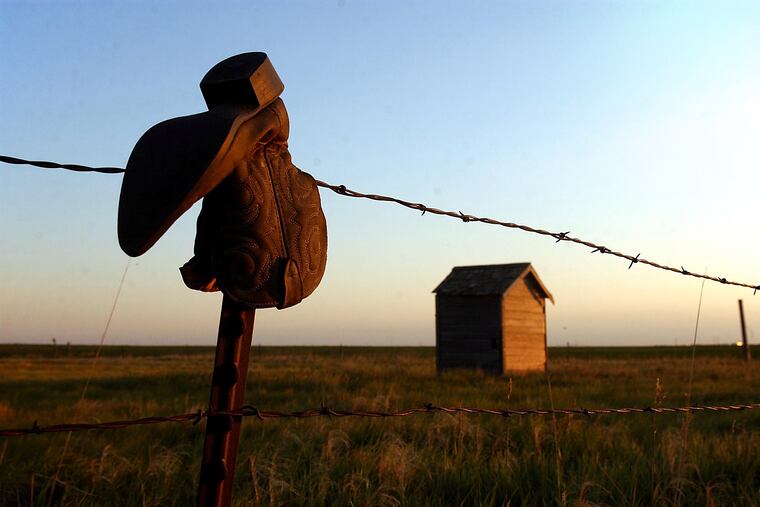
There were no outhouses dotting the landscape during the trek 200 years ago like this one along US hwy 83 near Blunt, South Dakota. The Corps carried plenty of "Dr. Rush's Bilious Pills," also known as "thunderclappers," which Lewis had purchased in Philadelphia. They contained a mercury compound mixed with a powerful laxative. Archaeologists have identified one of Lewis and Clark's old campsites, just east of the Lolo Pass in Montana, by the high levels of mercury at the possible location of their latrines.Read moreTom Gralish / Staff Photographer
Things change as you travel America from east to west. Like calling a carbonated drink soda or pop, or a paper grocery container a bag or a sack, at some point graffiti begins to disappear from roadside signs only to be replaced by bullet holes. This sign along the Yellowstone River near Billings, Montana, is close to where William Clark carved his initials on a butte in 1806 at Pompey's Pillar, the only remaining physical evidence of their expedition along the actual route.
Read moreTom Gralish / Staff Photographer
A neon sign on a pawnshop in Hamilton, Montana shares the night with a full moon east of the Bitterroot Range where Lewis and Clark first encountered the Nez Perce. “Nuun wisiix kii weetespeme” (We are of this land), they say. Theirs was just one of many homelands Lewis and Clark "discovered" on their way to the Pacific. Indian elders tell stories of ancient ancestors reaching back over thousands of moons, so the few hundred years since the arrival of Europeans is only a brief chapter in the story of native peoples. Still, the opening of the West to pioneers and the U.S. Army brought disaster to the Indians in the form of diseases and war.Read moreTom Gralish / Staff Photographer
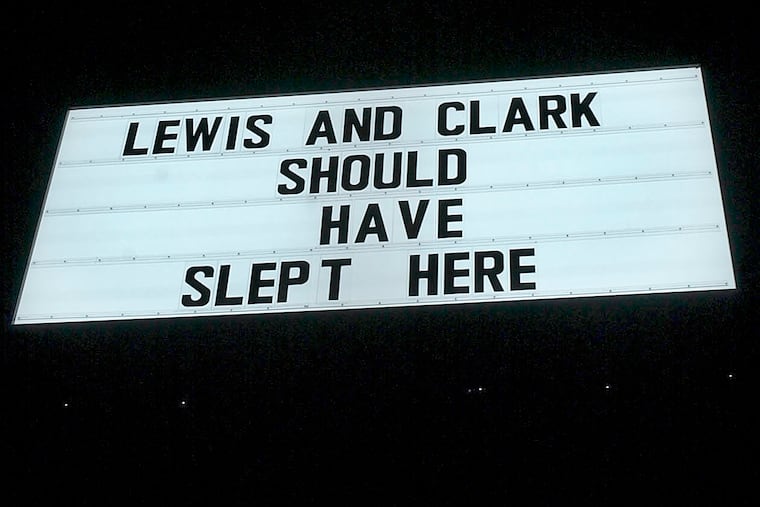
A twist on a familiar saying is found on a motel sign in Dillon, Montana, not far from the Idaho border and Lemhi Pass. The National Council of the Lewis and Clark Bicentennial estimates that 25 million travelers will camp/drive/bike/paddle/ride/walk -- and sleep -- across the western trail over the four years of the expedition's anniversary.Read moreTom Gralish / Staff Photographer
Poles at Big Hole National Battlefield near Wisdom, Mont., mark the locations of tepees of the Nez Perce who, under Chief Joseph, died in an 1877 battle with U.S. troops. A visitor has left a feather out of respect. Decades before the battle, the tribe had helped Lewis and Clark when they got lost in the Bitterroot Range.Read moreTom Gralish / Staff Photographer
Richie No Heart, 7, watches smoke rise through a hole in the roof of a replica Mandan lodge in the Knife River Indian Villages National Historic Site near Stanton, N.D. His grandmother Dee Joyce Kittson was teaching a quilling workshop at the site. Lewis and Clark sent Thomas Jefferson tobacco pouches decorated with porcupine quills, like those Kittson makes.Read moreTom Gralish / Staff Photographer
Bob Daniel, 73, of Anaheim, Calif., fishes for rainbow trout above the Toston Dam near the Missouri River headwaters in southwestern Montana. In 1805, reaching the headwaters thrilled Lewis; he said traveling up the river had been “toilsome.”Read moreTom Gralish / Staff Photographer
The prairie dog was among scores of animal discoveries for the explorers, who sent one to President Jefferson in Washington. It was later displayed in artist Charles Willson Peale’s Philadelphia Museum on the second floor of Independence Hall.Read moreTom Gralish / Staff Photographer
Along one of the most remote stretches on the Lewis and Clark Trail, the Lochsa River in Idaho, is where Ryan's Wilderness Inn offers rooms with a television that receives “One Station Only” - but has restrooms that are “sanitized for your protection.” 200 years ago Clark wrote the "road" was "Excessively bad & Thickly Strowed with falling timber….Steep & Stoney." Read moreTom Gralish / Staff Photographer
Far from highways and accessible only by canoe, a 150 mile stretch along northern Montana's Missouri River Breaks is virtually unchanged since Lewis wrote in his journal on May 31, 1805: "As we passed on it seemed as if those seens of visionary enchantment woud never have and (an) end; for here it is too that nature presents to the view of the traveler vast ranges of walls of tolerable workmanship, so perfect indeed are those walls that I should have thought that nature had attempted here to rival the human art of masonry had I not recollected that she had first began her work."Read moreTom Gralish / Staff Photographer
Since then I have made lots of more local road trips. I sought out retro kitschy giant roadside Muffler Men‚ wandered New Jersey’s Pine Barrens, and Pennsylvania’s political T-zone during the 2020 election.
And one of my favorites: visiting all 10 of the New Jersey joints and restaurants featured in a 2015 episode of CNN’s Parts Unknown, by the late Anthony Bourdain, a chef, author, TV personality — and a Jersey Boy from Bergen County.
Speaking of food and other roadside attractions, this is on my maybe to-do road trip list this winter:
I photographed that Buc-ee’s sign near mile marker 291 on the westbound Pennsylvania Turnpike earlier this year, near the Bowmansville Service Plaza, back when the closest outpost of the Texas-based travel center described as a “theme park on the highway” was the one off I-95 in Florence, South Carolina.
My daughter has been sending me social media food videos (mostly by international visitors) and even bought me a mug, but I have never been to any of the chain’s 51 locations across 11 states or experienced their extensive gas stations, “world-famous” restrooms or Beaver Nuggets.
A new one opened in Virginia this past summer, off I-81, two hours southwest of Washington, D.C. — only 275 miles from Philadelphia’s City Hall.
So, readers, let me ask you. Is it worth a trip? Let me know here.
Or do I just stick with getting my highway food-fix at Wawa, Sheetz, Royal Farms, Turkey Hill, QuickChek, or Circle K?
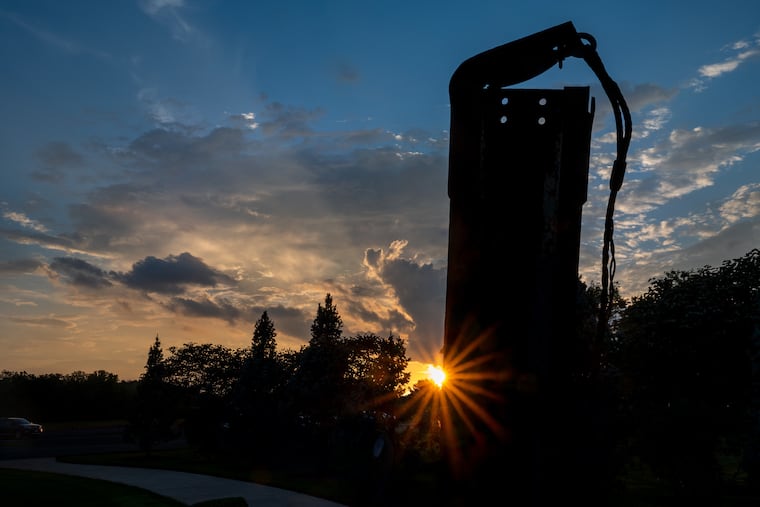
Since 1998 a black-and-white photo has appeared every Monday in staff photographer Tom Gralish’s “Scene Through the Lens” photo column in the print editions of The Inquirer’s local news section. Here are the most recent, in color: