All of Philly’s judges were reelected to the bench, including those not recommended by the city’s bar association
Among those retained was Common Pleas Court Judge Scott DiClaudio, who is on administrative leave amid accusations that he attempted to influence a colleague's decision in a criminal case.

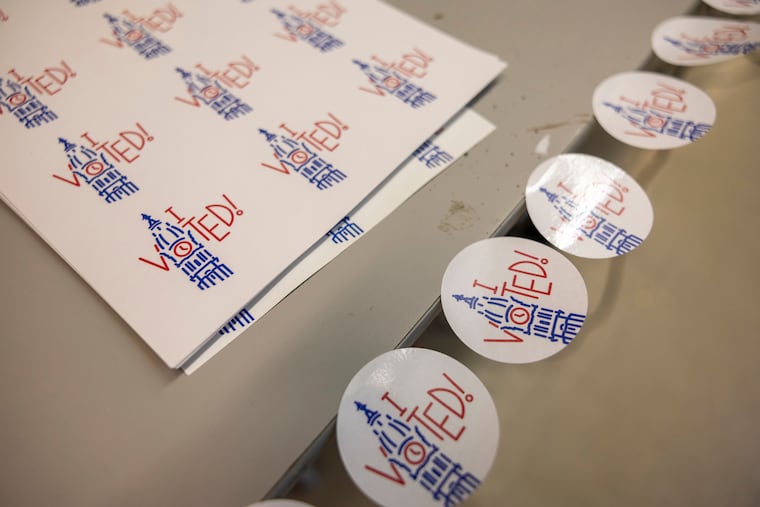
All Philadelphia judges on the ballot Tuesday were retained for 10-year terms — including some who are embroiled in scandal or were not recommended by the city’s bar association.
Roughly a quarter million voters chose to keep 18 judges on the bench in Municipal and Common Pleas Courts, though some margins were closer than others.
Among those retained was Common Pleas Court Judge Scott DiClaudio, who is on administrative leave amid accusations that he attempted to influence a colleague’s decision in a criminal case. Unofficial data show that, of the approximately 278,000 people who voted, about 64% said DiClaudio should remain on the bench — the lowest percentage among the judges approved for retention Tuesday.
DiClaudio, in a statement, said the outcome underscores voters’ support for him despite the ongoing legal challenges. He denies interfering in the case and said he looks forward to working hard for all Philadelphians.
DiClaudio was one of five judges not recommended by the Philadelphia Bar Association who coasted toward another decade on the court. The others are Common Pleas Court Judges Frank Palumbo Jr., Daine A. Grey Jr., and Lyris F. Younge, and Municipal Court Judge Jacqueline Frazier-Lyde.
That outcome was not unexpected. Judges are almost always retained during their bids for new terms.
In addition to the local races, the costly, closely watched election to retain three Pennsylvania Supreme Court justices initially elected as Democrats ended Tuesday with all three easily winning new terms and preserving the liberal majority on the state’s highest court.
In Pennsylvania, judges are chosen through partisan elections, meaning they must win a primary and then compete in the general election under a party label. To prevent sitting judges from running directly against opponents at the end of their terms, voters instead decide in a retention election — voting “yes” to keep judges on the bench or “no” to remove them.
Since 1969, when the judicial retention voting system was adopted, only one Philadelphia Common Pleas Court judge has ever been denied another term — Bernard Snyder, who was already facing removal for allegedly colluding with the plaintiff’s attorney in a high-profile civil case he was overseeing.
The city’s bar association this year recommended 13 of the 18 judges seeking reelection to Philadelphia’s Common Pleas and Municipal Courts, though it did not explain its reasoning.
Those it did not recommend — DiClaudio, Palumbo, Grey, Younge, and Frazier-Lyde — all saw a lower percentage of voters opting to retain them than those whom the association did recommend, but still sailed to victory with yes votes of 64% to 71%.
That comes after The Inquirer obtained confidential survey responses from hundreds of Philadelphia lawyers who answered yes-or-no questions about judges’ integrity, legal skill, temperament, and overall fitness for the bench.
For Younge, a judge in civil court, only 25% of lawyers who responded to the survey said she was qualified in her role.
Younge is no stranger to controversy. When she presided in Family Court, parents in 2018 took to the streets to protest some of her actions. And the state judicial oversight body, the Court of Judicial Discipline, sanctioned Younge in July 2021 for misusing her authority — suspending her for six months, putting her on long-term probation, and barring her from Family Court for the duration of her term.
She did not respond to a request for comment Wednesday.
An Inquirer review of Superior Court rulings showed that Grey, who sits in Family Court, and Palumbo, who mostly handles violations of probation in criminal court, saw their decisions reversed at higher rates than others.
Grey acknowledged he has made some errors, but said those mistakes represented only a fraction of the hundreds of complicated and emotionally fraught cases he has overseen.
Grey and Palumbo did not respond to a request for comment Wednesday.
» READ MORE: In case after case, a Philly judge’s behavior and decisions came under fire
DiClaudio, who mostly heard appeals filed by people seeking to have their murder convictions overturned, was placed on leave in June. He has been accused of misconduct by the Pennsylvania Judicial Conduct Board three times in six years.
In the first case, from 2019, the board said DiClaudio ignored court orders related to a lawsuit over unpaid membership dues he owed to a sports club. He was given a two-week suspension and placed on judicial probation until 2026.
Earlier this year, the board accused him of improperly using his role to promote his wife’s cheesesteak shop. DiClaudio has denied wrongdoing and is fighting the case.
Then, in September, he was accused of attempting to influence a colleague’s decision in a criminal case.
In June, fellow Common Pleas Court Judge Zachary Shaffer told his supervisors that DiClaudio tried to sway his sentencing decision in a gun case by calling Shaffer to his robing room, then showing him a piece of paper with the name of a defendant and saying, “I’ve heard you might do the right thing anyway.”
DiClaudio has denied attempting to influence the case and said he was complimenting Shaffer.
The judicial conduct board said it referred the matter to the FBI for a potential criminal inquiry, and, for reasons that remain unclear, federal investigators have since sent it to the Pennsylvania Attorney General’s Office. The status of any ongoing inquiry by that office is not clear.
The Court of Judicial Discipline is now weighing whether DiClaudio should be suspended without pay as the case moves forward.
Staff writer Samantha Melamed contributed to this article.