EMR will reopen Camden facility after recent fire, following judge’s ruling
The ruling came on the same day Gov. Mikie Sherrill signed a new law aimed at EMR and the scrap metal industry.
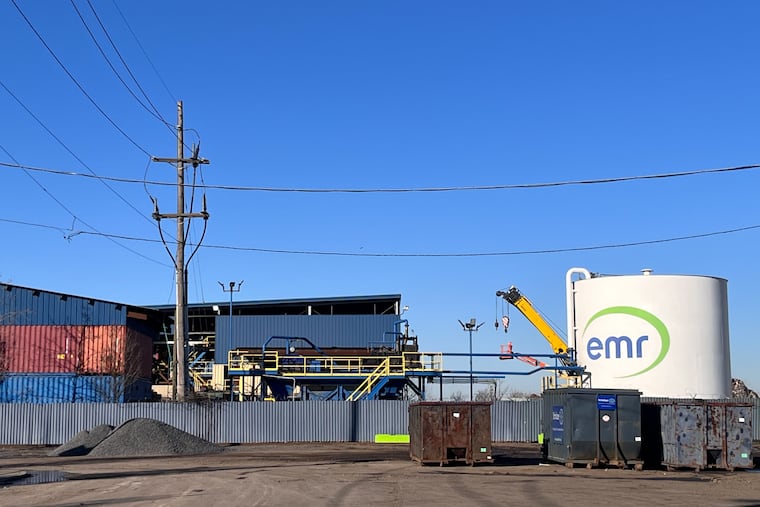
The EMR scrap metal recycling plant will reopen after Camden suspended its operations following a late May fire, the latest in a string of fires in recent years.
The decision fell to Camden Superior Court Judge Stephen J. Polansky on Wednesday after the Camden City Council voted unanimously on Tuesday against a settlement that would have allowed EMR to reopen under certain safety precautions. EMR had sued Camden for suspending its junkyard license last month for the facility, where Camden officials say there have been more than a dozen fires in the last six years.
Shortly after the hearing, New Jersey Gov. Mikie Sherrill’s office announced that she signed a bill into law aimed at increasing safety in the scrap metal industry led by Assembly member Bill Moen, a Camden County Democrat. He introduced the bill after a four-alarm fire in February 2025 at EMR.
The court fight to open EMR
The judge said EMR can open its doors only if it follows a list of safety precautions. The company’s legal team told The Inquirer that it had already fulfilled those requirements and is ready to open as soon as the judge submits his order.
“We intend to open and operate in accordance with the judge’s order, which directly incorporates the recommendations of EMR’s third-party fire expert,” Joe Balzano, CEO of EMR USA, told The Inquirer after the hearing Wednesday. “EMR is the only scrap metal recycling facility in the state of New Jersey that has a facility-wide fire suppression system installed and operating.”
Among the required precautions are a 24-7 fire watch, fire suppression system testing, and procedures for scanning material coming into the facility and responding to fires.
In court, EMR’s legal team argued that the city did not have the authority to suspend its license without proper hearing or notice, and that the company has undergone irreparable harm as a result. It has lost millions of dollars, endured tainted industry relationships, and, as of Wednesday morning, sent more than 300 layoff notices, said Kathleen Campbell, a lawyer for EMR.
The fire took place on May 29, at which point EMR voluntarily shut down its operations. The city issued an immediate suspension notice days later, on June 4. A big question in the courtroom was whether there was enough of an emergency at that point that the city could circumvent its normal due process.
“The city can regulate,” Campbell said in court. “What it can’t do is continue an emergency shutdown when there is no basis for it. The fire is over. The testing that this court authorized is complete.”
She argued that the city is more worried about a “desire to keep EMR closed” than an actual immediate danger.
William Tambussi, the city’s lawyer, argued that the possibility of another fire was enough to present an emergency.
“The city is required and has the right to protect its citizens from the harms that come,” he said in court.
Tambussi said after the hearing that the judge’s decision is still a win for the city because the safety precautions EMR has to follow overlap with what the city wants from the company.
“The judge found that the city rushed the process, which the city doesn’t apologize for,” he said in an interview.
Camden and EMR will meet again in court in August, where they will assess whether EMR has complied. The city can also attempt to shut down EMR through a full hearing process if it finds that the company has violated its terms of opening. The city cannot, however, just shut the company down.
A new law stemming from a Camden County legislator’s fight against EMR
The law Sherrill signed on Wednesday, which goes into effect in a year, will require heat detection equipment, publicly accessible fire safety plans developed with local fire officials, and compliance with certain fire prevention standards. It also requires fire suppression systems that can be remotely operated and limits the height allowed for piles of material.
The legislation is part of a four-bill package Moen has been pushing for in Trenton, but is the only one to make it to the governor’s desk before the summer recess.
“We were met at every step of the way with opposition from a well-funded industry,” Moen said in an interview Wednesday.
Balzano, the CEO of EMR USA, said in an interview Wednesday that he believes his Camden site is mostly in line with what the new law requires. But he said the height limit would be “very detrimental to the industry and probably to the environment,” arguing that it is too broad and applies to scrap metal that is not prone to fires. He said that could have “unintended consequences” by having scrap metal spread out across more space.
“I fully support the premise of it,” said Balzano, who has pointed to lithium-ion batteries as a source of scrap metal fires.
Moen emphasized that while the issue of scrap metal fires has become particularly important in Camden, it is not restricted to the city’s borders. Scrap metal sites in Vineland and Newark, for example, have also seen fires in recent years.
“This will be the first step in hopefully many of the state bringing greater transparency, accountability, and an expected level of responsibility for these scrap facilities,” Moen said.