Philly and Camden may need federal aid, but the politics of FEMA are getting messy
New Jersey and Philadelphia may need to request help from FEMA after major storms. But President Donald Trump is accused of politicizing FEMA amid high rejections of Democratic states requesting aid.
New Jersey Gov. Mikie Sherrill and Philadelphia Mayor Cherelle L. Parker are assessing whether they’ll need to ask the federal government for help following recent storms in Philadelphia and Camden as President Donald Trump rejects more disaster aid from blue areas.
Camden residents said they witnessed the worst flooding in recent memory just two days after celebrating Independence Day.
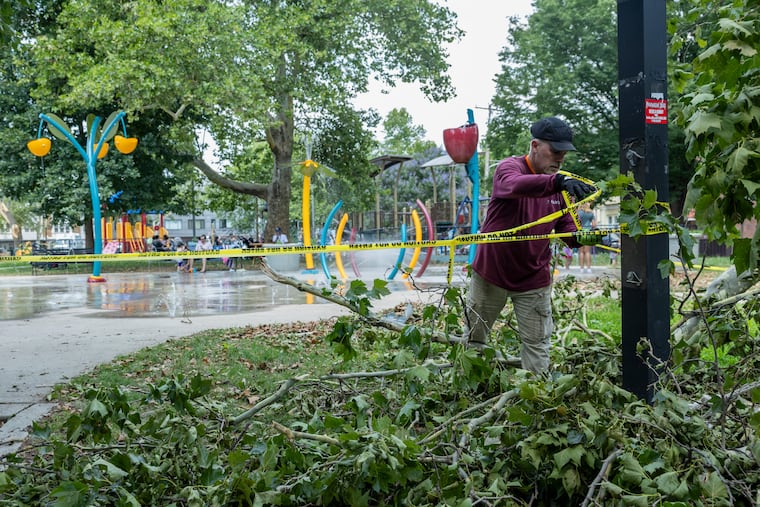
Less than a week later, in parts of Philadelphia and Montgomery County, at least four storms called microbursts caused fallen trees, leading to electrical outages and road closures.
Sherrill and Parker have both signaled they anticipate seeking federal emergency aid, but first they need to see if there’s enough damage to qualify. New Jersey is still trying to get aid for a snowstorm that took place just one month into Sherrill’s term — a request that Trump denied — and Pennsylvania has faced several Federal Emergency Management Agency request rejections in recent years.
Sen. Andy Kim, a South Jersey Democrat who serves as the ranking member on the subcommittee that oversees FEMA, recently led a group of senators accusing the Trump administration in a letter of a “significant partisan disparity” in federal disaster aid.
“Right now, there’s no predictability with this administration, and that’s just scary when you’re dealing with disaster response,” Kim said in an interview Wednesday.
Here is what to know about federal emergency aid at this moment.
How does FEMA aid work?
First, local officials work to assess the extent of the damage after a storm and report it to the county, which works with the state to assess the damage. If the disaster has caused more harm than the local and state government can address, the governor can request the president declare a major disaster. That’s required to unlock public FEMA aid.
Individuals can only apply directly for FEMA aid if the president approves individual assistance as part of a disaster declaration.
Residents should report damage to their insurance companies and begin the claims process as soon as possible and report damage to the Office of Emergency Management, said Joseph Walsh, a sergeant first class with New Jersey’s Office of Emergency Management.
“There are technical things we need to meet,” Sherrill said during her visit to Camden after the storm. “I think we probably will, but we’re collecting that now.”
Sean Higgins, a Sherrill spokesperson, said in a statement Wednesday that the governor’s team “has been working around the clock to ensure communities have the support they need and we will ensure that New Jersey applies for any and all help that we qualify for.”
In Philadelphia, Dominick Mireles, the city’s director of emergency management, said earlier this week that the city is figuring out the “financial price tag” of the damage, a process that will continue in the coming weeks. Then the city will determine what may be needed — and what it’s eligible to receive — from state and federal resources.
“This might be something above and beyond what we can navigate on our own,” Mireles said.
Has Trump denied FEMA aid to Pennsylvania and New Jersey?
New Jersey is in the process of appealing a FEMA rejection for Winter Storm Hernando from February of this year, Walsh said.
The rejection was part of a $227 million denial in disaster aid requests from four Democratic-led states, along with New York, Rhode Island, and Massachusetts. Higgins said more than $84 million of that pool represented costs from New Jersey municipalities and counties.
“Without that aid, our local governments will be stuck with the costs of an unprecedented snowstorm that didn’t care about political boundaries. ... Sherrill will continue to fight for every dime that New Jerseyans are owed, regardless of political party,” Higgins said in a statement.
FEMA data also show a 2018 rejection for a severe storm and flooding event in New Jersey during Trump’s first term. Walsh said the state requested aid for several counties even though the damage did not meet the threshold for federal assistance.
The data show that Pennsylvania faced denials from the Trump administration during his first term for a winter storm in March 2017 and storms and landslides from February to April 2018, following a close 2016 win for Trump in Pennsylvania during Democrat Tom Wolf’s gubernatorial administration. After losing the 2020 election to former President Joe Biden, Trump on Nov. 18 rejected requests for aid in Philadelphia and surrounding counties for the August 2020 Tropical Storm Isaias.
Pennsylvania’s appeal for the 2017 storm was rejected for not meeting the “severity and magnitude” for a disaster declaration, and an appeal for the 2018 incidents were rejected for being “separate and distinct” and not meeting the required threshold, according to documents from the Pennsylvania Emergency Management Agency.
The state did not appeal the rejection for damage from Isaias.
The commonwealth also faced rejections during Biden’s administration following flooding in July and September 2023, and a snowstorm in November 2024 after Trump flipped back Pennsylvania.
What is Andy Kim accusing Trump of?
Kim said Wednesday that Trump has been treating government money like “his own personal slush fund.”
“These are about families that are struggling, and you can’t punish them because of political retribution,” the senator said.
He was joined by 16 members of the Senate Democratic caucus in writing a letter last month to Russell Vought, the director of the federal Office of Management and Budget, citing a Politico report that said Trump’s second administration rejected disaster aid for Democratic-run states at the highest rate in the 47 years that FEMA has existed.
Trump has approved 23% of disaster declaration requests from states with a Democratic governor and two Democratic senators, compared with 89% of requests from states with a Republican governor and two Republican senators so far during his second term, and Democratic-led states also had longer wait times to find out the decision, the report said.
“To be clear, this reporting suggests that in the wake of disasters, as President, President Trump, who has the sole authority to grant or deny this assistance, may be punishing Americans who live in states with Democratic Senators and Governors, by denying access to disaster relief funding,” the senators said in the letter.
FEMA did not respond to a request for comment on the letter. White House spokesperson Abigail Jackson has previously told news outlets that “there is no politicization” in Trump’s disaster relief decisions and that he “provides a more thorough review of disaster declaration requests than any Administration has before him.”
The senators contended there are specific approval criteria and called for more transparency on the administration’s process.
In response to their letter, the budget office told the senators to talk to FEMA, so they sent the letter to FEMA to ask for a meeting and are awaiting a response, Kim’s office said Wednesday.
What has Trump’s approach to FEMA been?
The president previously called for the dismantling of FEMA, a stance his own advisers have rejected. But a council of Trump appointees more recently suggested big changes to the agency.
In the meantime, the president has attempted to use the agency to advance his agenda.
A report by House Democrats found the Trump administration improperly diverted resources from FEMA by sending staffers to help with immigration enforcement, Trump’s hallmark policy.
His administration also recently threatened to withhold FEMA terrorism prevention money for states that don’t run their elections the way the president wants them to.
During his first term, Trump opposed disaster funding for Puerto Rico and said he wanted more aid to go to Texas and Florida, according to news reports.
Recently, Trump touted FEMA funding for states with candidates he supports.
But the administration’s efforts haven’t always succeeded.
Pennsylvania and New Jersey were part of a lawsuit against the Trump administration for cutting certain FEMA funding meant for preventing harm from natural hazards through infrastructure upgrades. That program, called Building Resilient Infrastructure and Communities (BRIC), has since been reinstated. As a result, Pennsylvania was awarded nearly $838,000 for recovery from the 2024 Tropical Storm Debby.
Trump signed BRIC into law during his first term, but during his second term FEMA criticized it for being too “focused on ‘climate change’” under Biden.
Kim said he has advocated for the program’s expansion to help prevent damage from major weather events before they happen.
“This is not a shock that Camden had the flooding that it did,” he said. “We’ve known for a long time that their drainage and sewage and other types of efforts to mitigate flooding are just not to the level that is needed for the people there.”