As promised, Mikie Sherrill immediately declares state of emergency on utility bills in N.J.: ‘Just the beginning’
Gov. Mikie Sherrill declared a state of emergency and froze utility rates in New Jersey within moments of being sworn in during her inauguration speech.
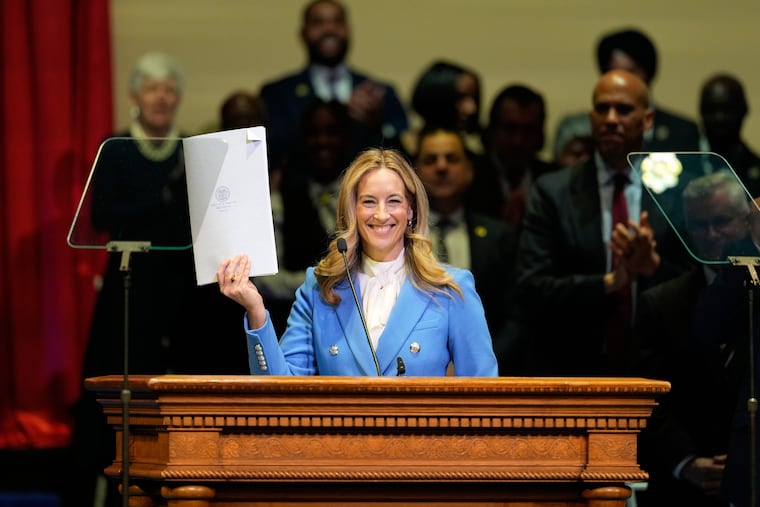
New Jersey Gov. Mikie Sherrill was so excited to fulfill her promise of declaring a state of emergency on utility bills on her first day in office, she did it before finishing her inauguration speech.
“I’ve heard you, New Jersey — we are facing an affordability crisis, and you want costs to come down," she said during her speech that followed her swearing-in. “And you want that to begin today.”
Sherrill, a Democrat, signed two executive orders on stage in front of roughly 2,000 people before she wrapped up her inaugural address at the New Jersey Performing Arts Center in Newark on Tuesday.
The first freezes utility rates in New Jersey, which she is able to do by directing the state Board of Public Utilities to provide credits to bill payers for increases. The board made a similar move over the summer under former Gov. Phil Murphy after significant bill increases. Those credits were funded with money from clean energy programs.
The public utilities board, known as the BPU, is a regulatory authority that oversees private utility companies in New Jersey and works on clean energy programs in the state. It is funded in part through a charge on utility bills.
BPU President Christine Guhl-Sadovy said in a statement that the board “looks forward to supporting the governor’s agenda to lower utility costs for New Jersey ratepayers while encouraging the development of new energy resources here in the Garden State.”
» READ MORE: Mikie Sherrill takes oath as New Jersey governor, becoming the second woman to lead the state
Sherrill also directed the public utilities board to consider pausing or modifying the schedule for proceedings in which utility companies seek rate increases — as much as the law allows — and called for a study into modernizing the current electricity distribution business model. She also called for the board to revise the Clean Energy Program for the upcoming FY 2026 budget.
Sherrill also signed an executive order on stage to increase power generation in the state as part of her effort to lower costs.
“This is just the beginning,” she said on stage.
“Not of my speech, of my work,” she joked.
Her second order rolls out efforts to make it easier and faster for companies to generate power in the state, particularly via solar and battery sources. She directs state agencies to pursue permitting reforms that can help speed up processes to get new energy sources up and running as part of this order.
She also calls on the New Jersey Department of Environmental Protection to expedite permitting processes for existing gas plants to expand capacity, run more efficiently, and reduce emissions.
In another request of the public utilities board, she asks officials to require electric utility companies to report on how much energy data centers request to assess “ghost loads,” which are forecasts for how much energy large projects may require. These predictions impact how much energy the regional grid operator PJM anticipates needing to handle, which can increase prices.
Sherrill has blamed PJM for high utility costs, and the regional grid operator has argued that it has simply responded to supply and demand issues as energy usage has drastically increased in recent years in part to the increasing demand for artificial intelligence.
The order also creates a Nuclear Power Task Force to support nuclear power generation.
“I heard the people of New Jersey loud and clear – these rate hikes are unacceptable – and as your governor, I will not stop fighting to lower costs and make New Jersey a more affordable place to live, work, and raise a family,” Sherrill said in a statement.