New Jersey lawmakers got a 67% pay increase, but most have other jobs too
It’s their first pay raise in 25 years. Will it lead to better lawmaking?
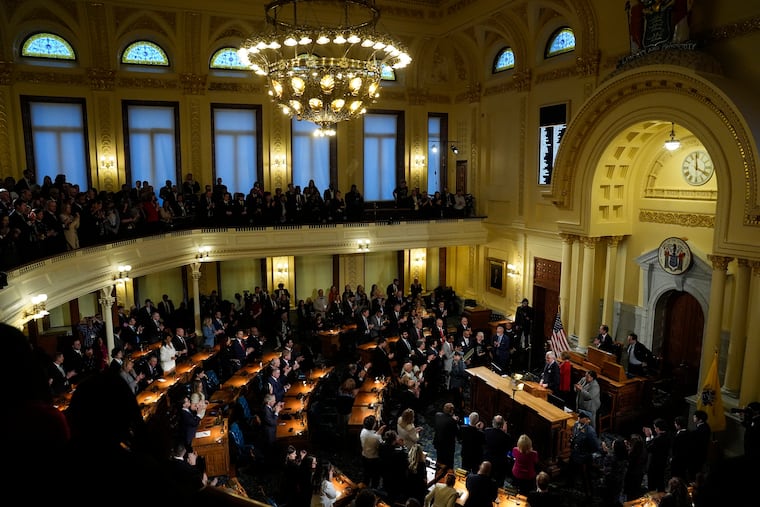
New Jersey lawmakers just got a nearly 70% raise when they took their oaths in January.
It’s their first pay bump in more than two decades. The state’s legislators had been paid a $49,000 salary since 2001, but this year they saw it jump to $82,000 under a law signed in 2024.
Despite the increase, their spending power isn’t any bigger than it was 25 years ago. But legislators giving themselves a raise is a politically fraught move.
Their new salaries fall below the state’s median household income of more than $100,000, though the legislature says most of its members have other employment. Garden State lawmakers are considered part-time, even though they meet throughout the year and some members say the job is a full-time commitment.
“They say it’s part-time but I would argue that people act like it’s full-time, and it really is a full-time job,” said Assemblymember Anthony Angelozzi, a newly elected Democrat who represents parts of Burlington and Atlantic Counties and also works as a Hammonton teacher and leads the Hammonton Education Association, the local teachers union.
“My term is two years, and I am in a swing district … so if I don’t work hard every day to do things in my district and to talk to people, build relationships, visit the 25 towns that I represent, I’m going to lose my seat,” he said.
New Jersey legislators are now among the highest-paid in the country, but they’re still paid less than their counterparts in Harrisburg, whose salaries are more than $113,000, including per diems, above Pennsylvania’s median household income of roughly $78,000.
Though Pennsylvania lawmakers only come to Harrisburg a few times per month to vote on bills — and many hold other jobs — they are considered a full-time legislature.
In New Jersey, each chamber was scheduled to meet for less than a dozen full sessions in 2025, but members met more frequently for committee meetings and quorums, in which lawmakers can conduct business if more than half are present.
Most New Jersey state lawmakers have other jobs, too
Along with Angelozzi, all of the other 19 state lawmakers who represent Camden, Burlington, and Gloucester Counties in the state House and Senate also received a paycheck from outside employment, according to 2024 financial disclosures. A handful of them also reported receiving Social Security or pension income.
Assemblymember Balvir Singh, a Burlington County Democrat who began his term last year, said he’s not sure he would have voted for the pay increase given the drastic jump at once, though he would have supported a formula with annual increases over time.
“I think not doing something for so many years and then doing it all of a sudden, definitely is a suspicion among people, and rightfully so,” he said.
Singh works as a public school curriculum and instruction supervisor, which gives him flexibility to plan his work hours around days he has to be in the legislature, though he still uses his time off for legislative matters and constituent services.
Does better pay mean Trenton can better represent New Jerseyans?
Proponents of paying elected officials higher salaries argue that it can lead to a more diverse legislature that’s more representative of New Jerseyans, though the evidence is limited.
Anthony Campisi, a political consultant who works in both New Jersey and Pennsylvania, said higher legislative pay opens up the prospect of running for state office to those who aren’t independently wealthy or hold white-collar jobs, that come with the flexibility to go to Trenton regularly, like lawyers.
“I think it’s a good thing to pay legislators living wages,” he said. “They’re responsible for appropriating billions of dollars for overseeing important legislative work that impacts every aspect of our lives.”
But Peverill Squire, a national expert on legislative pay based at the University of Missouri, said pay increases lead to minimal changes in the makeup of legislatures because of the financial and time commitment that comes with running for office.
“It makes it more attractive for more people to think about, but it’s still a very difficult thing to run for office, and so in the final analysis, it doesn’t have as big an impact as one might have thought it would,” he said.
That being said, higher pay can incentivize legislators to remain in the job. Squire said state lawmakers who step down voluntarily often do so because of the financial impact on their families.
The average state legislator salary across the country hasn’t kept pace with inflation over the past few decades, according to the National Conference of State Legislatures (NCSL). In New Jersey, the old salary of $49,000 in 2001 had the buying power of roughly $90,000 today.
New Hampshire legislators receive the lowest annual salary of $100, which has not been changed since 1889. Meanwhile, New Mexico lawmakers do not receive a salary, but they receive per diems.
In 2025, only six states paid their lawmakers more than New Jersey lawmakers’ new salary of $82,000, while Pennsylvania lawmakers made the third most behind New York and California, according to NCSL data.
Should New Jersey become a full-time legislature?
The 2024 law, which was signed by former Gov. Phil Murphy, also increased the salary for the governor and other public employees, including legislative staff, cabinet members, and judges.
Starting this year with Gov. Mikie Sherrill, the state’s top executive got a 20% pay increase from $175,000 to $210,000. For comparison, Pennsylvania Gov. Josh Shapiro’s salary has risen to nearly $254,000 this year.
The Office of Legislative Services estimated in 2024 that the increases altogether would bring a cost increase to the state of at least $9.8 million for 2026 and at least $12.4 million in 2027 and thereafter.
The bill faced opposition from some Republican lawmakers, including member Alex Sauickie, a Republican whose district includes parts of Burlington, Middlesex, Monmouth, and Ocean Counties. Sauickie said the bill was brought forward at a horrible time as New Jersey residents struggled with the high cost of living — an issue that persists as the law takes effect.
“We should fix the state for everybody else before we make adjustments for ourselves,” said Sauickie, whose district includes parts of Burlington, Middlesex, Monmouth, and Ocean Counties.
The GOP lawmaker said he does not believe higher wages lead to better legislators.
“Under the old salary we had questionable legislators, and out of the gate on the new salary I think we still have questions about certain legislators,” he added.
Antoinette Miles, the state director of the progressive Working Families Party, said New Jersey should have a full-time legislature with term limits, attractive pay, and limits on outside income.
“The real problem is that too many legislators are moonlighting as lawyers, lobbyists, or even at a second public job,” she said.
But even with a higher salary, the lack of job security as an elected official makes it a hard sell as an only source of employment, especially in a politically fickle district like Angelozzi’s.
“Nothing in politics is guaranteed … if I lose my job, I would have to be guaranteed to go back to my full-time day job, because, you know, I have bills to pay,” Angelozzi said.